

Most Sacramento business owners look at their August SMUD bill and see a number that simply doesn't add up. It isn't just the 37.65 cents per kilowatt-hour peak rate that's the problem. It's the demand charges that often devour 50% of your total utility spend before you've even fully powered up your facility. You've likely seen the headlines about the new battery manufacturing hub in Metro Air Park and wondered if that local growth actually translates to lower overhead for your property. It's a valid question. Watching the grid strain during a Central Valley heatwave while your costs skyrocket feels like a losing game, especially when you're caught between sticking with current lithium-ion tech or waiting for the next big thing.
This article cuts through the noise to show you how commercial battery storage Sacramento is becoming a necessary financial hedge rather than just a "green" initiative. We'll explore how local shifts in battery production and specific SMUD rate structures create a unique window for slashing demand charges. You'll get a clear look at the 2026 fiscal landscape, the impact of federal tax credits, and a logical roadmap to move from analyzing your energy spend to installing a system that protects your bottom line.
Key Takeaways
- Sacramento's transition into a battery manufacturing hub, led by the Peak Energy facility in Metro Air Park, is making high-capacity storage more accessible for local property owners.
- You'll learn how commercial battery storage Sacramento uses peak shaving to automatically neutralize the aggressive demand charges that often account for half of a monthly SMUD bill.
- We'll explain why a professional energy cost saving analysis is the mandatory first step to ensure you don't over-engineer a system or waste capital on unneeded capacity.
- Get a clear, no-nonsense look at navigating the specific permitting and interconnection hurdles within Sacramento city and county building departments.
- Understand the 2026 fiscal landscape, including how to maximize the 30% federal tax credit before utility rates and regulations shift again.
The Sacramento Battery Boom: Why Local Storage is the New Commercial Standard
It's hard to ignore the scale of what is happening at Metro Air Park right now. We've spent years talking about Sacramento becoming a tech hub, but the Peak Energy factory actually puts hardware on the ground with a 4 GWh annual capacity. This proximity is the real reason commercial battery storage Sacramento is finally making sense for local property owners. You aren't waiting for a shipping container to cross the Pacific; you're looking at a supply chain that lives ten miles up the road. It changes the conversation from "maybe someday" to "how fast can we get this installed."
I'm seeing a lot of people get hung up on the lithium versus sodium debate. For an office building, sodium-ion is just the more pragmatic choice. It doesn't have the same fire risk profile that makes insurance companies and fire marshals nervous about lithium-ion. It's a trade-off. You might lose a bit of energy density, but you gain a system that is significantly easier to permit in a crowded commercial zone. In a state where the grid is as shaky as ours, having that storage on-site is a hedge against reality, not a luxury.
What Commercial BESS Means for Your Property
A Battery Energy Storage System (BESS) is basically a financial asset that lets you time-shift your energy costs. It isn't just a backup for when the lights flicker. Its real job is strategic discharge. You're buying power when it is cheap and using it when the utility wants to charge you the most. It is an automated way to stop being a victim of the rate schedule and start controlling the flow of cash out of your business.
Sacramento’s Competitive Advantage in 2026
The logistics are one thing, but the talent is another. Because the manufacturing is here, the installers in this region actually know what they are doing. They've seen these systems before. Implementing commercial battery storage Sacramento is faster and less prone to errors because the people doing the work are part of the local ecosystem. You're getting a level of expertise that is harder to find in cities that don't have this kind of manufacturing base right in their backyard.
Killing Demand Charges: The Strategic Math of Sacramento BESS
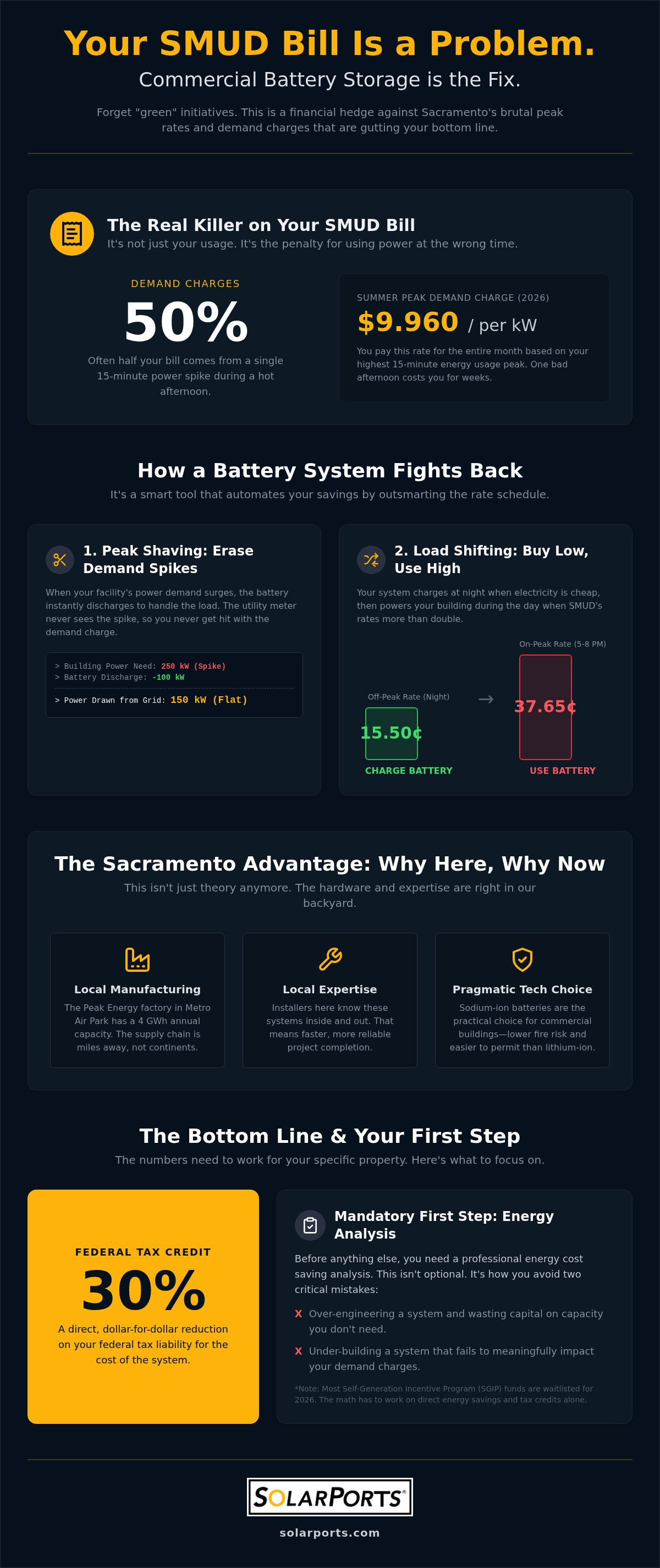
Demand charges are what actually break the budget on a SMUD bill. You can be as careful as you want with the lights and HVAC, but one hot afternoon where your equipment cycles at once triggers a charge that can account for half your total monthly expense. For businesses with demand between 21 and 299 kW, that summer peak demand charge sits at $9.960 per kW in 2026. It is a frustrating system because you end up paying for a single 15-minute spike for the rest of the month. This is where commercial battery storage Sacramento functions as a precise financial tool. Peak shaving isn't just a technical concept; it is the battery stepping in to handle that spike so the utility meter never records the surge.
SMUD vs. PG&E: Navigating Local Utility Structures
SMUD rates are still a bargain compared to the neighboring PG&E territory, but their Time-of-Day pricing is where the logic gets tricky. You're looking at an off-peak rate of 15.50 cents that jumps to 37.65 cents the moment the clock hits 5 PM. Load shifting is the only way to win that game. You buy power at night when it's cheap and deploy it when the utility wants to charge you more than double. We go deeper into these mechanics in our piece on Strategies to Lower Commercial Electricity Bills in California. Also, don't bank on the Self-Generation Incentive Program (SGIP) right now. Most general market funds are waitlisted for 2026, so the math has to work based on the direct energy savings themselves.
Carports and BESS: The Dual-Purpose Solution
Commercial rooftops are usually a mess of HVAC units and vents, which makes solar carports the much better play for housing a system. They turn a hot parking lot into a dedicated power plant. It is the most efficient way to mount panels and house a BESS without worrying about the structural integrity of an older roof. If you're trying to figure out how the payback period looks, our Commercial Solar ROI Analysis shows how these integrated assets perform over a 10-year horizon.
The 30% federal tax credit is still the big anchor for these projects, but the clock is ticking. You have to start construction by July 4, 2026, to lock in that specific credit level. It’s worth looking at your actual usage data now rather than guessing. You can schedule a data-driven energy analysis to see if the numbers actually pencil out for your specific property and usage profile.
From News to Implementation: Navigating Your Sacramento BESS Project
Reading about the Metro Air Park battery factory is one thing. Actually getting a system commissioned on your property is a different animal. Most commercial owners get excited about the tech but stall when they realize a battery isn't a "plug and play" appliance. Successfully deploying commercial battery storage Sacramento requires more than just high-quality hardware. It demands a rigorous movement from data analysis to utility interconnection. You aren't just buying equipment; you're re-engineering how your building interacts with the SMUD grid.
The difference between a vendor and a development partner is accountability. A vendor sells you a box and leaves you to figure out the permitting. A partner handles the site walk, the structural engineering for your solar carports, and the final Permission to Operate (PTO) from the utility. In 2026, the goal is to move from interest to installation before the July 4th federal tax credit construction deadline. If you don't have a funded project by then, you're leaving 30% of your capital recovery on the table.
The Essential Energy Audit
Buying a battery without a data-driven usage audit is gambling with your capital budget. We analyze 12 to 24 months of your interval data to right-size the system. If the battery is too small, you won't shave enough of those $9.960 per kW summer demand charges to matter. If it's too large, your ROI stretches out into the next decade. You need a system that fits your specific load profile, not a generic one-size-fits-all solution. You can learn more about our approach on our services page.
Managing the 2026 Installation Timeline
Permitting through Sacramento County or city building departments takes time. It's a methodical process of site walks, electrical engineering, and fire safety reviews. Because we have local manufacturing, we can often bypass the supply chain delays that stall projects in other regions. We focus on domestic-made systems that may qualify for additional federal content bonuses. You can see how these timelines play out in the real world by looking at our completed projects. The path to energy independence is a marathon, but with the right data, it's a predictable one.
Locking in Your Strategic Energy Hedge
The reality is that your utility bill doesn't have to be a fixed tax on your business. We've seen the logic shift over the last year. It isn't just about being "green" anymore; it's about the fact that Sacramento is now the best place in the state to build an energy hedge. With hardware being manufactured locally and utility rates moving in only one direction, the math for commercial battery storage Sacramento has become too aggressive to ignore. You're either paying the utility for the privilege of their peak rates, or you're paying for an asset that eventually pays you back.
Getting this right isn't about buying the biggest battery you can find. It's about matching the system to the actual rhythm of your building's usage. We've spent our time specializing in Northern California commercial real estate because the rules here are different. We handle the whole mess from the first data audit to the final utility sign-off. It's a turnkey process because most property owners have enough on their plate without trying to become amateur electrical engineers or city permit experts.
The logic is simple, but the timing is tight if you want to hit the 2026 tax credit windows. You can Request Your Commercial Energy Cost Saving Analysis to see if the numbers actually work for your property. It's an honest look at your data that tells you exactly where you stand. Taking control of your utility spend is a logical next step for any property owner looking at the long-term horizon.
Frequently Asked Questions
Is sodium-ion better than lithium-ion for my Sacramento business?
Sodium-ion is often the more pragmatic choice for local properties due to its inherent fire safety and local availability. With Peak Energy producing up to 4 GWh of these systems annually at Metro Air Park, you aren't waiting on international shipping. While lithium-ion offers higher energy density, sodium-ion is less prone to thermal runaway, which significantly streamlines the permitting process with Sacramento’s building departments.
How much can a BESS actually reduce my monthly demand charges?
Most properties see a 30% to 50% reduction in demand charges once they implement commercial battery storage Sacramento. Since these charges can make up half of your total SMUD bill, the financial impact is immediate. By using peak shaving to cap your building's draw during those expensive 15-minute windows, you avoid the $9.960 per kW summer peak charge entirely.
Do I need to install solar panels to use a battery storage system?
No, you can operate a standalone battery system to perform "energy arbitrage" by charging from the grid when rates are 15.50 cents and discharging when they hit 37.65 cents. However, pairing storage with solar carports or rooftop arrays is a smarter move. It allows you to charge the system with free energy and makes the project eligible for the 30% federal tax credit, which standalone systems sometimes struggle to maximize.
What is the typical lifespan of a commercial battery system in 2026?
You should expect an operational lifespan of 15 to 20 years for a Tier-1 commercial system installed today. While most warranties are structured around a 10-year period, modern thermal management and improved cell chemistry mean the hardware continues to provide value long after the initial payback period. By the time the battery needs a cell refresh, the system has usually paid for itself multiple times over through avoided utility costs.


