

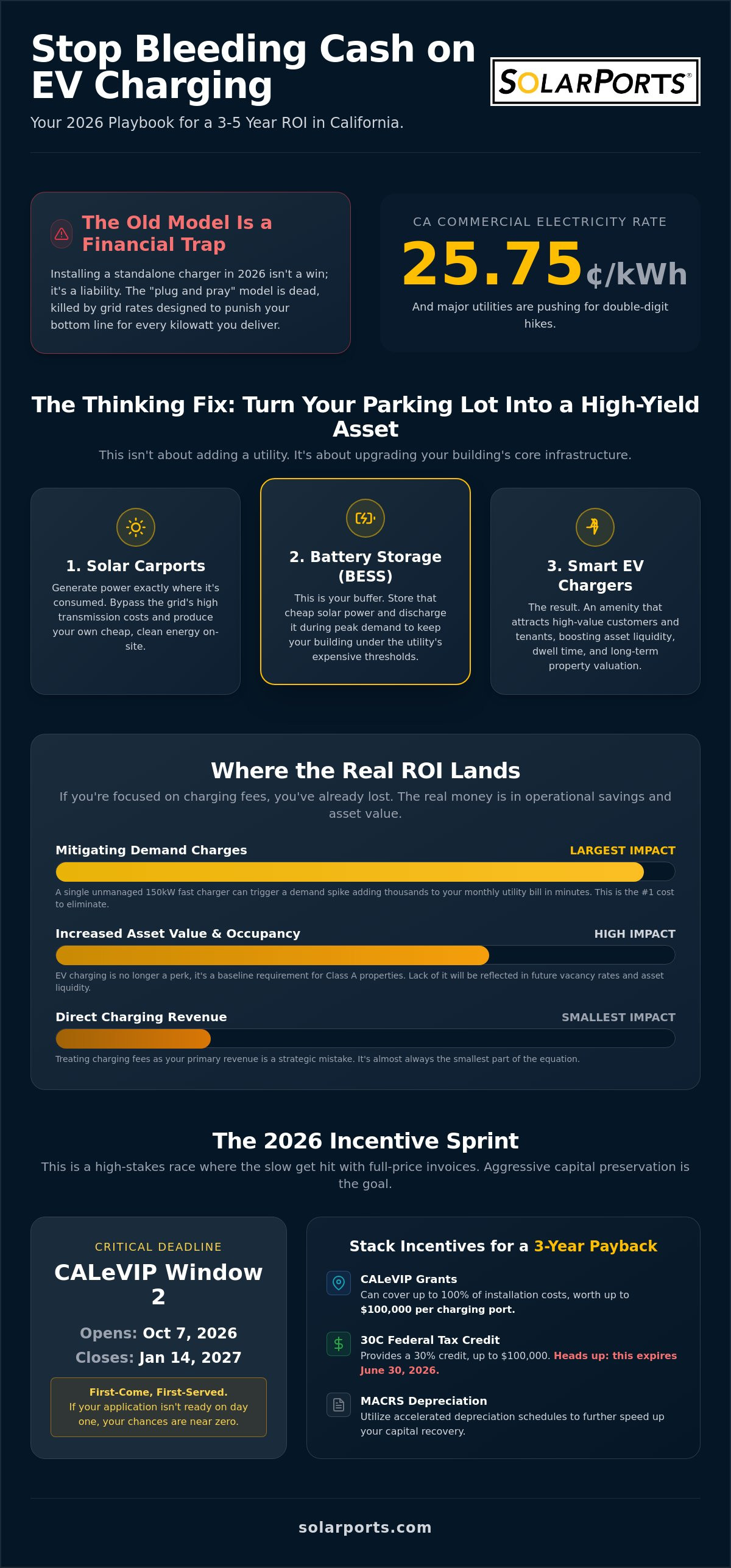
Installing a standalone charger in 2026 isn't a sustainability win; it's a financial liability. With California's average commercial electricity rates hitting 25.75¢/kWh and major utilities pushing for double-digit hikes, the old "plug and pray" model is dead. You've probably stared at a utility bill and realized that one poorly timed charging session can wipe out a month of operational savings. It's a frustrating spot to be in. You're expected to lead the transition to electric, yet the grid seems designed to punish your bottom line for every kilowatt you deliver.
This guide offers a raw, data-driven look at how to secure a commercial EV charging station ROI California by treating energy as a managed asset rather than a fixed cost. We'll break down the critical CALeVIP Window 2 deadlines opening in October and show you why stacking solar carports with battery storage is the only way to hit a 3-5 year payback. You'll get a clear strategy to stop the "stranded asset" fear and turn your parking lot into a high-yield financial tool that actually pays for itself. We're moving past the marketing hype to look at the cold, hard numbers of 2026 energy strategy.
Key Takeaways
- The October 7, 2026, CALeVIP window is a first-come, first-served sprint that can cover up to 100% of installation costs if your pre-planning is finished before the portal opens.
- Stop focusing on charging fees as your main revenue; a defensible commercial EV charging station ROI California strategy relies on mitigating demand charges that can otherwise spike monthly bills by thousands.
- Integrating Battery Energy Storage Systems (BESS) acts as a critical buffer, letting you discharge stored power during simultaneous charging events to keep your building under expensive utility thresholds.
- Solar carports transform basic parking lots into high-yield assets by generating power exactly where it's consumed, bypassing the high transmission costs of the California grid.
- A professional energy cost saving analysis is the mandatory first step to ensure you aren't building "stranded assets" that become obsolete as 2026 grant requirements and charging speeds evolve.
Beyond the Charging Fee: The Real Drivers of ROI for California Properties
Most property owners look at the wrong numbers. They focus on the cents per kilowatt hour while ignoring the structural impact on their property's Cap Rate. It's a mistake that leads to bad math. The true commercial EV charging station ROI California isn't found in the transaction at the plug; it's found in the asset's overall performance. If you're treating charging fees as your primary revenue stream, you've already lost. Direct revenue is almost always the smallest part of the equation when compared to property valuation and operational savings.
Indirect value is what actually moves the needle. For a property owner, an electric vehicle charging station serves as a magnet for a specific, high-value demographic. This infrastructure affects asset liquidity and long-term valuation. When you integrate energy systems into the site, you're not just adding a utility; you're upgrading the building's core infrastructure to meet the 2026 reality of commercial real estate competition.
The Impact of Customer Dwell Time and Employee Retention
Retailers benefit from "dwell time" which is a fancy way of saying people stick around longer. High-income EV drivers often spend significantly more time in-store when they aren't rushing back to a meter. Some industry reports suggest these customers spend up to 30% more per visit. In the workplace, charging is no longer a "perk" for Class A office tenants in Northern California. It's a baseline requirement. If your building can't support a fleet of executive EVs, your vacancy rates will eventually reflect that lack of foresight.
Avoiding the Utility Bill Shock
California utilities like PG&E and SCE don't just bill you for what you use. They bill you for your highest 15-minute spike in demand during the month. This is the "Demand Charge Trap." A single 150kW fast charger, if unmanaged, can trigger a demand spike that adds thousands of dollars to your monthly utility bill in minutes. It's a massive risk that can completely cannibalize your commercial EV charging station ROI California. A professional energy cost saving analysis prevents you from over-engineering your site and ensures your charging strategy doesn't become a utility burden. You don't need the biggest power draw; you need the smartest one.
The 2026 Incentive Landscape: Navigating CALeVIP and Federal Credits
The capital required for these projects is substantial, but 2026 offers a unique, shrinking window to offset nearly the entire cost. If you aren't stacking incentives, you're leaving six figures on the table. This isn't about being "green"; it's about aggressive capital preservation. To maximize your commercial EV charging station ROI California, you have to treat grant applications like a high-stakes race where the slow are penalized with full-price invoices. You can find a comprehensive list of these opportunities through California's ZEV funding resources, but simply knowing they exist isn't enough to win the funding.
CALeVIP Window 2: Dates and Readiness
The CALeVIP Window 2 is the most critical date on your 2026 calendar. It opens October 7, 2026, and slams shut on January 14, 2027. This program is strictly first-come, first-served. If your application isn't in on day one, your chances of approval drop to near zero. You need a completed project design ready by September to have any real shot at success. Waiting until the window opens to start your engineering is a guaranteed way to miss out on up to $100,000 per charging port. If the calendar looks daunting, you can speak with our team about a 2026 strategy to ensure your site is application-ready before the portal opens.
Stacking Incentives for Maximum Capital Preservation
Incentive stacking is the only logical path to a three-year payback. The 30C federal tax credit provides a 30% credit up to $100,000, but there is a major catch: it is currently set to expire on June 30, 2026. This creates a massive mid-year hurdle for projects that aren't already in the ground. Beyond the tax credit, you should be utilizing MACRS depreciation to further accelerate your recovery of capital. Hardware choice is also a factor in your eligibility. If your chargers aren't ENERGY STAR certified, CALeVIP will reject your claim regardless of how quickly you apply. Local municipal utility rebates in Northern California often provide a third layer of funding that most developers overlook, but these require specific, early-stage site verification to qualify.
The Thinking Fix: Why Integrated Solar and BESS is the Only Way ROI Lands
Standalone charging is a losing game. If you're just bolting chargers to a wall and connecting them to the building's main panel, you're subsidizing your tenants' fuel at your own expense. To fix the commercial EV charging station ROI California equation, you have to move away from being a utility customer and toward being a power generator. Standalone hardware is a liability; an integrated system is a financial asset.
Solar Carports: The Ultimate Dual-Purpose Asset
Solar carports solve the "space vs. power" conflict that plagues urban commercial properties. They provide shade for vehicles, which is a premium amenity in California’s heat, while generating power exactly where it is consumed. This eliminates the transmission costs and inefficiencies of pulling power from a stressed grid. For a deeper look at the financial modeling behind these structures, see our Commercial Solar ROI Analysis. It's about turning dead asphalt into a productive power plant.
Battery Storage: The ROI Protector
Battery Energy Storage Systems (BESS) act as your ROI protector. They perform "peak shaving" by discharging stored energy during high-demand events, such as when multiple vehicles charge simultaneously. This keeps your building’s load under the utility's expensive demand threshold. Beyond cost control, these systems provide critical resiliency. They offer emergency power to the property when the grid is stressed or the sun is down, ensuring your infrastructure remains operational 24/7.
You can't guess your way into a 3-year payback. A commercial energy cost saving analysis is the only way to right-size your hardware and avoid over-investing in capacity you won't use. Programs like the California Electric Vehicle Infrastructure Project (CALeVIP) favor these integrated approaches because they reduce grid strain. By building this infrastructure now, you're preparing for the massive fleet transitions coming to California by 2030. It's about building a system that works as an asset today and stays relevant tomorrow.
Securing Your Asset's Energy Future Before the 2026 Window Closes
The math for 2026 is uncompromising. If you're installing charging infrastructure without a strategic buffer for demand charges, you're essentially building a permanent leak in your property's balance sheet. We've established that a defensible commercial EV charging station ROI California requires a shift from being a passive utility consumer to an active power generator. By stacking CALeVIP grants with federal credits and integrating solar carports, you're not just adding an amenity; you're fundamentally upgrading your building's core financial performance.
Success in this market belongs to the property owners who move before the October 7 deadline. Waiting until the funding window opens to begin your engineering is a recipe for missed opportunities and six-figure losses. We provide the turnkey California-specific project management and data-backed ROI modeling that CFOs require to make these high-stakes decisions with confidence. Our expertise in BESS and solar carport integration ensures your infrastructure remains a high-yield asset well into 2030.
Request your 2026 Commercial Energy Cost Saving Analysis to see exactly how these integrated energy strategies will impact your specific property's bottom line. Your parking lot is either a growing cost center or a productive power plant. It's time to make it pay for itself.
Frequently Asked Questions
What is the average payback period for a commercial EV charging station in California?
A 3 to 5 year payback period is the current standard for an optimized commercial EV charging station ROI California project. This timeline assumes you're stacking state grants with federal credits and using on-site storage to kill demand charges. If you're relying solely on charging fees, that window stretches significantly longer. Most property owners who fail to integrate solar or batteries find themselves stuck in a 7 to 10 year recovery cycle which is often unacceptable for commercial capital expenditures.
How much can I actually get from the CALeVIP grant in 2026?
You can secure up to $100,000 per charging port through the CALeVIP Window 2 funding cycle opening October 7, 2026. This incentive is designed to cover up to 100% of eligible installation costs for DC fast chargers. It's a first-come, first-served race. By the time Window 3 opens in February 2027, the incentive cap drops to $55,000 per port. This makes the late 2026 window the most aggressive capital preservation opportunity for California owners.
Will installing EV chargers increase my property taxes in California?
Installing EV charging infrastructure typically doesn't trigger a property tax reassessment in California thanks to active legislative exclusions for green infrastructure and ZEV equipment. While the hardware adds significant value to the asset's Cap Rate and tenant appeal, it's generally shielded from increasing your base tax liability. You should verify this with your specific county assessor's office, but the state's current policy is to incentivize these upgrades rather than penalize them through higher property taxes.
Can I charge my tenants for electricity and still claim the tax credits?
Yes, you can charge your tenants or the public for electricity and still claim the 30C federal tax credit. The credit is based on the initial investment in the hardware and installation; it isn't tied to your ongoing revenue model. In fact, generating revenue through charging fees is a standard part of a robust commercial EV charging station ROI California strategy. Just ensure your billing software is compliant with state transparency laws regarding price-per-kWh reporting at the point of sale.
Do I need a new transformer from PG&E to install Level 3 fast chargers?
Most Level 3 fast chargers require a dedicated transformer from PG&E or SCE because the existing building service wasn't designed for 150kW spikes. This is where the cost usually explodes. However, integrating a Battery Energy Storage System (BESS) can often bypass the need for a massive grid upgrade. By using the battery to buffer the load, you can pull power from your existing service at a lower rate and discharge it rapidly when a vehicle plugs in.


