
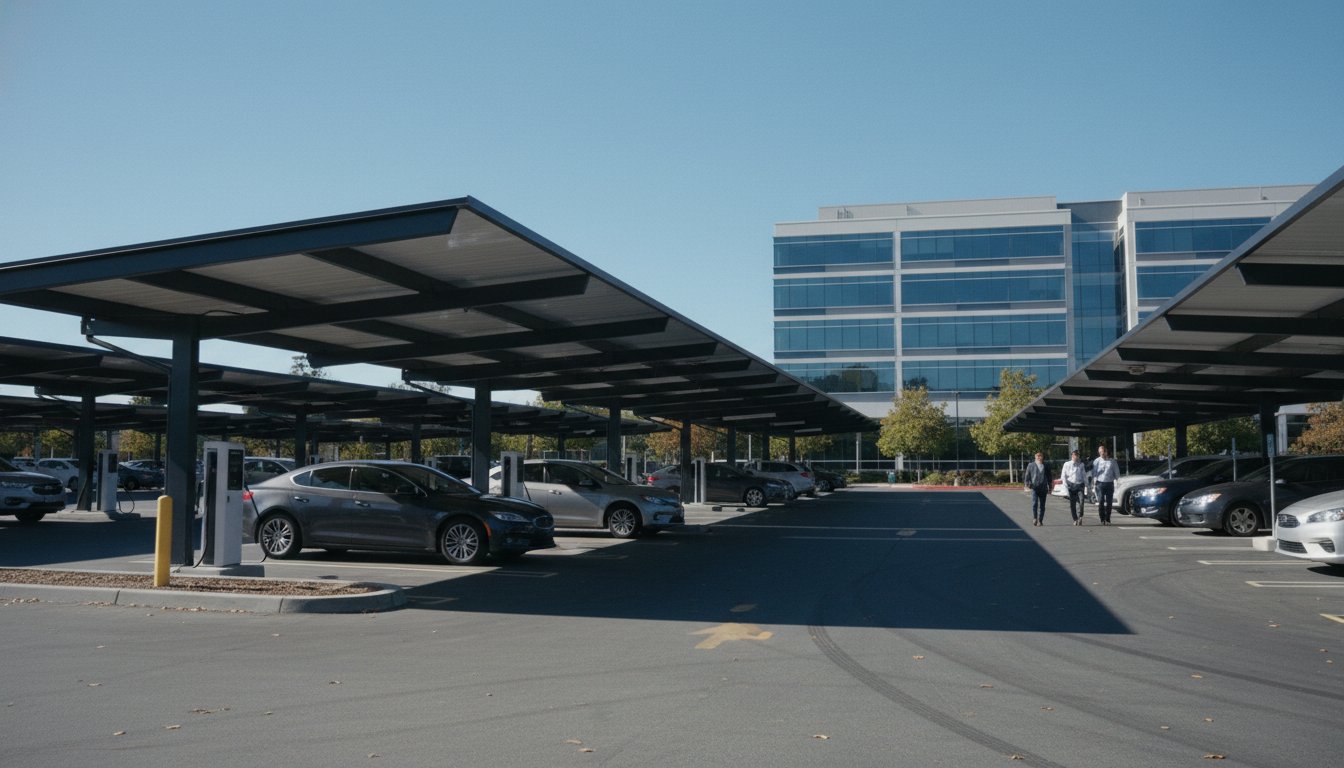
Most California property owners view renewable upgrades as a mere utility hedge, but the most sophisticated investors recognize them as a high-yield capital optimization play. You've likely noticed that rising peak-demand charges and the complexities of NEM 3.0 are steadily eroding your operational margins. It's a significant burden to manage multiple contractors while navigating the fragmented landscape of state and federal rebate programs. Implementing a commercial solar carport with EV charging California system isn't just an environmental initiative; it's a structural necessity for long-term asset preservation.
This article provides a data-backed framework to help you evaluate integrated solar-plus-EV infrastructure and maximize your long-term internal rate of return. You'll learn how to leverage the 30% Federal ITC before the critical July 4, 2026 construction deadline. We'll also analyze the strategic role of battery storage in mitigating the 75% reduction in export value under current net billing tariffs. This comparison details how a "trench once" approach to project management can future-proof your property while capturing maximum fiscal incentives through MACRS and CALeVIP 2.0 rebates.
Key Takeaways
- Learn how to transform underutilized parking space into a revenue-generating power plant that addresses California's 2035 EV mandate and rising utility costs.
- Identify the specific financial and operational profiles for Level 2 versus DC Fast Charging to align infrastructure with your tenant or fleet dwell times.
- Discover the "Trench Once" methodology for a commercial solar carport with EV charging California project to eliminate redundant labor costs and minimize property disruptions.
- Navigate the complex 2026 incentive landscape, including the 30% Federal ITC and MACRS depreciation, to accelerate capital recovery and optimize your internal rate of return.
- Establish a rigorous, data-driven framework for energy cost saving analysis and custom engineering to ensure structural integrity and maximum solar yield.
The Strategic Case for Integrated Solar Carports in California
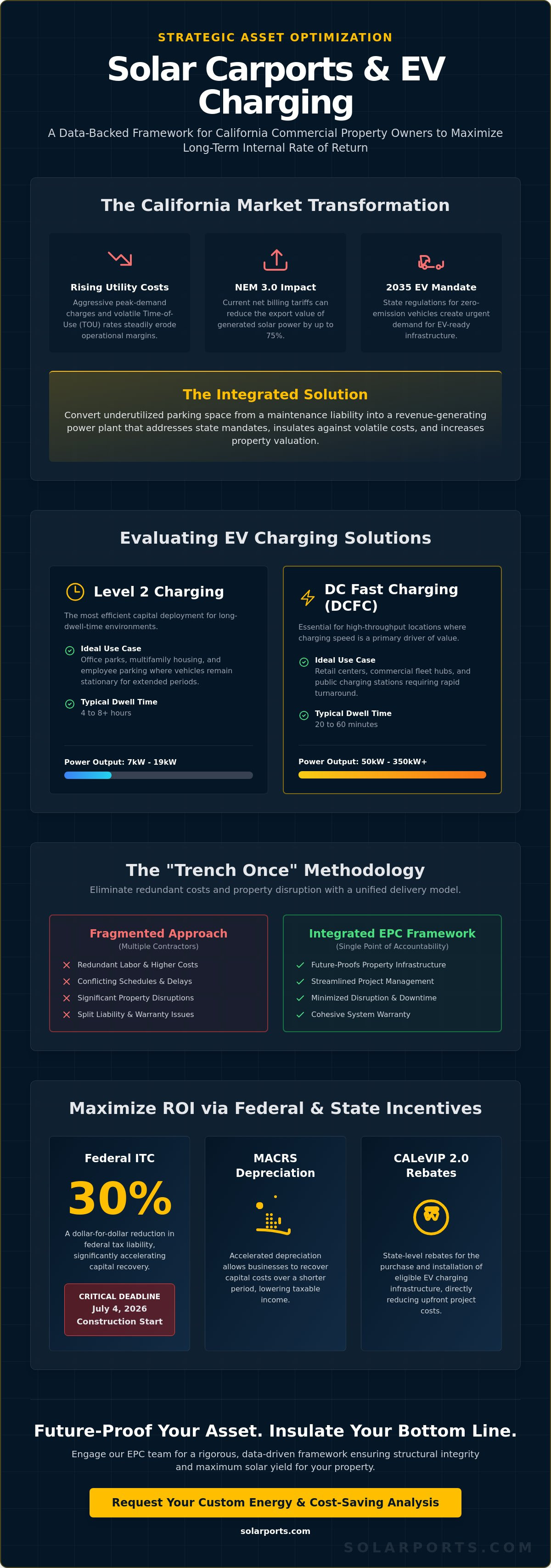
California's energy market is undergoing a structural transformation. The state's 2035 mandate for zero-emission vehicles, coupled with aggressive peak-demand charges from utilities, has created a scenario where passive property management is no longer viable. Every square foot of asphalt represents an opportunity for fiscal optimization. By deploying a commercial solar carport with EV charging California system, property owners convert a maintenance-heavy liability into a sophisticated energy asset. This isn't just about sustainability; it's about insulating your bottom line against volatile Time-of-Use (TOU) rates that can devastate operational budgets during peak afternoon hours.
Market Drivers and Regulatory Pressure in 2026
Building codes in California now mandate EV-ready infrastructure for many new developments and significant renovations. Proactive installation is a capital preservation strategy. If you wait to retrofit these systems after the initial construction or repaving phase, you face increased labor costs and permitting hurdles that drive up total project expenses. Managing the current Net Billing Tariff (NEM 3.0) requires a precise integration of generation and consumption. By generating power where vehicles are parked, you minimize transmission losses and maximize the utility of every kilowatt-hour produced. Solar canopy technology provides the structural foundation for this integration, offering shade for tenants while simultaneously fueling the next generation of transportation.
Defining the Integrated EPC Advantage
Fragmentation is the enemy of efficiency. Engaging separate contractors for solar arrays, electrical upgrades, and EV charging stations often leads to conflicting schedules and split liability. An Engineering, Procurement, and Construction (EPC) framework provides a single point of accountability for the entire project lifecycle. This turnkey approach ensures that the structural engineering of the carport is perfectly aligned with the electrical requirements of high-speed charging ports. It moves the relationship from a simple vendor-client interaction to a strategic partnership focused on long-term asset value. A unified delivery model mitigates the risk of downtime and ensures that all components operate under a cohesive warranty schedule, protecting your investment from the granular complexities of California's energy landscape.
Integrated energy systems are becoming a hallmark of Class A commercial real estate. Tenants now prioritize properties that offer onsite charging as a standard amenity. This market demand allows owners to command higher lease rates and improves tenant retention. Ultimately, the parking lot becomes a revenue-generating power plant that enhances the overall valuation of the property and ensures its relevance in a decarbonizing economy.
Evaluating EV Charging Solutions: Level 2 vs. DC Fast Charging
Infrastructure choice dictates operational throughput. For office parks and multifamily developments, Level 2 (L2) charging represents the most efficient capital deployment. These systems typically deliver between 7kW and 19kW, aligning perfectly with the four to eight-hour dwell times common among employees and residents. Because L2 stations place less strain on existing switchgear, they're often the most cost-effective addition to a commercial solar carport with EV charging California project. Owners can manage access through RFID-enabled software or mobile applications, ensuring that charging remains a controlled tenant amenity or a tiered revenue stream.
Level 2 Charging for Office and Multifamily
Dwell time is the primary metric for L2 viability. In environments where vehicles remain stationary for the duration of a workday, high-speed charging is often unnecessary and fiscally inefficient. Standardizing on L2 allows for a higher density of charging ports without requiring immediate, massive upgrades to your property's electrical transformer. Integrating these ports directly into the carport support structures streamlines the wiring process and protects the hardware from the elements. This configuration provides a seamless experience for long-term users while maintaining a manageable load profile for the building's main distribution panel.
DC Fast Charging for Retail and Fleet Hubs
Retail centers and logistics hubs require a different methodology. High-turnover environments demand DC Fast Charging (DCFC), where outputs ranging from 50kW to 350kW can provide a significant charge in under 20 minutes. This speed attracts high-value retail foot traffic and supports fleet vehicles that need to return to service quickly. However, rapid power draws can trigger massive demand charges from utilities. Implementing a California's Demand Side Grid Support program strategy helps mitigate these spikes by coordinating with state-level grid incentives. To avoid these costs, many property owners integrate a Battery Energy Storage System (BESS) to buffer the load and maintain price stability during peak hours.
Monetization strategies must reflect your specific asset class. Some owners prefer an amenity-based model to drive lease renewals, while others utilize pay-per-charge systems to generate immediate cash flow. Regardless of the speed, your property's existing switchgear capacity remains the ultimate gatekeeper. Conducting a commercial property energy cost saving analysis is a critical first step to determine which tier of charging your current electrical footprint can support without requiring a prohibitively expensive utility transformer upgrade. By matching the charging speed to the user's stay, you optimize both the user experience and your project's internal rate of return.
Strategic Capital Deployment: Bundled vs. Phased Infrastructure
Efficiency is the primary driver of project profitability. Executing a commercial solar carport with EV charging California project in separate phases is a common but expensive strategic error. Phased deployment requires multiple rounds of mobilization, redundant permitting fees, and repeated disruptions to parking lot operations. By adopting a "Trench Once" philosophy, property owners consolidate the most labor-intensive portion of the installation: the underground electrical infrastructure. This unified approach eliminates the need to excavate, backfill, and repave the same site twice; it directly reduces the hard costs associated with civil engineering and site preparation.
Interconnection with major utilities like PG&E, SCE, or SDG&E is often the most significant bottleneck in renewable deployment. Submitting a single, comprehensive interconnection application for a bundled system is significantly more efficient than managing separate filings for solar and EV charging infrastructure. This streamlined process reduces administrative overhead and ensures that the property's electrical capacity is right-sized from the outset. Bundled projects consistently yield a higher Internal Rate of Return (IRR) because they capture the full suite of federal and state incentives simultaneously, front-loading the financial benefits of the investment while reducing the total depreciable basis.
Quantifying the Savings of Bundled EPC
Soft costs often account for a substantial portion of total project expenses. Managing one project manager instead of three independent vendors reduces the communication burden and ensures technical cohesion. In many California jurisdictions, securing a single master permit for an integrated system is significantly more efficient than obtaining separate permits for solar, storage, and EV charging. Integrating a Battery Energy Storage System (BESS) during the initial build further enhances these savings by utilizing the same inverter and control hardware. This prevents the need for costly retrofits as utility rates continue to climb and export values under NEM 3.0 remain suppressed.
Addressing the High Upfront Capital Objection
Capital constraints don't have to stall strategic infrastructure upgrades. Various financing structures, including Power Purchase Agreements (PPAs), solar leases, and PACE financing, allow commercial real estate owners to deploy these systems with minimal out-of-pocket expenditure. Integrated systems often qualify for larger, unified financing packages that offer more favorable terms than smaller, piecemeal loans. The cost of inaction is quantifiable. Projecting a five-year utility spend without a commercial solar carport with EV charging California installation reveals a mounting liability as peak-demand charges and EV adoption rates both accelerate toward the 2035 mandate. Utilizing the 30% Federal ITC before the July 4, 2026 deadline is essential for maximizing the project's financial viability.
Maximizing ROI via California-Specific Incentives and Tax Credits
Fiscal optimization is the cornerstone of any high-stakes infrastructure project. In the current economic climate, simply installing hardware is insufficient; you must strategically layer federal and state incentives to compress the payback period. Implementing a commercial solar carport with EV charging California system allows property owners to access a sophisticated stack of tax credits and rebates that directly offset capital expenditures. These mechanisms aren't merely perks. They're essential components of a rigorous 2026 financial model designed to maximize internal rate of return (IRR) in a post-NEM 3.0 environment.
The Federal Tax Advantage (ITC & MACRS)
The Inflation Reduction Act (IRA) has solidified the 30% Federal Investment Tax Credit (ITC) as a primary driver for renewable energy investment. To secure this 30% rate, your project must meet the "begin construction" criteria by July 4, 2026. Missing this deadline could result in a lower credit tier, significantly altering your long-term fiscal projections. Beyond the ITC, businesses can leverage the Modified Accelerated Cost Recovery System (MACRS) to recover investments over a compressed timeframe. In 2026, a 20% bonus depreciation remains available, allowing for a substantial reduction in tax liability during the first year of operation. MACRS allows for the accelerated depreciation of energy assets over a five-year period, significantly front-loading the tax benefits and improving the project's early-year cash flow.
California State Rebates: CALeVIP and SGIP
State-level programs provide the necessary capital to bridge the gap between standard solar and integrated EV infrastructure. The California Electric Vehicle Infrastructure Project (CALeVIP) 2.0 has shifted its focus toward high-capacity DC fast chargers of 150 kW or greater. This program is particularly lucrative for projects located in low-income or disadvantaged communities, where at least 50% of funding is designated. While many general market funds for the Self-Generation Incentive Program (SGIP) are currently waitlisted, the "Equity" and "Equity Resiliency" budgets still offer significant rebates for a Battery Energy Storage System (BESS). Integrating storage is no longer optional; it's a structural requirement to mitigate the 75% reduction in export value under the Net Billing Tariff.
Navigating these fragmented programs requires precision and technical verification. Most property owners find that a commercial property energy cost saving analysis is the most effective way to quantify how these specific incentives will impact their unique site conditions and load profiles. By identifying the intersection of CALeVIP rebates and Federal ITC eligibility, you can ensure that your project is right-sized for both operational needs and maximum capital recovery. The "Equity" bonus can further enhance these returns, providing a specialized financial path for properties that serve as community hubs or critical infrastructure nodes.
- Federal ITC: 30% credit for projects beginning construction by July 4, 2026.
- Bonus Depreciation: 20% first-year deduction available for 2026 installations.
- CALeVIP 2.0: Focus on 150kW+ DC fast charging with priority for disadvantaged communities.
- SGIP: Essential funding for BESS to counteract NEM 3.0 export rate shifts.
The Turnkey EPC Framework: From Cost Analysis to Delivery
Precision in execution is as critical as the initial financial modeling. Successfully delivering a commercial solar carport with EV charging California project requires a disciplined progression from analytical validation to physical commissioning. This turnkey Engineering, Procurement, and Construction (EPC) framework ensures that every technical decision serves the overarching goal of asset optimization. By consolidating these phases under a single strategic partner, property owners avoid the costly misalignments that typically plague fragmented energy projects.
- Step 1: Commercial Energy Cost Saving Analysis. We begin with a granular review of 12 to 24 months of interval utility data to right-size the system for your specific load profile.
- Step 2: Custom Engineering. Our engineers balance structural integrity with maximum solar yield, focusing on site-specific factors like seismic requirements and soil composition.
- Step 3: Procurement and Permitting. We manage the "California bottleneck" by navigating complex local AHJ (Authority Having Jurisdiction) requirements and securing long-lead hardware.
- Step 4: Construction and Commissioning. Execution follows a phased schedule to minimize parking lot disruptions, culminating in a rigorous testing phase before the system goes live.
The Importance of Property-Specific Analysis
Generic estimates are a recipe for budget overruns. A commercial solar carport with EV charging California installation must be tailored to the unique physical and electrical constraints of the site. We analyze two years of historical utility data to ensure the generation capacity doesn't exceed your actual needs under current net billing rules. Structural fit-checks are equally vital. We optimize parking layouts for column-free spans of 18 to 30 feet, ensuring that the structures don't impede vehicle maneuverability or visibility. This phase also includes designing an electrical backbone capable of supporting your projected 2030 charging capacity, preventing expensive underground retrofits as your fleet or tenant needs expand.
Partnering for Long-Term Performance
The handover of the system is just the beginning of its lifecycle. Long-term performance requires a dedicated Operations and Maintenance (O&M) strategy that protects your 30-year structural and 25-year solar performance warranties. Regular monitoring and reporting are essential for verifying energy savings and providing the data necessary to meet corporate ESG goals. By maintaining a single point of accountability, you ensure that the integrated components, from the solar modules to the high-speed charging ports, operate at peak efficiency. It's time to move beyond theoretical savings and implement a verified energy strategy.
Request your no-obligation Commercial Energy Cost Saving Analysis to begin the process of future-proofing your California property assets today.
Securing Your Competitive Advantage in the 2026 Energy Market
The window for maximizing the 30% Federal ITC is narrowing as the July 2026 construction deadline approaches. Strategic property owners recognize that a commercial solar carport with EV charging California system is more than a required amenity; it's a high-yield financial instrument. By consolidating generation, storage, and charging into a single turnkey EPC contract, you eliminate redundant labor costs and streamline the utility interconnection process. This unified approach ensures your property remains competitive as California's 2035 EV mandates and rising peak-demand charges continue to reshape the commercial real estate landscape.
Our California-based expert team provides the technical precision and data-driven 30-year cash-flow modeling required to transform your parking lot into a high-performing asset. We manage the entire project lifecycle through a streamlined framework, offering the professional relief of one contract and one comprehensive warranty. This methodology ensures that your capital deployment is optimized for the highest possible internal rate of return.
Schedule Your Professional Energy Cost Saving Analysis to verify your property's potential for fiscal optimization. Proactive planning today secures the structural and financial integrity of your real estate portfolio for decades to come.
Frequently Asked Questions
What is the typical ROI for a commercial solar carport in California?
Payback periods for these assets typically range from five to eight years when property owners fully utilize available state and federal incentives. The exact internal rate of return depends on your specific utility tariff and the ratio of onsite consumption to grid export. Under the current Net Billing Tariff, ROI is maximized by aligning solar generation with peak electric vehicle charging loads to avoid high demand charges.
How much does a commercial solar carport with EV charging cost in 2026?
Total project expenditure varies based on structural complexity, total wattage, and the number of charging ports required. Hardware costs for steel structures and high-efficiency modules are only one component of the budget. Site-specific variables like soil conditions, existing switchgear capacity, and underground trenching requirements significantly influence the final capital outlay. We recommend a professional energy cost saving analysis to establish a precise budget for your specific property.
Can my existing commercial electrical panel handle DC fast chargers?
Most existing commercial panels lack the spare capacity to support the massive power draw of DC fast charging without significant upgrades. These chargers require between 50kW and 350kW of dedicated power, which often necessitates a new utility transformer or reinforced switchgear. A detailed load study is the first step to determine if your current infrastructure can support high-speed charging or if a battery buffer is required to mitigate grid stress.
What are the ADA requirements for EV charging stations in California parking lots?
California building codes under Title 24 mandate specific ratios for accessible EV charging spaces based on the total number of charging ports provided. These requirements include specific stall dimensions, designated access aisles, and precise signage to ensure compliance with both state and federal accessibility standards. Failure to integrate these requirements during the initial engineering phase can lead to costly retrofits and permitting delays during final inspection.
How long does the installation of a solar carport typically take?
Most projects require six to twelve months to move from initial engineering to final commissioning. While the physical assembly of the steel structures often occurs within a few weeks, the majority of the timeline is consumed by the "California bottleneck" of permitting and utility interconnection. Securing a commercial solar carport with EV charging California system requires proactive planning to ensure all components are placed in service before critical tax credit deadlines.
Is battery storage (BESS) required for a solar carport with EV charging?
Battery storage is not a regulatory requirement, but it's a structural necessity for financial viability under NEM 3.0. Without BESS, the 75% reduction in solar export value makes it difficult to offset the high peak-demand charges triggered by simultaneous EV charging sessions. Storage allows you to "shave" those peaks by discharging stored energy when the grid is most expensive, protecting your operational margins from utility price volatility.
What is the 'Trench Once' approach and how does it save money?
The 'Trench Once' methodology involves installing all underground conduit for solar, storage, and EV charging during a single excavation phase. This strategy eliminates the redundant costs of multiple mobilizations, repeated asphalt cutting, and separate repaving sessions. Consolidating the civil engineering work in this manner directly reduces soft costs and minimizes the duration of parking lot closures for your tenants or customers.
How do Federal tax credits apply to integrated solar and EV projects?
A commercial solar carport with EV charging California project qualifies for a 30% Federal Investment Tax Credit (ITC) if construction begins by July 4, 2026. This credit applies to the solar generation hardware and the integrated battery energy storage system. Additionally, businesses can utilize MACRS accelerated depreciation to recover the cost of these energy assets over a five year period, significantly front loading the project's tax benefits and improving early year cash flow.


