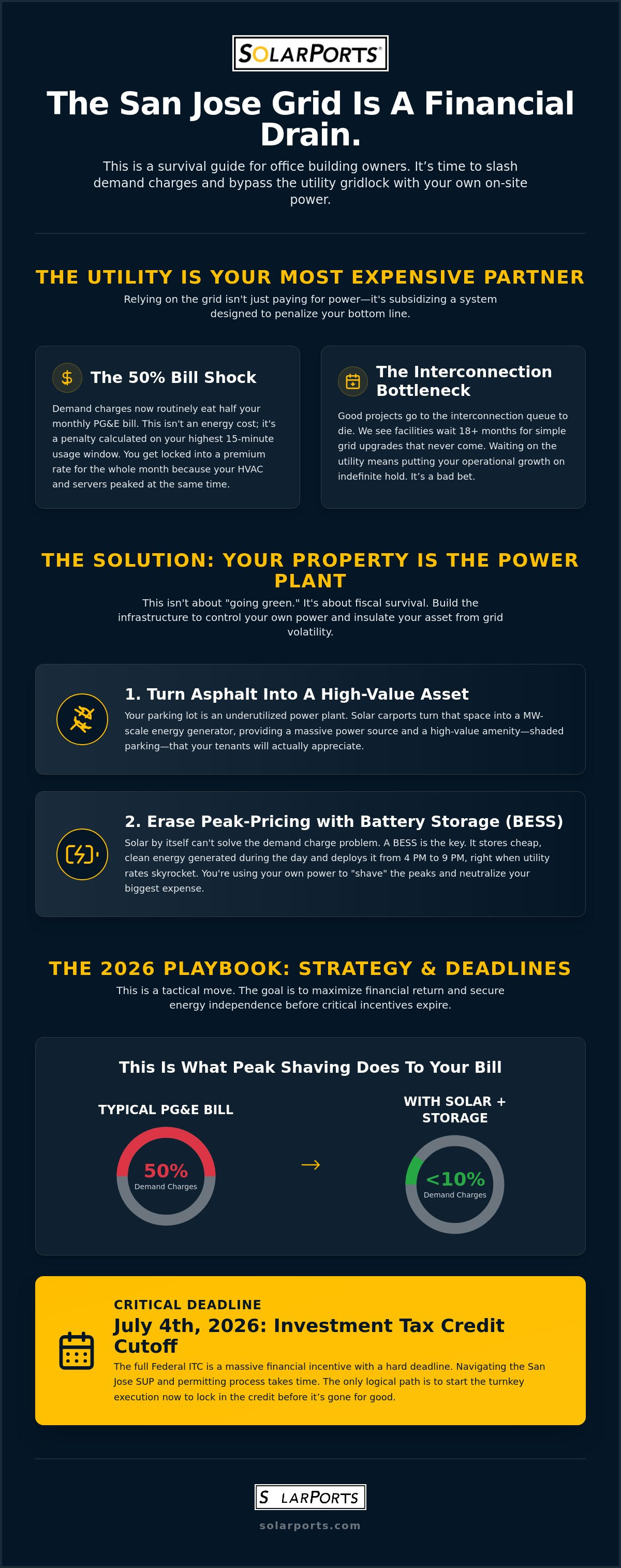
If your office building is still relying solely on the San Jose grid, you aren't just paying for power. You're subsidizing a system that's actively penalizing your bottom line. Demand charges for commercial solar for office buildings San Jose are now routinely eating 50% of the monthly bill, making the utility company your most expensive, and least reliable, partner. It's a calculated drain on capital that no executive should tolerate in 2026.
We see the same bottleneck everywhere: corporate mandates demand green energy, but the grid won't let you connect for another eighteen months. It's an exhausting cycle of rising rates and stalled progress. This guide explains how to break that cycle by pairing targeted solar with BESS infrastructure to slash demand charges and bypass interconnection delays. We're looking at a strategy that prioritizes fiscal survival and operational resiliency over simple compliance. You'll learn how to navigate the July 4th ITC deadline and why a turnkey execution is the only logical path to securing your asset's energy future.
Key Takeaways
- Stop waiting for utility-scale upgrades that are years away. On-site infrastructure is the only way to get the power you need today without the grid's timeline holding you hostage.
- Neutralize the demand charges eating your budget. We'll show you why commercial solar for office buildings San Jose must be paired with BESS to actually move the needle on your PG&E bill.
- Look at your parking lot as a power plant. Solar carports turn basic asphalt into high-density energy assets that generate revenue while protecting tenant vehicles.
- Navigate the San Jose Special Use Permit (SUP) process without the usual headaches. Use our roadmap to clear local planning hurdles and capture the full 2026 tax credit before the July 4th cutoff.
The San Jose Grid Reality: Why On-Site Solar is a Financial Survival Strategy
San Jose is currently pushing a massive 2GW transmission expansion. That sounds impressive in a municipal press release. It doesn't help an office park in North San Jose that's hitting its capacity ceiling today. If you're waiting for the utility to upgrade local substations, you're effectively putting your operational growth on indefinite hold. It’s a high-risk strategy that assumes the utility’s timeline aligns with your fiscal goals. It won't. In 2026, the conversation has shifted. This isn't about "green energy" as a corporate PR stunt; it's about energy independence. Behind-the-meter assets act as a vital buffer against a grid that’s increasingly congested and prone to volatility.
The reality for Silicon Valley operators is simpler and more brutal than the headlines suggest. Relying on the centralized grid means accepting a lack of control over your most volatile OPEX line item. On-site rooftop solar power systems provide a structural hedge against this instability. By generating power exactly where it's consumed, you bypass the macro-level transmission failures that are currently dogging Santa Clara County. It’s a tactical move that prioritizes asset performance over utility-scale promises.
The Impact of Peak-Demand Charges in Santa Clara County
Demand charges are the silent killer of the commercial bottom line. In San Jose, these fees often account for 50% of the total utility spend. These charges are calculated based on your highest 15-minute window of usage. If your HVAC systems ramp up while the server rooms are peaking, you're locked into a premium rate for the entire billing cycle. Implementing commercial solar for office buildings San Jose allows you to "shave" these peaks. You use your own solar production to cover those high-draw moments, effectively lowering the monthly baseline and protecting your margins from PG&E’s aggressive rate structures.
Interconnection Bottlenecks and Local Realities
The interconnection queue is where good projects go to die. We’ve seen San Jose facilities wait years for a simple transformer upgrade that never seems to arrive. This is why turnkey commercial solar CA strategies focus on optimizing what happens on your side of the meter. Instead of waiting for a grid that's perpetually behind schedule, you build the infrastructure to handle your own loads. It's a pragmatic pivot from asking for permission to securing your own power supply.
Buying Guide: High-Density Solar and BESS Assets for Office Hubs
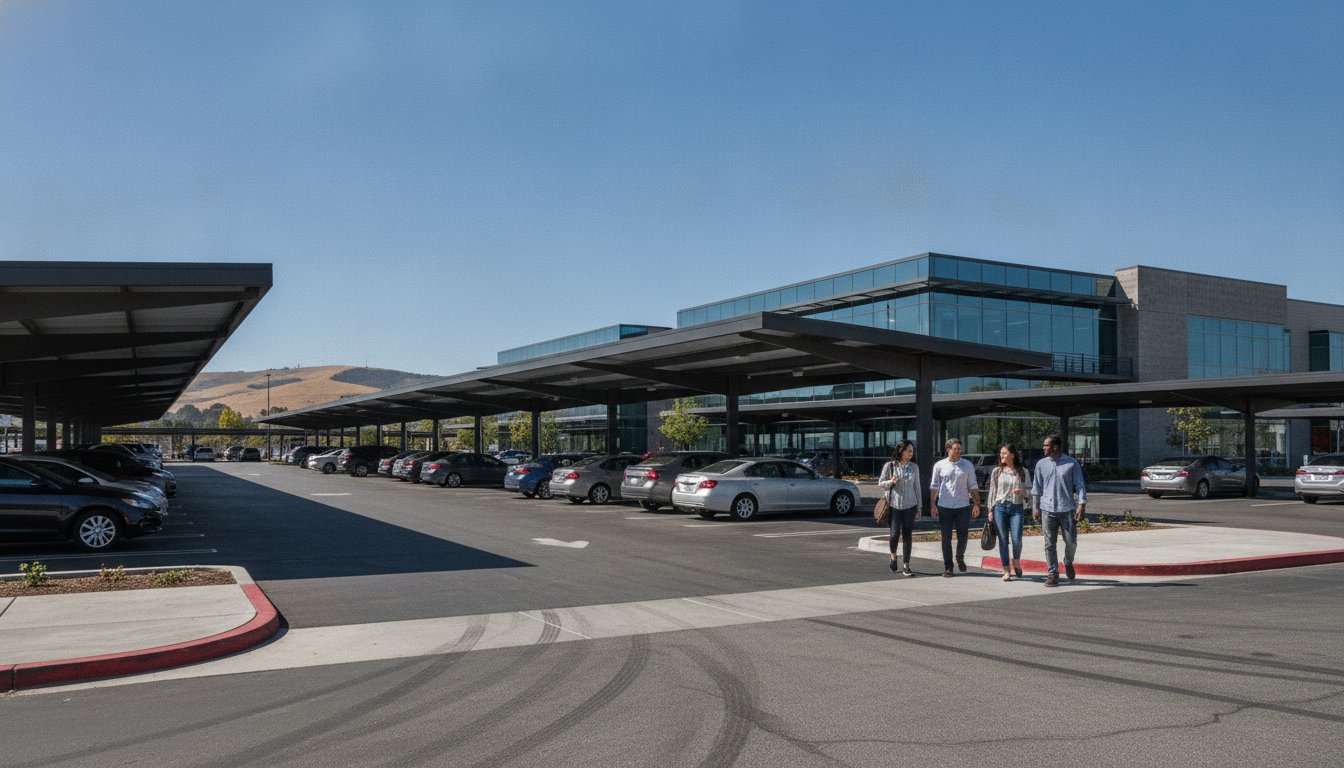
Density is the primary constraint for commercial solar for office buildings San Jose. Most rooftops are already crowded with HVAC units and mechanical penthouses, which leaves very little usable square footage for meaningful generation. This is why we look at the parking lot. Solar carports turn underutilized asphalt into MW-scale power plants. They provide a dual-purpose investment by generating massive amounts of energy while offering shaded parking that tenants actually value. It’s a pragmatic use of the footprint you already own.
You shouldn't guess at the scale of your system. A commercial property energy cost saving analysis is the only logical first step. This data-driven audit looks at your 15-minute interval data to find where the money is actually leaking. It determines whether you should focus on rooftop density or structural carports to offset those aggressive PG&E rates. Without this baseline, you're just buying hardware without a strategy.
Sizing BESS for San Jose Office Loads
Battery capacity isn't a one-size-fits-all metric. For a San Jose office, you're usually sizing for the B-19 or B-20 rate schedules. You need enough discharge capacity to bridge the 4 PM to 9 PM peak pricing window when utility costs skyrocket. It’s not just about storage; it’s about timing. Integrating a Battery Energy Storage System (BESS) with your existing backup generators creates a hybrid microgrid that keeps the lights on during grid volatility while slashing daily demand charges.
Solar Carport Systems as Strategic Assets
Structural integrity is non-negotiable in Santa Clara County. San Jose sits on active fault lines, so your carport engineering must account for specific seismic loads that generic, out-of-state designs simply ignore. These are heavy-duty energy assets, not just car covers. You can see how we've maximized power density in tight urban lots by reviewing our recent solar carport projects. Part of the process involves navigating the San Jose solar process to ensure your site meets municipal safety codes. If you want to see how these numbers pencil out for your specific facility, let’s look at your utility data.
Implementation and Permitting: Navigating the San Jose SUP Process
The San Jose Planning Division isn't exactly known for its speed. If you're adding significant energy infrastructure like a carport, you're likely looking at a Special Use Permit (SUP). Don't let the administrative label fool you; it's a rigorous environmental and structural review. You need to align your project with local environmental goals early to avoid getting stuck in a loop of revisions. This is where a turnkey partner earns their keep. They manage the municipal relationships and the technical documentation so you don't have to spend your time in planning hearings.
Timing is everything for your capital expenditure. To lock in the full 30% 2026 commercial solar tax credit, you must begin construction by July 4, 2026. Miss that window, and you're gambling with your ROI. Understanding the commercial solar installation timeline is crucial here. Realistically, you should be in the design and permitting phase at least six to nine months before that deadline to account for San Jose's specific local quirks. It's a tight window, but it's the only way to maximize the federal offset.
Strategic Financing for Silicon Valley Projects
Choosing between a PPA, a lease, or a direct purchase depends entirely on your tax appetite and how long you plan to hold the asset. A direct purchase usually maximizes your commercial solar ROI analysis, especially when you factor in accelerated depreciation. However, a PPA can preserve capital for other core business investments while still slashing your monthly utility baseline. While you evaluate these options, stay informed on California's solar incentive programs and how they interface with the current Net Billing Tariff.
Aligning with "Powering San Jose" Initiatives
Successfully implementing commercial solar for office buildings San Jose requires more than just hardware. It requires a strategic alignment with the city's broader resiliency goals. By positioning your project as a contributor to local grid stability, you can often move through the approval process with less friction. It's about showing the Planning Division that your building is becoming a proactive part of the solution rather than just another drain on a strained system.
Secure Your Asset's Energy Future Before the 2026 Cutoff
The window for reactive energy management has closed. Relying on the San Jose grid without a behind-the-meter buffer is no longer a sustainable way to run a commercial property. We've established that on-site generation and storage are the only real ways to neutralize demand charges and bypass utility-scale delays. It's a fundamental shift from being a passive consumer to becoming a strategic energy producer. Integrating commercial solar for office buildings San Jose is the most direct path to stabilizing your OPEX and protecting your bottom line from PG&E's volatility.
Execution at this level requires more than just hardware. It demands a partner who understands the granular engineering of BESS and the specific structural requirements of San Jose parking carports. We provide the data-driven ROI modeling and turnkey Northern California expertise needed to move from a cost-saving analysis to a fully commissioned system. Don't let the July 4th ITC deadline pass while your project is still in the conceptual phase. Book a free solar consultation for your San Jose office building to start your procurement process now. It's time to take control of your facility's power.
Frequently Asked Questions
Do San Jose office buildings need a Special Use Permit for solar carports?
Yes, most commercial solar for office buildings San Jose projects involving carports require a Special Use Permit (SUP). The San Jose Planning Division uses this process to review structural safety and environmental impact. It is a detailed administrative hurdle that typically takes several months to clear. You shouldn't assume you can skip it just because the panels are over a parking lot; the city treats these as significant site modifications.
How much can BESS reduce peak-demand charges for a San Jose facility?
BESS can neutralize the demand charges that often make up 50% of your monthly PG&E bill. By discharging stored energy during peak windows, usually between 4 PM and 9 PM, you lower the highest 15 minute usage spike the utility uses to calculate your rates. It is a surgical way to drop your operational costs without changing how your tenants use power. The reduction is immediate once the system is commissioned.
What are the current California tax incentives for commercial solar in 2026?
The cornerstone of 2026 incentives is the 30% federal Investment Tax Credit (ITC), provided construction starts before July 4, 2026. You can also leverage the Modified Accelerated Cost Recovery System (MACRS) for significant depreciation deductions. While state level SGIP funds are currently restricted to specific equity projects, these federal mechanisms remain the primary drivers for a strong ROI on any California commercial installation.
Can solar carports provide enough power for high-density office buildings?
Solar carports are often the only way to achieve MW-scale generation for high-density facilities. Rooftops on San Jose office buildings are usually too cluttered with mechanical equipment to provide the necessary square footage. By using the parking lot, you gain access to a massive, unobstructed footprint. This allows for a much higher energy density that can actually meet the heavy cooling and server loads typical of Silicon Valley offices.


