The 25-year warranty on your solar panels is a marketing baseline. It is not an expiration date. Most executives look at that quarter-century mark and see a looming liability, fearing the day their investment turns into a silent pile of glass and silicon. It is a reasonable fear. You don't want hidden O&M costs to eat your margins, and you definitely don't want to be blindsided when a battery hits its cycle limit years before the panels. Getting a handle on the actual commercial solar system lifespan California businesses are seeing in 2026 means moving past the brochures to look at the hard physics of N-type panels and the reality of NEM 3.0.
We are going to give you a data-backed breakdown of how long these assets truly last and how to maintain them for maximum fiscal ROI. You will get a clear look at the 25-year horizon, including how BESS longevity compares to panel degradation and why the July 4, 2026, ITC deadline changes the math for your replacement cycles. We will close with a practical maintenance checklist to ensure your system remains a high-performing asset rather than a line-item burden.
Key Takeaways
- Stop treating the 25-year warranty like an expiration date. You'll learn how to define the real economic life of your panels when production meets California's aggressive utility rates.
- Move past the "set it and forget it" trap. We break down a proactive O&M checklist that uses remote monitoring to catch underperformance before it hits the bottom line.
- Prepare for the "Inverter Gap" between years 12 and 15. We explain why planning for component replacement is a strategic necessity, not a system failure.
- See how BESS cycle life differs from panel longevity. This guide clarifies the commercial solar system lifespan California owners actually experience when pairing storage with rooftop or carport assets.
The 25-Year Myth: Defining 'Useful Life' for California Commercial Assets
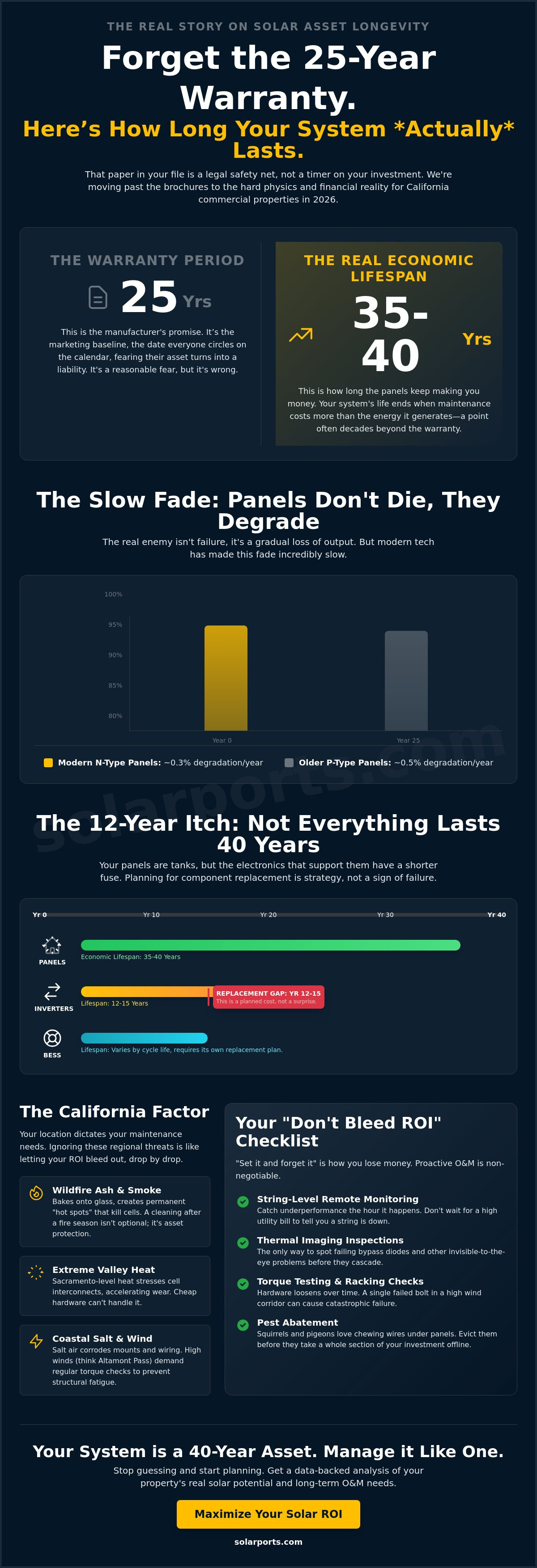
The 25-year warranty is a legal safety net, not a timer. Most CFOs assume the asset expires the moment the warranty does, but that isn't how the physics of Solar panel technology works in the field. In reality, the commercial solar system lifespan California property owners experience often stretches to 35 or 40 years. The real question isn't whether the panels still work; it's whether they're still profitable. You're looking for the point where production degradation meets rising utility costs.
As of 2026, Tier 1 N-type modules have pushed median degradation rates down to roughly 0.3% per year. While older P-type panels might lose half a percent annually, these newer assets are hitting year 25 with over 90% of their original nameplate capacity. When you factor in Northern California's 2026 utility rates, which often exceed $0.40 per kWh in peak periods, a panel producing at 90% efficiency is still a massive hedge against grid volatility. We often see this in a commercial property energy cost saving analysis; the ROI actually deepens as grid prices climb, even as hardware output slowly dips. Your economic lifespan ends when the cost of maintaining the system exceeds the value of the energy it generates, not when a piece of paper says the coverage is over.
Geography across Northern California complicates this math. A rooftop system in the Sacramento Valley faces extreme summer heat that can stress cell interconnects faster than a system in a temperate coastal zone like the San Francisco Bay. Conversely, coastal assets deal with salt air that can accelerate corrosion if the mounting hardware isn't high-grade. It's a variable curve that requires a localized perspective.
Understanding Degradation vs. Failure
Panels rarely just stop working. Total failure usually comes from a physical event, like a fallen branch or extreme hail. Most of what we call "aging" is actually Potential Induced Degradation (PID). This is a voltage-induced performance loss that happens in large-scale commercial arrays. It's a slow fade, not a sudden snap, and it's why string-level monitoring is non-negotiable for protecting your ROI.
The California Factor: Wildfires and Particulate Matter
Smoke and ash are the new variables in the commercial solar system lifespan California owners must manage. During major fire seasons in the North Bay or Sierra Foothills, ash doesn't just block the sun; it creates permanent "hot spots" if it's left to bake on the glass. Ignoring a cleaning cycle after a heavy smoke event can lead to localized cell overheating, which permanently lowers the ceiling of your system's output. It's a maintenance cost that pays for itself by preventing premature hardware retirement.
The 2026 Commercial Solar Performance & Maintenance Checklist
Most property owners think maintenance is just spraying panels with a hose once a year. It isn't. If you take a "set it and forget it" approach, you're essentially letting your ROI bleed out through invisible inefficiencies. Protecting the commercial solar system lifespan California assets require means moving to a proactive model. You need remote monitoring that looks at performance at the string level. If one string is down, you're losing money every hour the sun is up. This is where commercial solar project management CA experts earn their keep by catching these drops before they show up as a massive utility bill.
You also have to budget for the inevitable hardware cycles. Inverters are the workhorses of the system, and they usually tap out between year 12 and 15. It’s a known fiscal milestone. If you haven't set aside capital for this replacement, your 25-year plan is going to hit a wall. While an NREL analysis of photovoltaic degradation rates confirms that the panels themselves are incredibly durable, the power electronics around them have a shorter fuse. Planning for this mid-life refresh is the difference between a high-performing asset and a rooftop liability.
Quarterly and Annual Technical Inspections
Don't just look at the panels from the ground. You need thermal imaging to find bypass diode failures that aren't visible to the naked eye. In high-wind corridors like the Altamont Pass or the San Joaquin Delta, torque testing racking bolts is mandatory to prevent structural fatigue. Also, don't underestimate pests. Squirrels and pigeons love the shade of a rooftop array, and one chewed wire can take down an entire section of your investment.
Cleaning and Environmental Care
The "Soiling Loss" calculation is simple math. In the Central Valley, dust can cut production by 15% in a single month. If the cost of a professional cleaning is lower than the value of that lost power, you pull the trigger. For larger sites, automated robotic cleaning might make sense, but for most mid-sized properties, a manual crew is still the standard. If you're unsure where your system stands, you might want to schedule a performance review to see if your current output matches the model.
Beyond the Panels: Managing Inverter and BESS Lifecycles
If you only focus on the glass, you're missing the parts of the system that actually do the heavy lifting. The real friction in the commercial solar system lifespan California operators deal with comes from the inverters and the battery stacks. We call it the "Inverter Gap." While your panels are coasting through their second decade, your inverters will likely need a full replacement between years 12 and 15. It's just the nature of power electronics. Understanding Solar-plus-storage system basics helps you see that these components are high-wear items, not permanent fixtures like the racking they sit on.
Batteries are even more nuanced. You don't measure a Battery Energy Storage System (BESS) in years; you measure it in cycles. If you're aggressive with peak shaving to dodge high demand charges from PG&E or SCE, you'll burn through those cycles faster. It's a direct trade-off between immediate operational savings and long-term hardware health. For a deeper dive into specific equipment, check out our BESS solutions for commercial real estate guide to see how different chemistries hold up over a decade of use.
Optimizing BESS for Longevity
Depth of Discharge (DoD) is the primary lever for protecting your battery investment. If you drain your cells to zero every night, you're shortening the asset's life. Keeping that discharge within a managed window can add years to the usable capacity. Then there's the heat. Sacramento summers or heatwaves in the Central Valley can cook a battery rack if the thermal management isn't robust. It’s about protecting the chemistry from the environment to ensure the capacity doesn't fall off a cliff in year eight.
The SolarPorts Development Approach to Asset Longevity
Our commercial energy cost saving analysis doesn't just look at the honeymoon phase of year one. SolarPorts Development models a 30-year horizon that accounts for these inevitable hardware swaps and the shifting rules of NEM 3.0. We right-size the system from the start to ensure the asset remains a fiscal win even as cells degrade. You can view our commercial projects to see how we build for the long-term horizon rather than just the next few quarters.
Securing Your 30-Year Energy Strategy
The math is clear: your system isn't a "set it and forget it" appliance. We've looked at why the 25-year warranty is just a baseline and how proactive O&M prevents your ROI from slipping away. A successful commercial solar system lifespan California project depends on anticipating the "Inverter Gap" and managing BESS cycles with precision. If you treat these assets like the high-performance financial tools they are, the economic life of your array will likely outlast your original projections.
We provide California-specific commercial expertise and data-driven ROI modeling that looks past the initial install to the 20-year horizon. Whether you're integrating a turnkey BESS or a solar carport, the goal is always a streamlined, turnkey solution to a complex financial burden. You don't have to guess about your system's health or its future costs. We can help you map out exactly how your hardware will perform as utility rates continue to climb.
Take the first step toward a verified asset strategy. Request a Professional Energy Cost Saving Analysis to see the real numbers behind your property's potential. It's time to stop worrying about degradation and start focusing on long-term fiscal certainty.
Frequently Asked Questions
How long do commercial solar panels last in California?
Modern commercial panels are built to remain operational for 30 to 40 years. While most manufacturers offer a 25-year production warranty, the hardware doesn't simply stop functioning when that date hits. In the California market, high utility rates often make panels profitable even when they're operating at 80% of their original capacity. The real lifespan is determined by the asset's ongoing ability to hedge against grid costs.
Do solar panels lose efficiency over time?
Solar panels experience a median annual degradation rate between 0.3% and 0.5%. For the N-type modules standard in 2026, this means you can expect roughly 90% of original nameplate output after 25 years of service. It's a slow, predictable decline in efficiency rather than a sudden drop. This gradual fade is a core component of any accurate long-term fiscal ROI model for commercial real estate.
What is the most common cause of commercial solar system failure?
The inverter is the most frequent point of failure in any commercial array. Unlike the panels, inverters are complex power electronics that handle high-voltage DC-to-AC conversion under significant thermal stress. You should plan for a full inverter replacement between year 12 and 15. Treating this as a scheduled lifecycle event rather than a surprise failure is the key to maintaining a consistent energy cost saving analysis.
How often should commercial solar panels be cleaned in Northern California?
A bi-annual cleaning schedule is usually the baseline for Northern California properties. However, fire seasons change the math. Wildfire ash is far more obstructive than standard dust and can cause permanent cell damage if it's allowed to bake onto the glass during a heatwave. If your property is near agricultural zones or heavy traffic corridors, you may need a quarterly cleaning to prevent significant soiling losses.
Will my commercial solar system still work after 25 years?
Yes, your system will likely produce significant power well beyond the 25-year mark. The commercial solar system lifespan California owners see in the field is often 35 years or more. While the warranty expires, the physics of the silicon doesn't just stop. You'll just need to ensure the balance-of-system components, like inverters and racking, have been maintained or replaced to keep the energy flowing into your building.
Does wildfire smoke permanently damage solar panels?
Smoke itself doesn't cause permanent damage, but the accumulated ash and particulate matter can. Ash creates "hot spots" by unevenly shading cells, which leads to localized overheating and accelerated degradation. If you don't clean the panels promptly after a major fire event, these hot spots can permanently lower the efficiency ceiling of the module. Proactive maintenance after smoke events is a mandatory cost of doing business in California.


