Why are you still letting a utility company dictate your operational margins during the most critical weeks of the year? With Sonoma County electricity costs averaging 42¢ per kilowatt-hour as of July 2026, it's clear the old way of managing power is broken. You know the frustration of watching peak-demand charges skyrocket during crush season while PG&E substation constraints limit your ability to push power back to the grid. Achieving real energy cost reduction for wineries Sonoma County requires more than just slapping a few panels on a roof; it demands a calculated shift in how you treat energy as a financial asset.
We agree that relying on utility generosity is a losing strategy in the current NEM 3.0 landscape. It's an expensive gamble that rarely pays off. This guide provides the exact sequence to audit your facility's waste, bypass restrictive export caps, and implement high-ROI solar and battery storage solutions. We're moving past the marketing fluff to look at a storage-first logic that ensures your refrigeration and production lines keep running without the fiscal drain of the standard grid.
Key Takeaways
- Stop obsessing over the total utility bill; the real hemorrhage is in the peak demand charges triggered during crush season.
- Learn how to use Battery Energy Storage Systems (BESS) to "shave the peak" and keep your refrigeration running without hitting PG&E’s highest price tiers.
- Discover the technical workaround for PG&E export caps, using limited export control strategies to ensure your energy cost reduction for wineries Sonoma County doesn't get stalled by grid red tape.
- Secure a clear path to ROI by stacking the 2026 commercial solar tax credit with local incentives like the Sonoma County Energy Independence Program (SCEIP).
Step 1: Auditing the Invisible—Why Your Winery’s Bill is Bleeding Cash
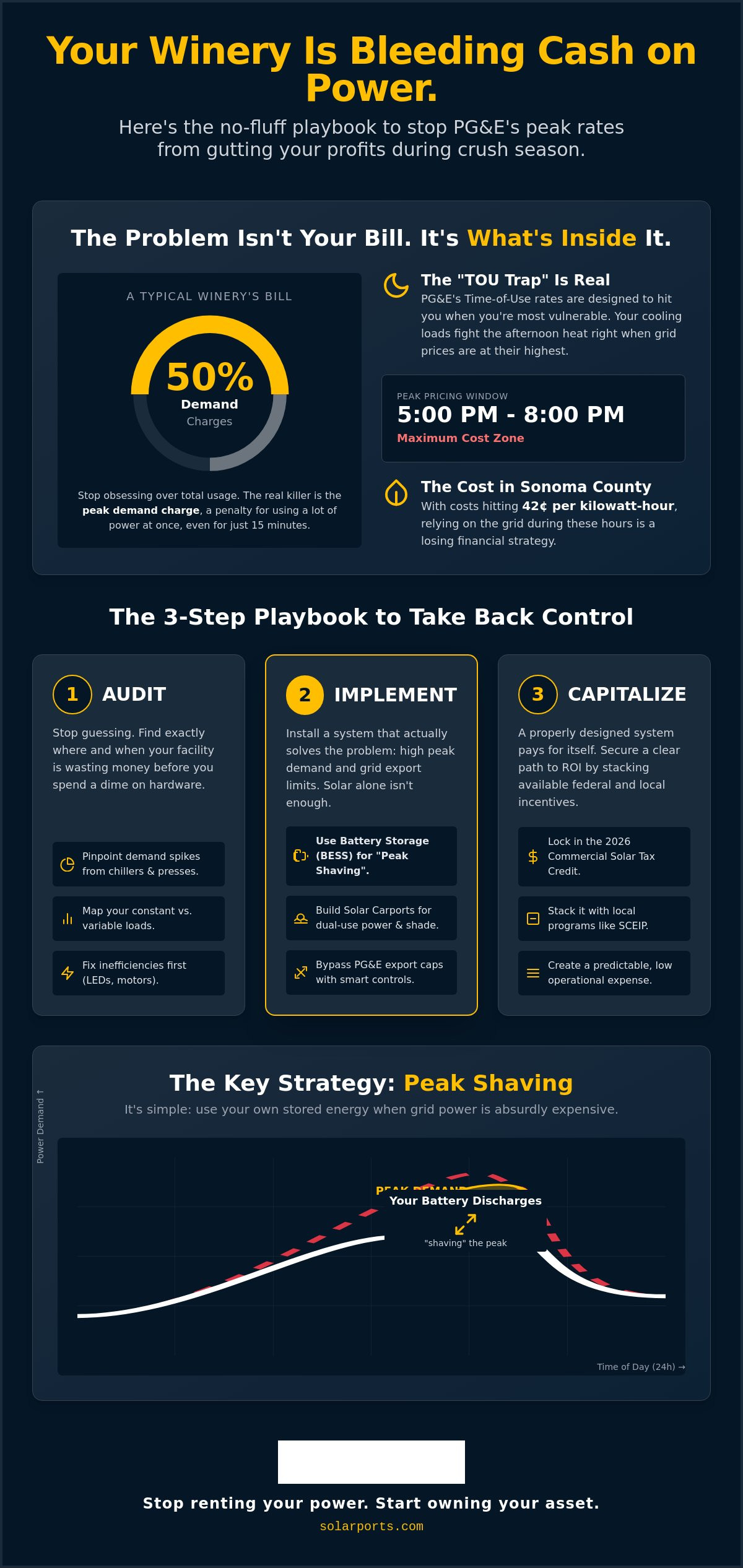
Stop looking at the bottom line of your PG&E statement. It's a distraction. If you want to see where you're actually losing money, you have to look at the fine print of your demand charges, specifically during the crush season. Most efforts for energy cost reduction for wineries Sonoma County fail because they treat electricity like a flat commodity. It isn't. When your chillers, presses, and bottling lines all fire up simultaneously, you aren't just paying for the power you use; you're paying a massive structural premium for the "peak" capacity you've demanded from the grid.
The "TOU Trap" is real and it's expensive. PG&E’s peak rates, particularly under Schedule AG-5, often hit their highest points between 5:00 PM and 8:00 PM. This is exactly when your cooling loads are struggling against the day's residual heat. Without a clear view of your interval data, you're essentially flying blind. You need to see exactly when those compressors create spikes that the utility uses to benchmark your entire month's billing. Identifying these moments is the first step toward a professional commercial energy cost saving analysis that actually moves the needle.
The "Thinking Fix" for Demand Charges
Think of electricity not as a volume of water, but as the size of the pipe required to deliver it. If you turn on every piece of heavy equipment at once for just 15 minutes, you've forced the utility to provide a massive "pipe" for your facility. They'll charge you for that capacity for the rest of the month, even if your average usage is low. This demand fee can easily dictate 50% of your bill. Applying the principles of energy conservation here means learning to stagger your starts and decouple heavy loads from the utility's most expensive windows.
Mapping Your Operational Load
You have to differentiate between constant drains and intermittent spikes. Cold storage is a persistent baseline, while tasting room HVAC and bottling lines are variable. Before you invest in heavy hardware, look for the low-hanging fruit. LED retrofits and high-efficiency motors are simple fixes that lower your baseline. This ensures that when you finally size a solar or storage system, you aren't paying to power an inefficient operation. You're building for a lean, optimized facility that maximizes every dollar of ROI.
Step 2: The Solar-Storage Playbook—Fighting Export Caps and Peak Rates
The days of oversized solar arrays and unlimited net metering are over. Today, energy cost reduction for wineries Sonoma County depends entirely on your ability to manage PG&E’s increasingly rigid export caps. If you try to push too much power back to the grid, you'll hit the common 980-kW AC limit that stalls many large-scale projects. This is where limited export control strategies and SEL-751 relays become essential. These tools allow your system to modulate output in real time, ensuring you stay within utility constraints while still maximizing your onsite generation.
Implementing a Battery Energy Storage System (BESS) isn't a luxury; it's a financial necessity for peak shaving. By storing excess solar power during the day and discharging it when PG&E’s rates spike, you bypass the TOU trap mentioned earlier. You can see how this works in practice by reviewing a winery energy efficiency case study, where integrated systems transformed operational overhead. It's about keeping your money in your facility rather than donating it to the utility.
Solving the PG&E Substation Headache
Substation constraints in Sonoma mean the grid often can't handle your midday solar surplus. Batteries solve this by acting as a buffer. You keep generating power even when the grid won't take it, storing that value for use when your compressors are working overtime. It's about right-sizing the hardware so you aren't paying for panels that have to be throttled by the utility's red tape.
Aesthetic Energy: Why Carports Beat Rooftops for Wineries
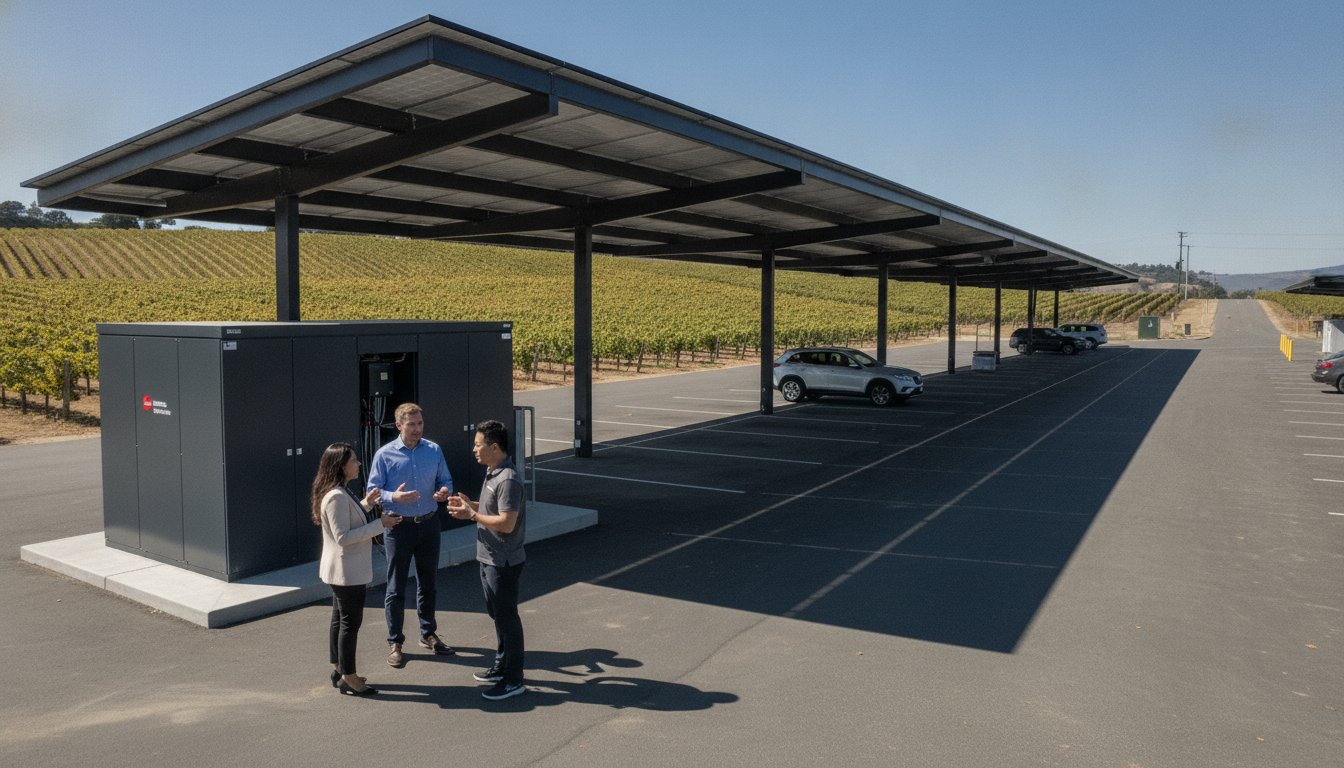
Rooftop solar on an old barrel room is often a structural liability. It traps heat and complicates roof maintenance. Solar carports, however, turn your parking lot into a powerhouse. They provide shaded parking for guests while keeping the generation near high-load areas like tasting room HVAC units. If you're weighing the options, look at the benefits of commercial solar carports California to see how they integrate EV charging into the mix.
If you're ready to see how these constraints affect your specific site, book a technical review to map out your capacity.
Step 3: Securing the ROI—Financing Your Transition Without the Fluff
Energy projects aren't just about sustainability; they're about fiscal survival. In a market where utility rates are volatile, achieving energy cost reduction for wineries Sonoma County requires a cold, analytical look at the capital stack. You shouldn't view solar or storage as a 25-year slow burn. Instead, focus on the 5 to 7 year payback window where the project pays for itself through avoided utility costs and aggressive tax positioning. If the math doesn't work in that timeframe, the system isn't designed correctly.
The smartest move right now is stacking the 2026 commercial solar tax credit with immediate local incentives. Don't ignore MACRS depreciation. It's often the hidden hero of the ROI calculation, allowing you to write off a significant portion of the asset value in the first year. When combined with the federal credit, you're often looking at a 50% or greater reduction in the effective net cost of the system before the first kilowatt is even generated.
Navigating Sonoma-Specific Rebates
Sonoma County offers unique levers, specifically the Sonoma County Energy Independence Program (SCEIP). This allows for property-assessed financing that stays with the land, preserving your operational credit lines for things like barrel programs or vineyard expansion. Under the NEM 3.0/NBT reality, the logic has shifted from selling power back to the grid to "avoided cost." Every kilowatt-hour you generate and store for your own bottling line is a kilowatt-hour you aren't buying at PG&E's 42¢ retail rate.
The CFO’s Reality Check
A professional commercial solar ROI analysis for a winery must account for a 15% annual energy inflation rate to be accurate. When you're looking at the "buy vs. lease" debate, remember that ownership allows you to capture all the tax benefits and depreciation that a lessor would otherwise keep. Ownership turns a monthly liability into a fixed, predictable asset that protects your bottom line from the next utility rate hike.
Executing Your 2026 Energy Strategy
The window for reactive energy management has closed. With Sonoma County rates sitting at 42¢ per kWh, your winery’s profitability depends on a proactive, data-driven approach to infrastructure. You've seen how auditing peak demand and bypassing PG&E’s export caps with BESS and carports changes the financial equation. It isn't just about "going green." It's about securing a predictable cost structure through a strategic energy cost reduction for wineries Sonoma County plan that actually accounts for the 2026 fiscal reality.
We specialize in navigating the granular substation constraints and ROI modeling that generalist vendors often miss. Our turnkey solutions are designed to maximize the 2026 commercial solar tax credit and local incentives like SCEIP, ensuring your capital is protected. Don't let another crush season drain your margins with avoidable utility spikes. We're here to help you move from a utility liability to an owned energy asset.
Request a custom energy cost saving analysis for your winery to see the numbers for your specific facility. It’s time to take control of your energy future and stabilize your operational bottom line.
Frequently Asked Questions
Is solar worth it for wineries under PG&E’s NEM 3.0 (NBT) rules?
Solar is absolutely worth the investment, but the strategy has shifted from selling power back to the grid to maximizing onsite consumption. Under NEM 3.0, the value of exported energy has dropped significantly, which means you need to prioritize energy cost reduction for wineries Sonoma County by using batteries to store your midday surplus. This allows you to avoid buying power during the expensive evening peak hours when utility rates hit their highest tiers. It's about self-generation and self-consumption rather than relying on utility credits.
How much space does a solar carport actually require for a typical tasting room?
Space requirements depend entirely on your annual load and available parking footprint. A typical tasting room might require enough coverage for 15 to 25 parking stalls to make a meaningful dent in HVAC and lighting costs. These structures are designed to fit over your existing asphalt, so you aren't sacrificing usable land. You're simply turning a passive asset like a parking lot into a functional power plant that also improves the guest experience by providing shade during hot Sonoma afternoons.
Can battery storage completely eliminate demand charges during crush season?
Battery storage can drastically reduce demand charges, though "completely eliminate" is a high bar when your presses and chillers are running at full capacity. By using a BESS to "shave the peak," you discharge power during your highest usage windows to prevent those 15-minute spikes from setting your monthly bill. It’s a calculated effort to flatten your load profile. This keeps you in a lower, more predictable billing tier regardless of the temporary intensity of your production schedule.
What happens if my winery is in a PG&E area with a strict export cap?
If you're facing a strict export cap, we implement limited export control strategies using specialized hardware like SEL-751 relays. These systems monitor your facility's real-time consumption and throttle the solar output so nothing flows back to the grid beyond the utility's allowed limit. This setup ensures you can still install a large enough array to power your cold storage and bottling lines without getting rejected by PG&E due to substation constraints or grid instability. You get the power you need without the grid export headache.


