
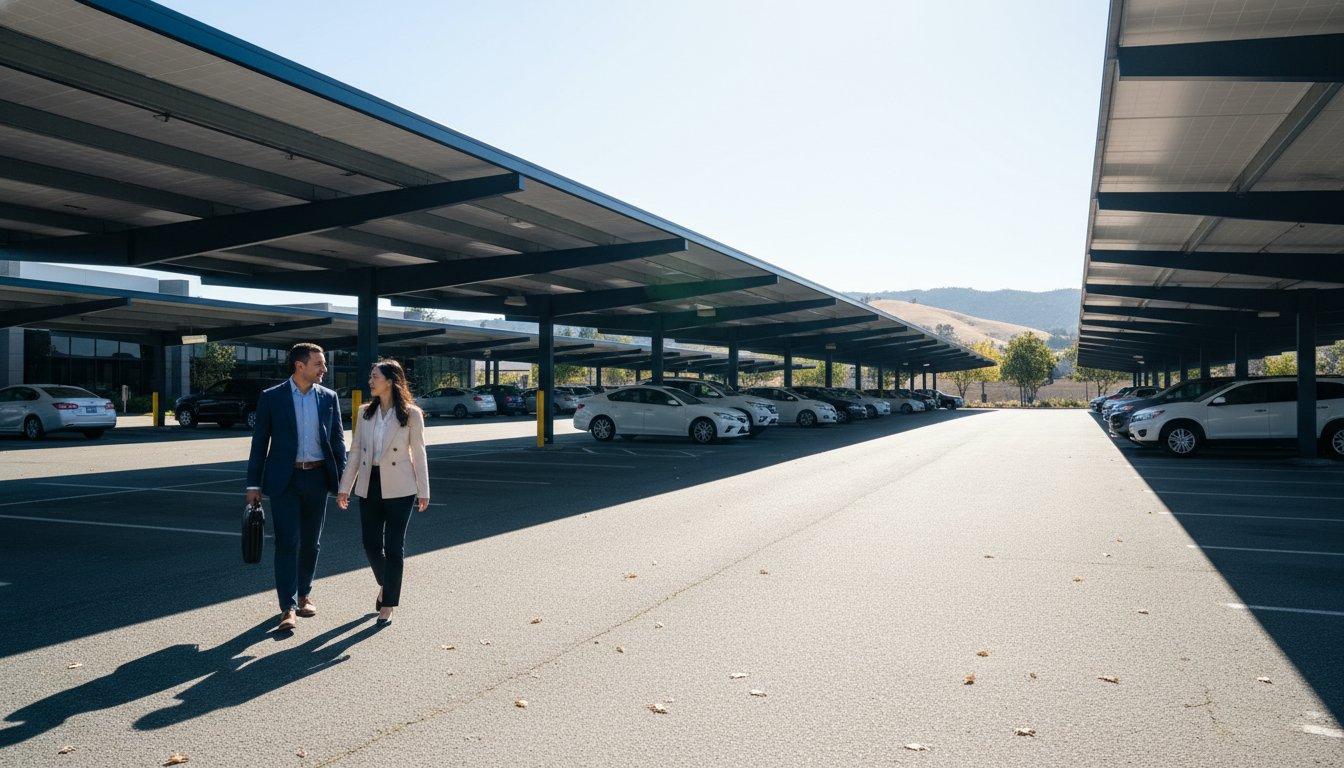
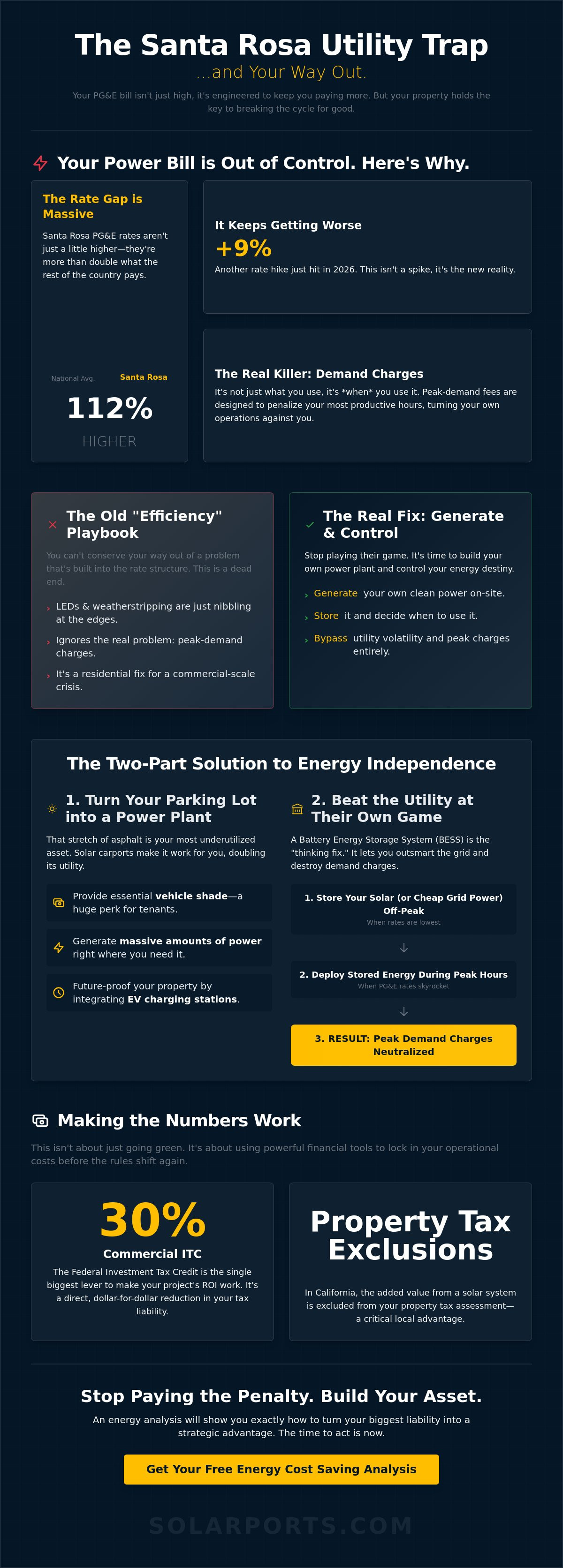
PG&E rates in Santa Rosa are sitting at 112% higher than the national average; that is a hard pill to swallow when your 2026 bills just jumped another 9%. Most property owners realize that basic efficiency isn't enough to stop the bleeding, especially when peak-demand charges are designed to penalize your most productive hours. You want real energy savings Santa Rosa, but the utility trap makes it feel like you're running on a treadmill that keeps getting faster. It’s exhausting to watch underutilized parking lots bake in the heat while your overhead climbs toward an average of 42¢/kWh.
I’m going to show you how to break that cycle by treating your property like a strategic energy asset instead of a liability. We’ll look at how BESS and solar carport infrastructure can shave those peak charges and bypass utility volatility entirely. This isn't about going green for the sake of it; it's about using the 30% commercial ITC and current property tax exclusions to lock in operational certainty before the rules shift again at the end of the year. Let's get into the mechanics of building a system that actually pays for itself.
Key Takeaways
- Efficiency upgrades like LEDs aren't enough. You need a commercial energy cost saving analysis to find where your money is actually leaking.
- Turn your parking lot into a productive asset. Solar carports shade vehicles and generate power at the same time, basically making your asphalt work for you.
- Use BESS to beat the utility clock. Storing energy when rates are low and using it during peak hours is the only way to stop letting PG&E dictate your overhead.
- True energy savings Santa Rosa won't come from just cutting back. It requires investing in infrastructure that lets you control your own power supply.
- Maximize your project’s financial viability before the rules change. Utilizing the 2026 commercial solar tax credit in California is how you make the numbers work.
The Santa Rosa Utility Trap: Why Rebates Aren’t Enough
Santa Rosa businesses are currently facing some of the highest peak-demand charges in California. It’s a localized financial crisis that a few free LED bulbs or a smart thermostat won't fix. While residential programs focus on small-scale conservation, a professional commercial energy cost saving analysis usually reveals that simple efficiency only scratches the surface of a modern operational budget. Demand charges are the primary driver of commercial utility bills in Northern California, functioning as a heavy fee based on the highest volume of electricity your property pulls from the grid in any single 15-minute window. It’s not just about the total volume of energy you consume; it’s about the specific timing of that consumption. If your facility spikes during the afternoon heat, you're paying a massive premium that no amount of weatherstripping can offset.
The Failure of Small-Scale Efficiency
Small "energy savings boxes" or residential-style rebates are designed for homes, not for warehouses, retail centers, or medical offices. You can't conserve your way out of a high-demand tariff. The returns on weatherproofing diminish quickly once your lighting is updated, leaving the bulk of your bill untouched. The real gains come from shifting the source of your power through generation. Understanding the fundamentals of Solar power technology is the first step in moving from a passive utility customer to an active energy producer. In a commercial environment, generation beats conservation every time because it attacks the source of the cost rather than just nibbling at the edges of usage.
The 2026 PG&E Rate Reality
The local utility landscape in Santa Rosa has become increasingly hostile to predictable overhead. PG&E implemented another 6-9% rate increase in 2026, continuing a trend that has seen cumulative rises of over 20% in the last few years. This isn't a temporary spike. It’s a structural shift in how power is priced. Waiting to implement a strategic response is essentially a hidden tax on your bottom line that compounds every month. To find actual energy savings Santa Rosa property owners have to stop looking for minor rebates and start looking at infrastructure that bypasses the grid’s volatility entirely.
Strategic Infrastructure: Solar Carports and BESS
Your parking lot is likely your most underutilized asset. Right now, it's just a stretch of asphalt absorbing heat and doing nothing for your bottom line. Strategic infrastructure like solar carports changes that by doubling the utility of your existing footprint. These structures provide essential shade for vehicles, which is a major tenant retention perk in the Santa Rosa sun, while simultaneously generating the power needed to drive down operational costs. When you integrate these with EV charging stations, you're not just saving money; you're future-proofing the property against the inevitable shift in tenant demand. Finding commercial solar companies California that specialize in these turnkey installations is vital for a smooth rollout. You don't want a generic solar installer. You need a partner that treats energy as a financial instrument.
Monetizing Your Parking Lot
Shading cars isn't just a courtesy. It’s a competitive advantage that keeps your occupancy rates high. By reducing the heat island effect on your property, you actually lower the cooling load for adjacent buildings. This creates a ripple effect of efficiency that contributes to long-term energy savings Santa Rosa property owners often overlook. It’s about turning a maintenance headache into a revenue-generating canopy.
BESS: The Financial Architect of Energy
Battery Energy Storage Systems (BESS) are the real "thinking fix" for your utility bills. As I mentioned earlier regarding demand charges, the goal isn't just to produce power, but to control when you use it. BESS allows you to store cheap, off-peak electricity and deploy it when PG&E’s rates are at their highest. It’s a "set and forget" solution for property managers who don't have time to micromanage their meters. When you factor in Federal financing and incentives, the ROI on these systems becomes much clearer. If you're ready to see how this fits your specific site, you might want to schedule a detailed infrastructure review to run the numbers.
The ROI Reality: Financing and Local Implementation
Leveraging the 2026 commercial solar tax credit in California is the difference between a project that barely breaks even and one that transforms your balance sheet. The 30% Investment Tax Credit (ITC) remains the primary engine for project viability, but it works best when combined with the state's property tax exclusion for solar value, which is currently set to expire after 2026. This creates a narrow window for execution. Reviewing our previous projects across Northern California shows that realistic payback periods are shrinking as utility rates climb, but those numbers only hold if you capture the incentives before they sunset. Maximized federal credits and accelerating local rate hikes make 2026 the definitive year for Santa Rosa energy investments.
Navigating the Santa Rosa Permitting Maze
Permitting in Sonoma County is notoriously complex, and trying to DIY the process is a recipe for expensive delays. You need a partner who understands commercial solar project management CA to handle the specific quirks of local building departments and fire marshals. For small-scale commercial installations, we typically see timelines ranging from four to eight months from initial design to final interconnection. Turnkey solutions are essential here because they remove the operational burden from the property owner, ensuring that technical hurdles don't stall your ROI.
Financing Strategies for CFOs
While the commercial SCEIP program still offers a fixed rate of 7.99%, many entities are finding better terms through private financing or Power Purchase Agreements (PPAs). The most critical metric for any CFO isn't just the upfront cost, but the "Cost of Inaction." If you're currently paying the Santa Rosa average of 42¢/kWh, every month of delay is essentially a voluntary overpayment to the utility. True energy savings Santa Rosa are found by locking in your power costs now, effectively hedging against the 6-9% annual increases that have become the new baseline for PG&E customers. Sticking with the status quo is no longer the "safe" financial bet; it's a guaranteed recurring loss.
Securing Your Operational Infrastructure
PG&E isn't going to solve your overhead problems for you. The 2026 rate hikes are a clear signal that the status quo is a losing strategy. We've established that real energy savings Santa Rosa property owners can bank on come from aggressive infrastructure moves, not just changing lightbulbs. By combining solar carports with specialized BESS, you're effectively taking control of your demand charges and turning a liability into a high-yield asset.
Our approach is built on data-driven ROI modeling and turnkey California-specific expertise. We specialize in small-scale commercial BESS projects because that's where the most immediate financial relief is found for property managers. You don't need a vendor; you need a strategic partner who understands the unfiltered reality of getting these projects through the local permitting maze. If you're tired of watching your margins evaporate into the grid, it's time to request a commercial energy cost saving analysis. Let's look at the actual numbers for your site and build a roadmap that makes sense for your bottom line. You've got the tools to fix this.
Common Questions Regarding Commercial Energy Strategy
How much can a typical Santa Rosa commercial property save with BESS?
BESS savings are primarily found by shaving the 30% to 50% of your bill that comes from demand charges. Since Santa Rosa has some of the highest peak rates in the state, the ability to cap those 15-minute spikes is your biggest lever. It isn't just about total usage; it's about making sure your meter never crosses into those expensive penalty tiers that drive up overhead.
Do solar carports require a lot of maintenance in Northern California?
Commercial carports are rugged, passive structures that require minimal upkeep beyond an occasional cleaning and basic electrical inspection. They're built to handle the specific climate of Sonoma County without the mechanical failures you might see in more complex systems. Most property owners find that the tenant shade benefits and energy production far outweigh the negligible cost of a bi-annual checkup.
What is the current payback period for commercial solar in Santa Rosa for 2026?
Most commercial projects in 2026 reach a full payback in four to seven years, depending on the specific configuration and tax strategy. This timeline is shrinking as PG&E rates continue to climb by 6-9% annually. Achieving energy savings Santa Rosa is a long-term play, but the initial capital is recovered quickly through the combination of the 30% ITC and immediate bill reduction.
Can I install BESS without having solar panels on my roof?
Yes, standalone BESS is a highly effective way to manage demand charges even if you don't have rooftop solar. This setup allows you to engage in grid arbitrage by pulling power when it's cheap and using it when it's expensive. It’s a purely financial fix that targets the most volatile parts of your utility bill without requiring a massive rooftop footprint or structural modifications.


