
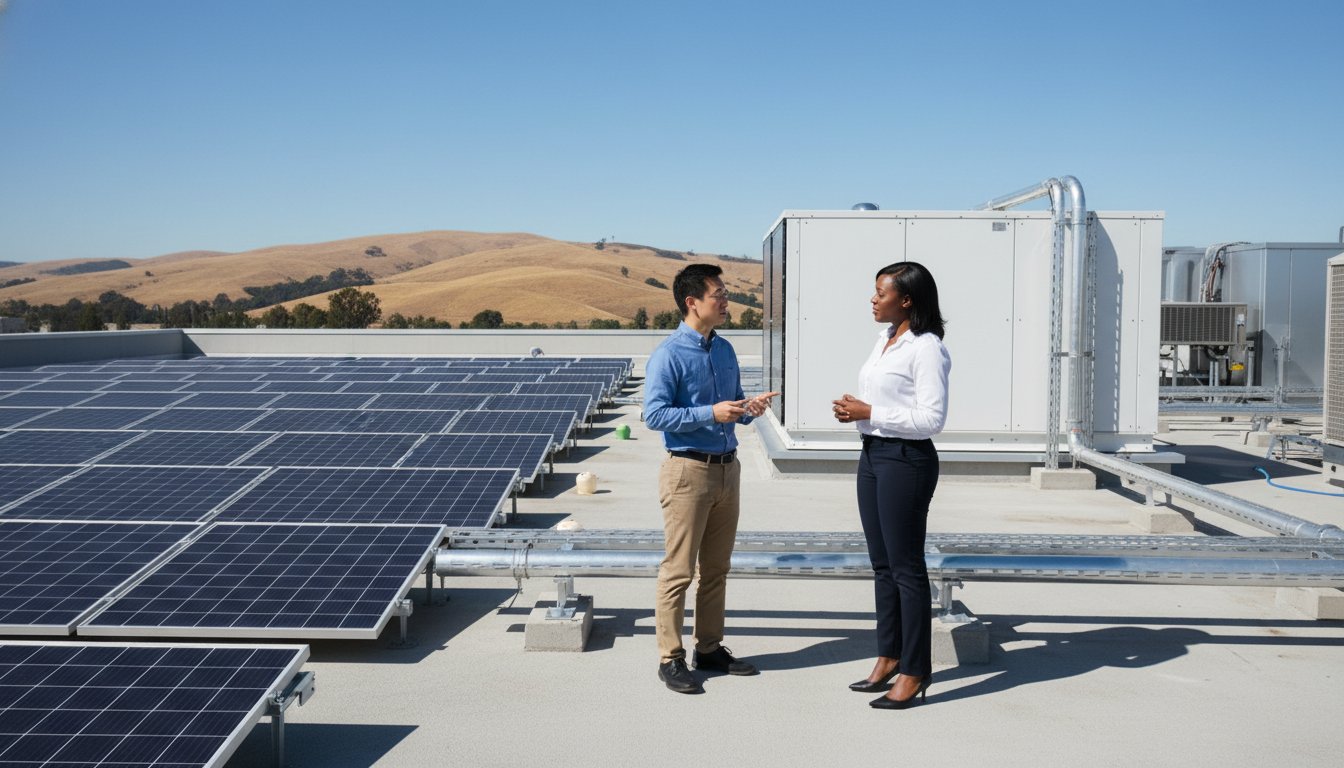
Solar is no longer just a hardware purchase. In 2026, implementing rooftop solar for office buildings CA is a strategic energy arbitrage play against a utility market that's increasingly hostile to commercial landlords. If you're looking at your current overhead and feeling the weight of opaque billing structures, you're right to be skeptical. Most owners realize the 2025 California Energy Code mandates change, yet they fear over-investing in a system that doesn't actually zero out the right costs. We've seen too many properties install oversized arrays that export power for pennies under NEM 3.0 while still getting crushed by demand charges after dark.
You need a strategy that prioritizes fiscal optimization over simple kilowatt-hour production. This guide provides a pragmatic framework to evaluate your building's specific load profile and deploy a system that moves the needle on operational expenses. We'll cover the critical July 4, 2026, deadline for the 30% Investment Tax Credit, the reality of 20% bonus depreciation, and why Battery Energy Storage Systems (BESS) are now the only way to make the math work. By the end of this analysis, you'll have a clear roadmap to predictable energy costs and increased asset value without the typical installation friction.
Key Takeaways
- Stop relying on monthly utility summaries and analyze 15-minute interval data to identify the specific demand peaks that actually drive your costs.
- Modern rooftop solar for office buildings CA only makes financial sense when paired with a BESS to shave demand charges that solar alone can't touch.
- Avoid the "oversizing trap" by modeling your post-solar load profile to ensure you aren't paying for system capacity the grid won't fairly compensate you for.
- Meet the July 4, 2026, construction deadline to secure the 30% Federal Investment Tax Credit and maximize your asset's total return.
- Verify your roof's structural integrity and remaining lifespan now; putting a 25-year energy system on a 5-year roof is an avoidable capital disaster.
Assessing Your Office Building’s Solar Readiness in the 2026 CA Market
Check your roof first. It sounds simple, but it's where most projects die a slow, expensive death. You shouldn't put a 25-year energy asset on a 5-year roof membrane. If your structural integrity is questionable or the remaining lifespan is under a decade, you're looking at a massive "remove and replace" bill long before the system pays for itself. Beyond the physical surface, we look at site-specific constraints like parapet wall heights and HVAC shading. These aren't just details; they dictate the usable square footage for rooftop solar for office buildings CA and can slash your projected yield by 20% if ignored.
The Critical Role of Commercial Energy Cost Saving Analysis
A generic quote based on your average monthly bill is a financial liability. To get the math right, you need a deep dive into your 15-minute interval data. This data reveals your building's "energy personality." A standard 9-to-5 office has a very different profile than a facility with a 24/7 server room. By conducting a rigorous commercial energy cost saving analysis, we move past the total kilowatt-hour mindset. The goal isn't just to produce power; it's to mitigate the specific, expensive peak-period draws that your utility uses to inflate your bill. If you don't know when you're hitting your peaks, you're just guessing at your ROI.
California Utility Nuances: PG&E, SCE, and SDGE
The rules of the game changed with the Net Billing Tariff (NBT). In Northern California, PG&E's rate structures are designed to penalize solar-only systems that export power during the day. The history of Solar Power in California shows a steady shift toward self-consumption. Because export rates now average between $0.05 and $0.08 per kWh, sizing a system too large without storage is a waste of capital. Your local utility provider's specific "sweet spot" for sizing depends entirely on how they price those demand windows. If you're in SCE or SDGE territory, the timing of those windows is the difference between a seven-year payback and a fifteen-year slog. It's about finding the balance where you aren't overpaying for hardware the grid won't reward you for using.

Steps to Designing a Right-Sized Rooftop System with BESS Integration
Designing rooftop solar for office buildings CA in 2026 is no longer a simple layout exercise. It's an exercise in load-shaping. You start by modeling your post-solar load profile to see what's left after the sun does its job. Solar alone shaves the midday peak, but it often leaves sharp shoulders of high demand in the early morning or late afternoon. If you don't account for these, your utility bill won't drop nearly as much as the sales brochure promised.
Choose high-efficiency modules. Office roofs are crowded. Between HVAC units and parapets, you need the highest power density possible to make the project pencil out. Smart monitoring hardware should be standard. Your property manager needs to see performance in real-time, not wait for a monthly statement to realize an inverter tripped.
Why Battery Storage is Non-Negotiable for Office Buildings
Under the current regulatory framework, which evolved from legacy programs like the California Solar Initiative, the focus has shifted entirely to self-consumption. Demand charges can easily make up 50% of an office building's electricity bill. Batteries are the only way to surgically target those 15-minute spikes. Plus, they provide a necessary buffer against the grid instability and rolling blackouts that have become a common risk in California's summers.
Coordinating with Existing Building Systems
Your solar inverters and battery controls must talk to your existing Building Management System (BMS). If they operate in silos, you'll miss the chance to automate load shedding during peak windows. It's also the time to plan for EV charging solutions for commercial real estate. Adding chargers later usually means redundant electrical upgrades and higher costs. If you want to see how these integrated systems look in practice, you can book a technical review to discuss your building's specific constraints.
Navigating the CA Regulatory and Financial Landscape for 2026
The capital recovery phase for rooftop solar for office buildings CA starts with paperwork, not hardware. If you haven't filed for interconnection yet, you're already behind. The queue is the real bottleneck. It doesn't matter how fast your contractor can mount panels if the utility takes six months to sign off on the permission to operate. You need to leverage the 30% Federal Investment Tax Credit (ITC) before the July 4, 2026, "begin construction" deadline. Pair that with the five-year MACRS schedule and the 20% bonus depreciation available for 2026 projects to front-load your tax benefits.
Northern California jurisdictions are notoriously inconsistent with permitting. The commercial solar project management CA reality involves navigating local fire codes and structural reviews that vary wildly between San Francisco, San Jose, and the Central Valley. Whether you choose direct ownership to capture the full tax appetite or a PPA to preserve capital, your financing structure must align with your long-term hold strategy for the asset.
Maximizing ROI Through Strategic Incentives
You shouldn't just look at the federal level. Stacking the commercial solar tax credit California with local utility rebates is how you collapse the payback period. However, "right-sizing" is the golden rule here. If you pay for system capacity that the grid won't credit you for under current export rules, you're just inflating your cost basis for zero marginal gain. Every extra kilowatt should have a documented purpose for on-site consumption.
Execution: From Analysis to Commissioning
The commercial solar installation timeline is rarely a straight line. Expect the unexpected during the structural reinforcement or electrical room upgrades. Proactive communication with your tenants is a core part of the engineering process. It's a "thinking fix" for project delays. If you manage expectations around crane days and roof access early, you avoid the friction that typically stalls large-scale office retrofits. Execution is about managing the bureaucracy as much as it is about managing the job site.
Executing Your 2026 Energy Strategy
The window to capture the maximum financial benefit from rooftop solar for office buildings CA is narrowing. Between the July 4, 2026, ITC construction deadline and the ongoing shift in utility rate structures, you can't afford a passive approach to energy management. Success in this market isn't about simply installing hardware. It requires a sophisticated understanding of your 15-minute load data and the integration of a Battery Energy Storage System (BESS) to actively manage demand charges.
We provide California-exclusive commercial expertise and data-driven ROI modeling to ensure your project moves the needle on operational expenses. Our focus is on turnkey BESS and solar integration that delivers professional relief, not another management burden. If you're ready to stop reacting to utility price hikes and start controlling your building's fiscal future, we're here to help you navigate the complexity.
Take the first step toward strategic energy arbitrage. Request a Professional Energy Cost Saving Analysis for Your Office Building. You have the framework; now it's time to build the solution.
Strategic Questions on California Commercial Solar
Is rooftop solar still worth it for CA office buildings under NEM 3.0/Net Billing?
It's absolutely worth it, but the financial logic has shifted from simple power generation to strategic self-consumption. Under the current Net Billing Tariff, exporting excess energy to the grid pays significantly less than it did in previous years, with rates averaging between $0.05 and $0.08 per kWh. To make rooftop solar for office buildings CA pencil out, you have to pair the array with a Battery Energy Storage System (BESS) to capture midday power and deploy it during expensive peak demand windows.
How long does the average commercial rooftop solar installation take in California?
Expect a timeline of 6 to 12 months for most commercial projects from the initial analysis to final commissioning. While the physical construction might only take a few weeks, the vast majority of that window is swallowed by the interconnection queue and local permitting hurdles. Starting your application early is the only way to secure the 30% ITC before the July 4, 2026, construction deadline. Delays usually happen at the utility level, so consistent project management is the only way to maintain momentum.
Can I install rooftop solar if my office building has a flat roof with existing HVAC units?
Flat roofs with HVAC equipment are the standard environment for commercial solar installations. We utilize ballasted mounting systems or specific attachments that navigate around existing units while maintaining the setback requirements mandated by local fire codes. The critical step is modeling the shading from those units to ensure they don't tank the efficiency of your array. If your roof membrane is near the end of its life, you should coordinate the replacement with the solar install to avoid redundant labor costs later.
What is the typical payback period for a commercial solar+storage system in 2026?
Most California office owners see a full return on investment within 5 to 8 years depending on their specific tax appetite and utility rate structure. This timeline is heavily influenced by how effectively you stack the 30% Federal ITC, MACRS depreciation, and the 20% bonus depreciation available for 2026 projects. Without integrated storage, the payback period stretches significantly longer because you're still exposed to high demand charges. Strategic sizing based on your 15-minute interval data is what keeps the ROI within a professional sweet spot.


