

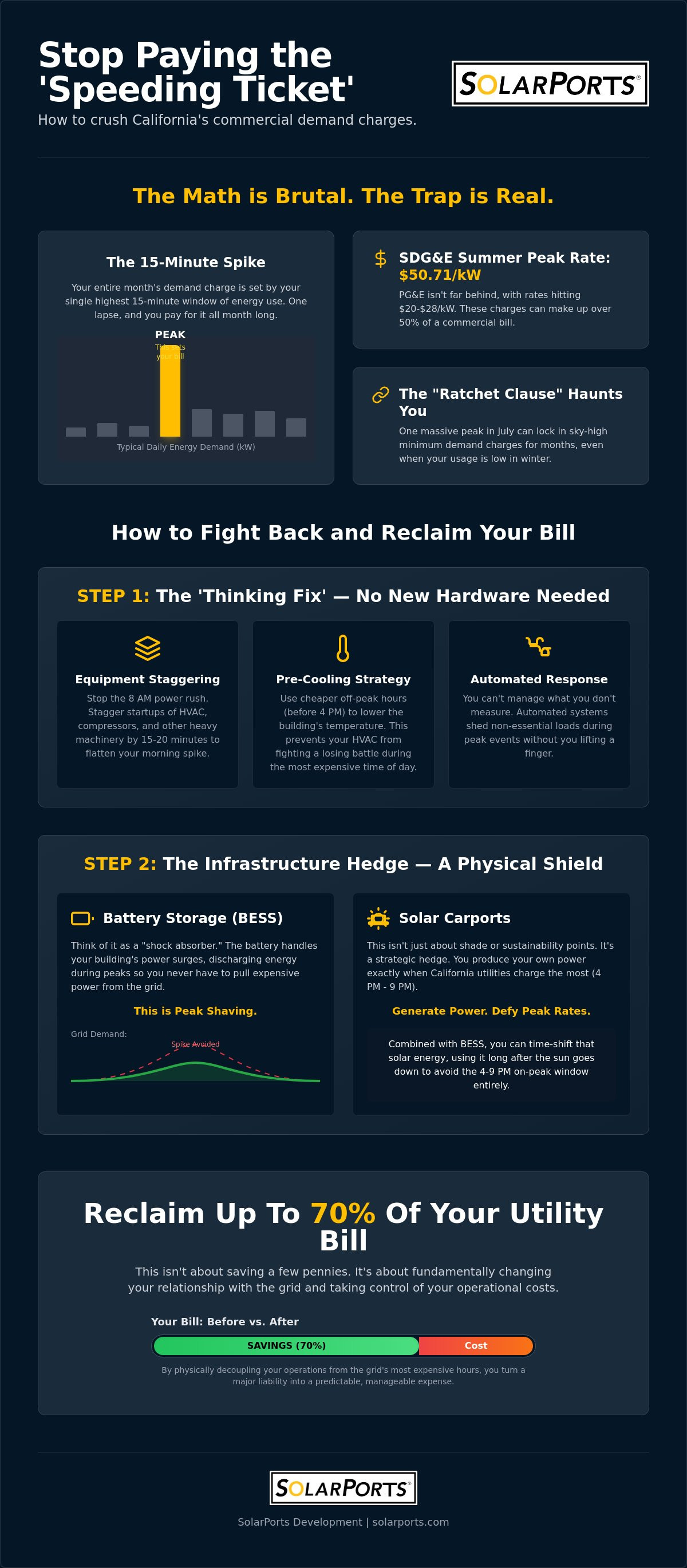
The math is brutal. In 2026, SDG&E large commercial rates have hit $50.71 per kW for summer on-peak demand. You can spend thirty days being efficient, but one 15-minute lapse in load management wipes out those gains instantly. It feels like a trap because, under current PG&E and SCE structures, it basically is. If you're tired of guessing what your overhead will look like next month, you're likely looking for how to reduce commercial electricity demand charges through actual infrastructure instead of just turning off the lights.
It's frustrating to feel penalized for the simple act of running your business. We're going to show you the specific operational shifts needed to reclaim up to 70% of your utility bill. This isn't about vague sustainability goals. It's about using Battery Energy Storage Systems (BESS) and solar carports to physically decouple your operations from the grid's most expensive hours. We'll walk through the data-backed justification for these assets and how to suppress peak spikes so your demand line item finally stops dictating your quarterly profitability.
Key Takeaways
- Your utility bill is basically a "speeding ticket" for a single 15-minute window of high usage. If you don't manage that one spike, you're paying for it all month.
- Stop turning everything on at 8:00 AM. We'll look at how simple load sequencing and HVAC staging can flatten your demand profile without spending a dime on new equipment.
- Learn the actual logistics of how to reduce commercial electricity demand charges by using BESS as a "shock absorber" that handles building surges so the grid doesn't have to.
- Infrastructure like solar carports isn't just about shade. It's a strategic hedge that lets you reclaim up to 70% of your bill by producing power exactly when California utilities charge the most.
The Math of the Spike: Why Your California Commercial Bill is 50% Demand Charges
Think of your utility bill as two separate invoices. One is for consumption, which is like the total mileage on your car. The other is for demand, which is like the highest speed you hit during the trip. You can drive 1,000 miles at 60 mph and pay a reasonable rate, but the second you hit 100 mph for just 15 minutes, the utility charges you as if you were speeding the entire month. This is the core reason why figuring out how to reduce commercial electricity demand charges is more about managing intensity than it is about saving energy.
The 15-minute trap is where most property owners lose the fight. If your HVAC system, elevators, and industrial refrigeration all kick in at the same moment, your meter records a massive spike. Even if you shut everything down five minutes later, that peak is locked in. Most electricity rate structures in California are designed to penalize these surges because the grid has to maintain enough capacity to handle them, even if you only need that power for a fraction of the day.
Understanding the Demand Ratchet Clause
The ratchet clause is the most expensive line item you've never heard of. It's a contractual ghost that haunts your bill for months. If you hit a massive peak in July because of a heatwave or a mechanical glitch, the utility "ratchets" your minimum demand charge for the next several months, often at 80% or 100% of that summer peak. You could be in the middle of a mild November, using almost no power, and still be paying for that July spike. This is why traditional efficiency like LED lighting doesn't move the needle much. You've lowered your consumption, but your "speeding ticket" remains exactly the same.
California’s 2026 Utility Landscape
In 2026, the financial pressure on California properties is hitting a breaking point. SDG&E has pushed large commercial demand charges to $50.71 per kW in the summer, while PG&E rates for B-19 plans now hover between $20 and $28 per kW. When you factor in the shift of on-peak hours to the 4:00 PM to 9:00 PM window, solar alone isn't enough to protect you. A commercial property energy cost saving analysis is usually the only way to see these overlapping charges clearly. Without a way to time-shift your load, you're essentially writing a blank check to the utility every time your building's equipment cycles on during a grid-strain event.
Operational Load Shifting: The 'Thinking Fix' for Demand Reduction
Before you spend a dime on new infrastructure, you have to look at the 'thinking fix.' Most demand spikes happen because of habit rather than operational necessity. The 8:00 AM rush is a prime example. Everyone arrives at once, the lights flip on, the HVAC cranks up to hit a morning set-point, and the elevators start cycling. That's your peak. It's a self-inflicted wound on your balance sheet that sets the tone for the entire month's bill.
The Power of Equipment Staggering
Flattening that curve starts with load sequencing. If you stagger the startup of heavy machinery, industrial compressors, or commercial refrigeration by just 15 or 20 minutes, you can drastically lower that critical 15-minute interval reading. A commercial energy cost saving analysis is the essential first step here. It allows us to map your facility's 'energy fingerprint' and identify exactly which systems are colliding to create those expensive spikes.
- Sequential Startups: Don't let your three largest motors kick in at the same second.
- Pre-cooling: Use off-peak hours to drop the building temperature before the 4:00 PM rate hike.
- Employee Culture: Train staff to avoid running high-draw equipment during the on-peak window.
Automated Demand Response (ADR)
You can't manage what you aren't measuring in real-time. If you're waiting for the utility bill to see your performance, you've already lost. Automated systems take the guesswork out of the equation by shedding non-essential loads during peak windows without human intervention. This might mean dimming non-critical lighting or slightly widening thermostat deadbands. It’s a surgical approach to how to reduce commercial electricity demand charges that prioritizes fiscal health over mindless consumption.
If you're ready to stop guessing and start measuring, you can schedule a brief call to look at your building's specific demand profile and find where the easy wins are hidden.
Infrastructure as a Hedge: Peak Shaving with BESS and Solar Carports
Operational shifts are a strong start, but they have a ceiling. You can't always ask tenants to stop using elevators or tell employees to sweat through a 4:00 PM heatwave. This is where physical infrastructure takes over. A Battery Energy Storage System (BESS) acts as a high-speed shock absorber between your building and the grid. When your load starts to climb toward a new peak, the battery discharges instantly to cover the difference. It's the most effective way how to reduce commercial electricity demand charges because it doesn't require a single person in the building to change their habits.
BESS: The Ultimate Demand Charge Killer
Modern storage systems don't just sit there; they watch your meter in millisecond intervals. If the system detects a surge that threatens to trigger a new monthly peak, it dumps stored power into your building's panel. You should look at the unfiltered reality of BESS to understand how the software manages these thresholds. BESS is a financial hedge against utility volatility. It turns a chaotic, unpredictable utility bill into a managed, predictable operating expense by physically capping your demand at a set level.
Solar Carports as Strategic Assets
Rooftops are often a mess of HVAC units and vents that make solar layout a nightmare. Parking lots are different. They're wide-open, underutilized assets that are perfect for high-density power generation. Solar carports produce energy exactly when California's 2026 rates are highest, but their real value comes from pairing them with BESS. You capture the midday sun and save it for that brutal 4:00 PM to 9:00 PM window when PG&E and SCE rates skyrocket.
Adding EV charging is usually where property owners get nervous because of the massive demand spikes chargers create. Smart infrastructure solves this. By integrating a commercial solar carport with EV charging, the battery handles the car's initial draw. The grid never even sees the car plug in. It only sees the steady, low-demand trickle used to refill the battery. This turns your parking lot from a patch of asphalt into a demand-reduction power plant that also provides backup power during a grid failure.
Reclaim Your OpEx: Turning Energy Strategy into a Competitive Advantage
The math is clear. You're either managing your demand spikes or the utility is managing your profit margins. We've covered how a single 15-minute lapse in load management can haunt your balance sheet for months; however, we've also looked at the tools available to stop the bleeding. Moving from reactive consumption to proactive demand management is the only way to gain real control over your property's overhead in this 2026 landscape.
Mastering how to reduce commercial electricity demand charges is ultimately a data problem with a hardware solution. As turnkey specialists focused exclusively on the California commercial market, we provide the rigorous, data-driven ROI projections needed to move these projects forward. It's time to turn your parking lot into a strategic asset and stop paying for peak-hour volatility. You can Request a Strategic Energy Cost Saving Analysis for Your Property to see exactly where your "speeding tickets" are coming from. Your bottom line will thank you.
Frequently Asked Questions
What is the difference between energy consumption and demand charges?
Consumption is the total volume of electricity you use over a month, measured in kilowatt-hours. Demand is the peak flow rate of that power, measured in kilowatts during your highest 15-minute window of usage. It's the difference between how much water you use to fill a tank versus how wide the pipe needs to be to fill it in five minutes. The utility charges you for the "pipe size" they have to maintain to handle your fastest surges.
Can solar panels alone reduce my demand charges in California?
Solar alone is rarely enough to solve the problem because of the shift in California's peak hours to the 4:00 PM to 9:00 PM window. By the time your building hits its highest demand, the sun is often setting and your panels are losing their output. To see real results in how to reduce commercial electricity demand charges, you usually need a way to store that midday solar energy to cover the evening ramp-up when the grid is most expensive.
How much can a Battery Energy Storage System (BESS) actually save on demand fees?
A BESS can typically reduce the demand portion of your utility bill by 20% to 40% by capping your grid pull during peak events. In specific high-intensity scenarios, especially in SDG&E territories where summer on-peak demand has hit $50.71 per kW, the savings can be even higher. The actual impact depends on your building's specific "load shape" and how many overlapping equipment cycles we can offset with stored power.
What is a 'demand ratchet' and how do I know if my utility uses one?
A demand ratchet is a clause that keeps your billing demand high based on a single historical peak, even if your current usage is much lower. If you had a massive spike last July, the utility might charge you for 80% or 100% of that peak for the next eleven months. You'll find this by looking for "Billing Demand" line items on your PG&E or SCE statement that stay suspiciously flat despite changes in your actual monthly usage.


