
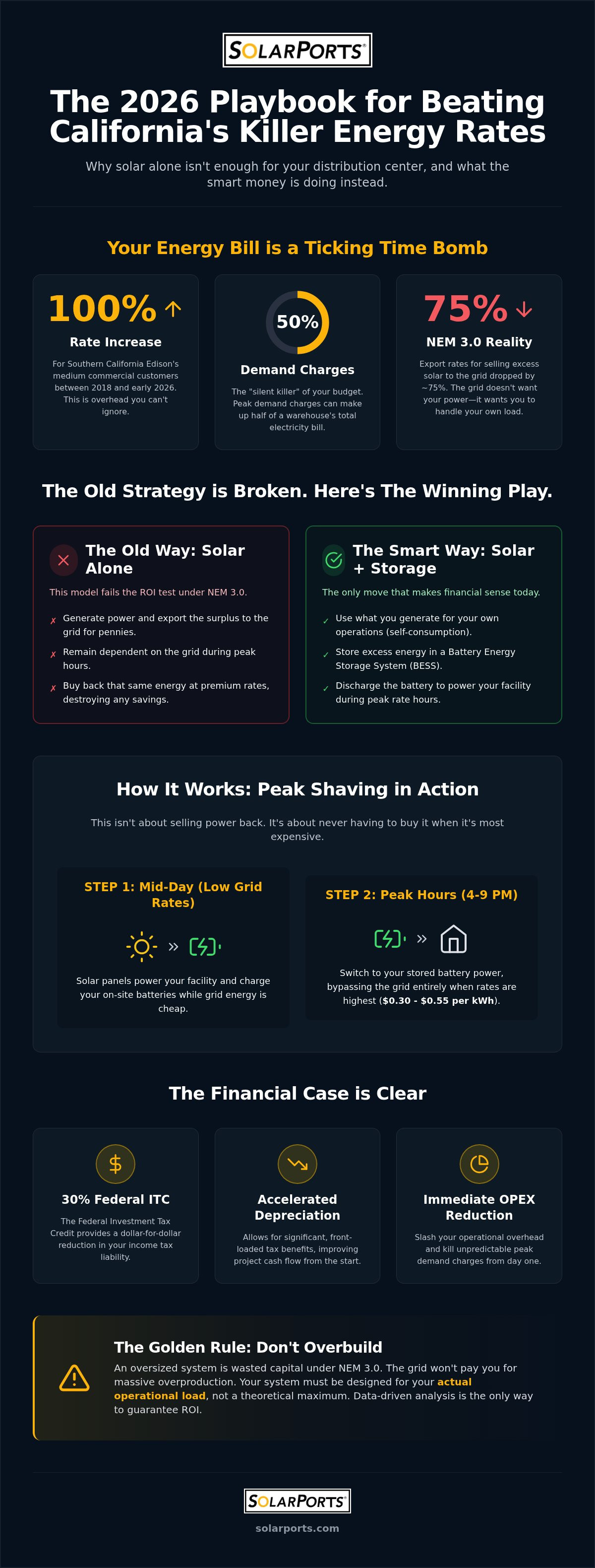
Between 2018 and early 2026, Southern California Edison rates for medium commercial customers doubled. That’s a 100% increase in overhead you can’t just pass on to clients without losing your edge. If you’re running a major facility, you already know that peak demand charges are the silent killer of your quarterly projections. Grid instability threatens your automated sorting lines and refrigeration while NEM 3.0 makes the fix feel like a moving target. You likely agree that energy costs are a variable you can't leave to chance anymore. This article explains how the business case for solar for distribution centers California has evolved into a sophisticated financial play for neutralizing demand charges. You’ll learn how to leverage battery storage to bypass peak rates and secure energy independence. We’re laying out the 2026 playbook for making your logistics operation resilient against a volatile grid.
Key Takeaways
- Stop utility demand charges from devouring half your warehouse budget by understanding how California’s 2026 rate structures actually work.
- Discover why pairing storage with solar for distribution centers California is the only move that makes financial sense under current NEM 3.0 rules.
- Shift your heaviest loads to stored power so you don't have to rely on the grid when rates are at their absolute highest.
- Move past the "bigger is better" myth by using a data-driven energy cost saving analysis to build a system that actually fits your operational footprint.
Solar for Distribution Centers in California: Managing the Logistics Energy Crisis
Logistics operations in California run on razor-thin margins. Electricity is no longer just a utility. It's a volatile, top-tier expense. It's a strategic liability. Major utilities like PG&E and SCE impose some of the nation’s highest demand charges. These fees often account for 50% of a warehouse bill. One spike in power usage during a peak window can trigger costs that haunt your balance sheet for months. This is why solar for distribution centers California has moved from a 'green' luxury to a financial necessity.
Deploying solar for distribution centers California used to be a simple calculation of offset. That’s gone. The history of Solar power in California shows a steady move toward self-sufficiency. Standalone solar often fails the ROI test today. Without a way to manage when that energy is used, you're essentially giving power away to the grid for pennies. Then you buy it back at a premium during peak hours. It doesn't make sense.
The NEM 3.0 Reality for California Logistics
The shift to NEM 3.0 in April 2023 fundamentally changed the payout. Export rates dropped by roughly 75%. The grid doesn't want your extra energy. It wants you to handle your own load. For distribution centers, this is actually an opportunity. Your facility likely has massive internal loads from automated sorting, HVAC, and refrigeration. The goal now is self-consumption. You use what you generate to neutralize high peak rates. If you want to dive deeper into specific billing tactics, look at these Strategies to Lower Commercial Electricity Bills in California. The math only works if you stop being a passive consumer and start acting like a micro-utility.
Integrating BESS and Commercial Solar for 24/7 Operational Resilience
Generation is only half the battle. If your facility has panels but no way to store that power, you're still at the mercy of the grid's pricing whims. A Battery Energy Storage System (BESS) is the actual brain of solar for distribution centers California. It allows for peak shaving. This means you charge batteries when power is cheap and discharge them when Northern California utility rates hit their $0.30 to $0.55 per kWh peak. It’s about enhancing resilience with battery storage so your sorting lines don't stall during a grid hiccup.
Rooftop space is finite. Many operators overlook the real estate sitting right in their parking lot. Solar carports act as a secondary power plant, generating kilowatt-hours without eating up valuable warehouse square footage. They protect your staff's vehicles while feeding the building's main panel. It's a dual-use strategy that turns a passive asset into a revenue-protecting machine.
Future-Proofing for Electric Fleet Charging
The push for electric delivery vans and heavy-duty trucks isn't a "maybe" anymore. It's happening. Most existing building tie-ins can't handle the massive draw of a dozen DC fast chargers. Solar carports provide the infrastructure for this shift. They let you charge fleets directly from the sun or stored battery power, bypassing the need for expensive utility transformer upgrades. You can check our Services to see how these systems tie together. If you're wondering how this fits your specific site, you might want to schedule a quick strategy call to look at the numbers.
Executing Your California Solar Strategy: From Analysis to ROI
The 2026 financial case for solar for distribution centers California rests on three specific pillars that drive the internal rate of return:
- The 30% Federal Investment Tax Credit for projects breaking ground this year.
- Accelerated depreciation allowing for significant front-loaded tax benefits.
- Immediate reduction in operational overhead and peak demand charges.
But these numbers only work if you don't overbuild. An oversized system is just wasted capital under current export rules. You need a system designed for your actual load, not a theoretical maximum that the grid won't pay you for.
Turnkey development is where the real execution happens. The hardware is the easy part. The soft costs are where projects go to die. Navigating PG&E interconnection, local fire codes, and CA-specific compliance takes specialized local expertise. While the California Solar Initiative provided the historical foundation for the state's energy shift, the current market requires much more surgical planning. You need a partner who manages the bureaucracy so your team can focus on moving freight.
The Critical Path: Energy Cost Saving Analysis
It all comes down to the data. We audit 12 to 24 months of your interval data to find the exact moments your demand spikes. These are the silent killers of your P&L. Data-driven recommendations stop you from overpaying for capacity you don't need. For an honest look at payback, consult our Commercial Solar ROI Analysis. The goal is a system that starts paying for itself on day one.
Secure Your Operational Edge for 2026
California’s energy market doesn't reward the passive. If you’re still relying on the grid for your peak hours, you’re essentially handing over a percentage of your margins to the utility every month. The shift to solar for distribution centers California is now about precision. It requires right-sizing your generation and using BESS to dictate when you pull from the grid. We bring California-exclusive expertise to handle the turnkey implementation of carports and storage, ensuring you don't overbuild for capacity you won’t use. It’s about building a data-backed hedge against volatility. You don’t have to guess where your energy budget is going anymore. We're here to help you lock in predictable overhead and keep your facility running 24/7. Request a Commercial Energy Cost Saving Analysis to see the real numbers for your site. Let’s get your logistics operation future-proofed.
Frequently Asked Questions
How much can a distribution center in California save with solar?
Savings aren't a flat number. They depend entirely on how much your utility is hitting you with demand charges during peak windows. Most Northern California facilities find that these charges make up roughly half their bill. By using an energy cost saving analysis to target those specific spikes, you can neutralize the most expensive parts of your utility overhead. It's about precision, not just adding panels.
Is solar mandatory for new commercial warehouses in California under Title 24?
Current Title 24 standards require solar and battery storage for almost all new commercial warehouses built in California. The state wants new buildings to act as their own power sources to reduce grid strain. If you're in the planning stages for a 2026 project, these systems aren't optional extras. They're foundational components of your building's compliance and long-term financial strategy.
How does the 2026 federal tax credit apply to California commercial solar projects?
The 30% Federal Investment Tax Credit is still a major driver for solar for distribution centers California projects through mid-2026. If you break ground by July 4, you lock in that base rate. There are also bonus credits available for using domestic content or locating in designated energy communities. It’s a massive upfront incentive that significantly shortens your project’s payback period.
Can solar carports be installed without disrupting distribution center traffic?
Installing solar carports shouldn't shut down your facility. We use a phased construction approach to ensure your logistics traffic and employee parking stay functional throughout the build. These structures are engineered for dual-use, turning underutilized pavement into a revenue-saving asset. You get the power generation and vehicle protection you need without the operational headache of a total site shutdown.


