

Your decade-old solar array is likely leaking capital every time the sun sets. While your initial investment was visionary, the shift to NEM 3.0 and the 100% spike in California utility rates since 2018 have fundamentally altered the ROI equation. You shouldn't be facing heavy peak demand charges when you already own a generation asset. It's a frustrating reality for many property owners who find their legacy technology can't keep pace with modern grid pricing. This 2026 guide provides the strategic framework for upgrading an existing commercial solar system to recapture that lost value. We'll explore how integrating Battery Energy Storage Systems (BESS) and strategic solar carports leverages the 30% ITC to transform underperforming hardware into a high-yield financial asset. You'll learn to move beyond simple generation toward total fiscal optimization and energy independence.
Key Takeaways
- Identify the performance gap between legacy technology and modern utility rate structures to stop capital leakage.
- Evaluate the superior ROI of integrating BESS and solar carports to mitigate peak demand charges that rooftop solar alone cannot address.
- Learn the specific financial triggers for upgrading an existing commercial solar system to maximize self-consumption under California's NEM 3.0 framework.
- Leverage the 2026 Federal Investment Tax Credit and bonus depreciation to turn energy infrastructure into a high-yield fiscal asset.
The Strategic Audit: Why Your Legacy Solar System is Leaking Capital
Your current infrastructure is likely a financial liability. While systems installed in the previous decade were optimized for a retail-rate export model, the 2026 California energy market operates on a different logic. Legacy solar panel technology often lacks the wattage density and conversion efficiency of modern high-output modules. This creates a quantifiable performance gap where your real estate produces less energy than it could while you continue to pay escalating utility rates.
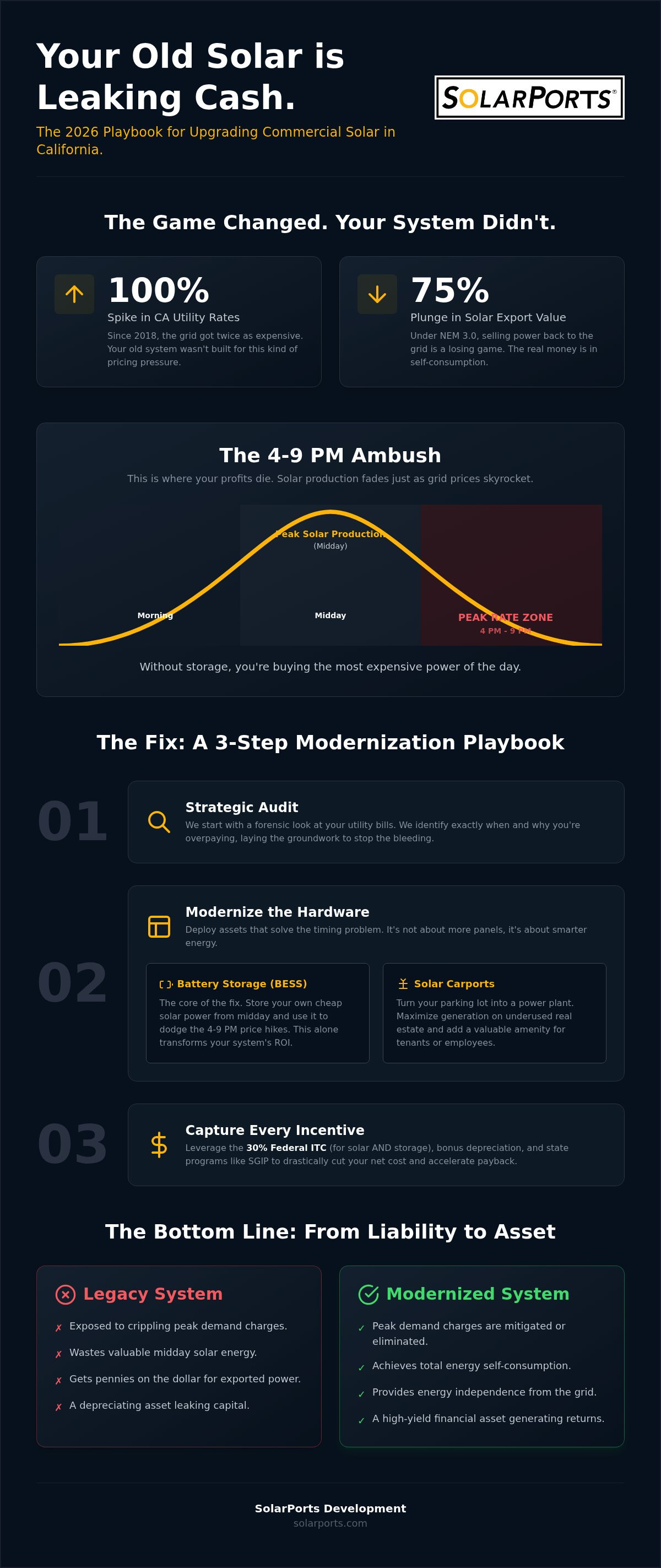
Simple net-metering systems are no longer effective. Under current tariffs, the value of exported solar energy has plummeted by approximately 75% compared to older programs. A commercial energy cost saving analysis serves as the essential baseline for any modernization effort. It moves the focus from gross generation to net fiscal impact. Upgrading an existing commercial solar system isn't always about adding more panels; it's about fixing the timing of your energy use to match peak utility pricing.
Identifying "Right-Sizing" Gaps in Existing Infrastructure
Modernization requires a forensic look at your historical utility data. You must identify exactly when demand charges spike, as these often occur when solar production is waning. Most California systems were engineered for 2018 rate structures that didn't penalize late-afternoon usage as heavily as today's market does. This lived-in perspective is critical. You aren't just managing hardware; you're managing a financial hedge that has lost its edge. We evaluate your current rooftop load capacity to determine if expansion is feasible or if your infrastructure requires a strategic shift toward storage when upgrading an existing commercial solar system.
Modernizing the Hardware: BESS and Solar Carport Integration
In 2026, a commercial solar system without BESS is like a bank vault with a hole in the floor. Upgrading an existing commercial solar system requires moving beyond simple rooftop expansion. While your roof may be near its load limit or nearing the end of its service life, underutilized parking areas offer prime real estate for solar carport systems. These structures maximize generation without structural compromises to your primary building. They provide shaded parking, creating a secondary asset for tenants and employees. Technically, you don't need to replace your entire legacy inverter stack. We utilize AC-coupling to integrate modern storage solutions with your existing setup, preserving your previous capital investments while fixing current operational leaks.
Strategic BESS Implementation for Demand Charge Mitigation
Peak shaving is the new mandate for California property owners. By storing excess midday solar for discharge during the 4 PM to 9 PM peak windows, you bypass the highest utility rates. This logic is supported by California's Self-Generation Incentive Program (SGIP), which provides critical financial offsets for storage deployment. SolarPorts manages the turnkey integration of these systems, ensuring the hardware aligns with your specific load profile. Modernization isn't just about new gear. It's about a fundamental shift in energy logic that prioritizes self-consumption over grid export. If you're ready to fix your system's inefficiencies, you can schedule a strategic energy audit to review your modernization options.
The Financial Playbook for California Solar Upgrades
Modernizing your energy infrastructure is a capital allocation decision. A comprehensive commercial solar ROI analysis is the first step in determining the viability of upgrading an existing commercial solar system. In 2026, the financial landscape remains favorable due to the 30% Federal Investment Tax Credit (ITC), which applies to both new solar generation and standalone battery storage. By capturing these credits, you significantly lower the net basis of your investment. The technical benefits of coupling solar and storage extend beyond simple backup; they provide the firming of generation required to navigate volatile avoided cost export rates.
Turnkey delivery is essential for mid-market projects. It eliminates the fragmented soft costs that typically erode the profitability of small-scale commercial endeavors. We manage the entire lifecycle, addressing the commercial solar project management complexities inherent to Northern California's regulatory environment. This integrated approach ensures that your upgrade moves from audit to interconnection without the typical delays associated with multi-vendor coordination.
Navigating California Incentives and Funding in 2026
NEM 3.0 has fundamentally changed the math. For owners of older NEM 1.0 or 2.0 systems, upgrading an existing commercial solar system requires a precise strategy to avoid losing grandfathered status while still addressing current demand charges. This transition must be handled with technical precision to ensure you don't inadvertently trigger a less favorable tariff by exceeding expansion limits.
C-PACE financing offers a robust mechanism for these upgrades. It allows for long-term funding that is repaid through property tax assessments, effectively preserving your working capital for core business operations. To build a custom financial model for your property, you can book a free solar consultation to review your specific utility data and site constraints.
Maximizing Your Commercial Energy Asset for the Next Decade
Your legacy solar array shouldn't remain a depreciating liability. By upgrading an existing commercial solar system with high-efficiency carports and BESS, you transition from simple generation to strategic energy management. This evolution is necessary to counter California's rising utility rates and the restrictive export rules of NEM 3.0. We provide turnkey BESS and carport integration specifically for Northern California commercial real estate, backed by data-driven cost-saving recommendations. Efficiency is a choice. You can continue to absorb peak demand charges, or you can leverage the 30% ITC to modernize your property's energy logic. Our team provides the professional reassurance of a streamlined, expert-led solution for your facility. Book your free commercial energy cost saving analysis for 2026 to start your modernization project today. We're ready to help you secure your facility's financial future.
Frequently Asked Questions
Can I add batteries to my existing commercial solar system without replacing my panels?
Yes, you can integrate Battery Energy Storage Systems (BESS) with your current array without a full panel replacement. Upgrading an existing commercial solar system isn't always about hardware swaps; it often involves AC-coupling modern batteries to your legacy inverter setup. This approach allows you to mitigate peak demand charges immediately while preserving your previous capital investment in generation hardware.
Will upgrading my solar system force me into a new NEM agreement with my utility?
Most minor repairs don't trigger a tariff change, but significant expansions often do. If you increase your system size beyond specific utility thresholds, you'll likely be moved to the current NEM 3.0 billing structure. Upgrading an existing commercial solar system requires a precise technical audit to ensure you don't inadvertently lose favorable grandfathered status while seeking higher efficiency.
How long does a typical commercial solar upgrade take in Northern California?
A typical upgrade project in Northern California spans four to six months from the initial audit to final interconnection. The timeline doesn't just depend on installation; it's largely dictated by local utility review cycles and municipal permitting requirements. Our turnkey approach streamlines this process by managing all regulatory filings to move your project through the analytical phase without administrative delays.
What is the expected ROI for adding a solar carport to an existing office building parking lot?
ROI for solar carport systems is driven by the 30% Federal Investment Tax Credit and the elimination of high-tier utility costs. These structures turn underutilized parking lots into high-yield generation assets without requiring roof modifications. While exact returns depend on your specific load profile, carports often provide superior financial performance by pairing shaded parking with significant demand charge mitigation.


