Let's get straight to it. You’re looking at your commercial property’s utility bill from PG&E or SCE, and the math doesn't make sense. The part you’re paying for actual electricity—the consumption—is dwarfed by another, much larger number. Demand charges. It feels like a penalty, an invisible tax for running your business when you need to most. You’re not wrong.
For just 15 minutes of high energy use, the utility can penalize your budget for an entire month. This isn’t about conservation; it’s about timing. A bank of elevators starting up, a row of HVAC units kicking on after lunch—these brief, necessary spikes are costing you thousands. A Battery Energy Storage System (BESS) is the strategic answer. It’s not just backup power; it’s a financial tool designed to surgically remove that peak-demand penalty from your bill. Here’s how it actually works.
The Invisible Tax: Understanding Commercial Demand Charges in California
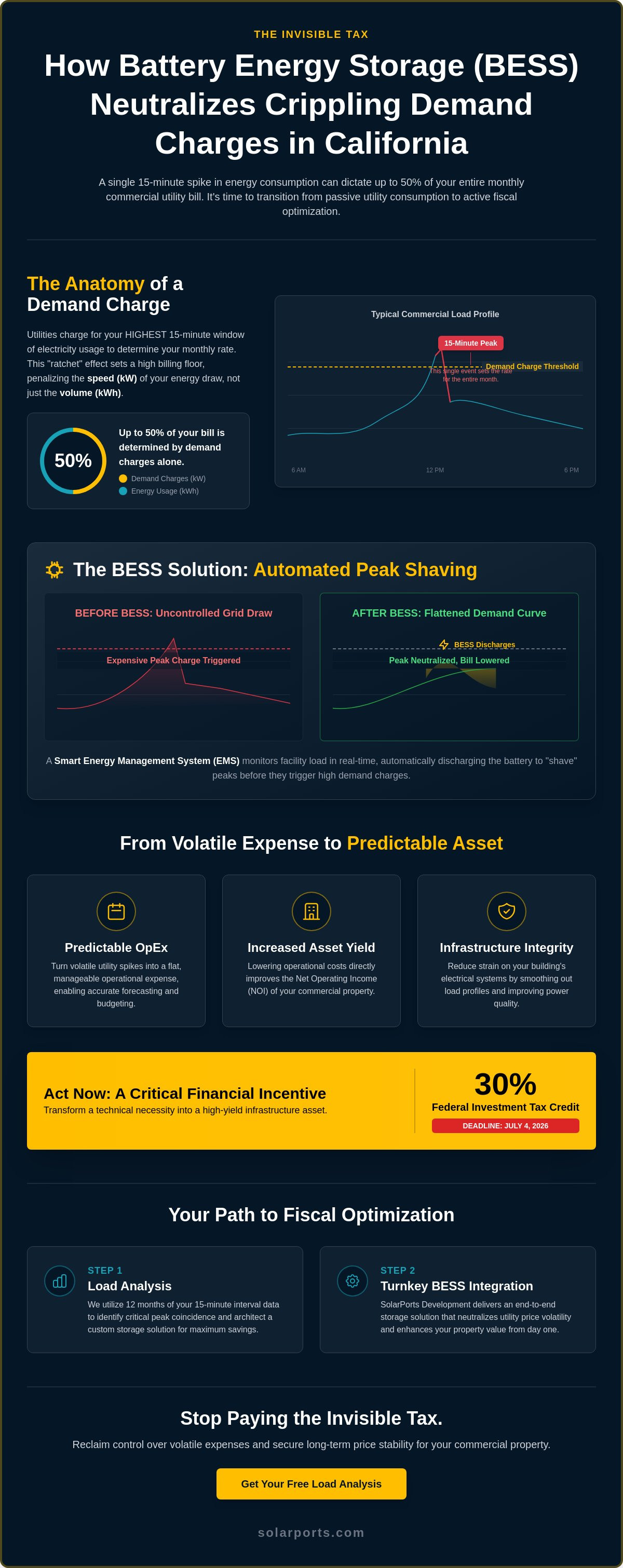
Most people think their electric bill is about how much energy they use. In the commercial world, especially in California, that’s only half the story. The other half is about how fast you use it. Demand charges are based on the single highest 15-minute window of your electricity use all month. One spike, and you’ve set a new, higher price for yourself.
Think about it. In places like Northern California, these charges can easily make up 30-50% of your entire bill. PG&E, SCE, and SDG&E argue they need this money to maintain the grid for those peak moments, whether you hit that peak once or a hundred times. For you, it’s a massive financial leak in your operating budget, all tied to one metric you probably don’t even track. (Battery Energy Storage System (BESS))
The 15-Minute Rule: Why Short Spikes Cost Thousands
This is where the pain really comes from. Utilities use something called a "ratchet clause." A single 15-minute interval where your building draws maximum power—maybe your machine shop, kitchen, and AC all fire up at once—sets the demand charge for the whole billing cycle. That one moment gets locked in.
It’s the difference between kilowatt-hours (kWh), the total volume of electricity you consume, and kilowatts (kW), the rate of consumption. You’re billed for both. You can run a 10 kW machine for one hour (costing you 10 kWh of energy) or a 100 kW machine for six minutes (also 10 kWh of energy). The energy cost is the same, but the demand cost for the second scenario will be ten times higher. It’s a system that punishes operational intensity.
California Utility Realities: PG&E, SCE, and SDG&E
In California, this isn't a minor issue; it's the core of the utility's rate structure. The whole system is designed to penalize energy use during peak grid stress, typically hot summer afternoons. Turning off lights or installing efficient equipment helps with your overall consumption, but it does almost nothing to stop a sudden, high-power draw. Those traditional energy-saving methods simply can’t address demand charges. You need a buffer—something that can absorb the shock instead of your wallet.
The BESS Mechanism: Automated Peak Shaving and Load Shifting
A Battery Energy Storage System is that buffer. It sits between your property and the grid, acting as a gatekeeper for your energy spend. Its job isn't just to store power; it's to deploy that power with millisecond precision to control your costs. This is done through two primary functions: peak shaving and load shifting, both managed automatically by a smart Energy Management System (EMS).
- Peak Shaving: The battery instantly discharges when your building's demand starts to spike, feeding your facility with stored energy so you draw less from the grid. This keeps your demand below a predetermined, cost-effective threshold.
- Load Shifting (Arbitrage): The system is smart enough to charge the battery when electricity is cheap—either overnight from the grid or from your own solar panels during the day. You then use that cheap, stored power during expensive peak hours.
Peak Shaving: Flattening the Demand Curve
This is the most direct way BESS reduces demand charges. The EMS constantly monitors your building's load. When it senses you're about to cross the peak demand threshold you want to avoid, it injects power from the battery to "shave off" the top of the spike. The grid never sees that surge, so as far as the utility is concerned, it never happened. That "ratchet clause" we talked about? It gets based on a much lower, flatter demand profile. The battery takes the hit, not your bank account. (BESS and NEM 3.0 in California)
Energy Arbitrage: Buying Low, Using High
Arbitrage is the second layer of savings. In California, the price of electricity can vary dramatically depending on the time of day. Under Time-of-Use (TOU) rates, "On-Peak" power can cost several times more than "Super Off-Peak" power. A BESS allows you to game this system. It charges up when rates are low, effectively buying cheap energy. Then, when the afternoon peak hits and grid power is most expensive, your building runs on the cheap energy you stored hours earlier. If you have solar carports or a rooftop system, the BESS stores that free energy instead of exporting it for pennies, letting you use it yourself when it's most valuable.
Strategic ROI: Why BESS is Essential Under NEM 3.0
If you're a California property owner who invested in solar, you know the game has changed. The old Net Energy Metering (NEM) system is gone. Under the new Net Billing Tariff (NEM 3.0), the value of exporting your excess solar power back to the grid has been slashed by around 75%. Suddenly, standalone solar doesn't pencil out like it used to.
This is where BESS becomes non-negotiable. Instead of selling your valuable solar energy for a pittance, a battery lets you store it and use it yourself. This strategy of "self-consumption" is now the key to solar ROI in California. The payback on BESS isn’t just about energy savings anymore; it's about avoiding crippling demand charges and making your solar investment financially viable again.
The NEM 3.0 Landscape for California Business
Let's be clear: NEM 3.0 was designed to push commercial properties toward battery storage. The financial incentive to simply dump excess solar onto the grid is gone. The new math requires you to use as much of your own generated power as possible. Without a battery, most of the solar power you generate during the middle of the day (when your building's load might not be at its absolute peak) goes to the grid for almost nothing. With a battery, that same power is saved and deployed a few hours later to offset the most expensive electricity of the day. Storage restores the ROI.
Incentives and Subsidies: Leveraging SGIP
The upfront capital expenditure for BESS is a real consideration, but California offers a powerful incentive to offset it: the Self-Generation Incentive Program (SGIP). This is a state-level rebate program that can significantly reduce the net cost of your battery system. There are different funding categories, but for most commercial projects, the goal is to secure a rebate from the "General Market" budget. Paired with the Federal Investment Tax Credit (ITC), which also applies to storage, these incentives can dramatically shorten the payback period and make the financial case undeniable.
Implementation Framework: Analyzing Your Commercial Load Profile
A BESS is not a one-size-fits-all product. Installing the wrong size system is like buying a snowplow in San Diego—an expensive, useless asset. A successful project is built on data, not guesswork. The process has to be meticulous.
- Get the Data: The first step is always to pull 12 months of your 15-minute interval data, often called "Green Button data," from your utility provider. This is the blueprint of your energy use.
- Find the Peaks: We analyze that data to pinpoint exactly when your highest demand occurs and, crucially, if it aligns with the utility's most expensive time-of-use windows. This is called 'peak coincidence.'
- Right-Size the System: Based on the data, we model the precise battery capacity (in kWh) and power output (in kW) needed to shave your specific peaks. Too big is wasted capital; too small is a missed opportunity. This is where a deep understanding of right-sizing commercial systems is critical.
- Integrate the Brains: Select an Energy Management System (EMS) that can talk to your existing building systems. The goal is seamless, automated operation.
- Simulate the Savings: Finally, we run a financial pro-forma that pits your new, BESS-optimized energy profile against your old utility bills, projecting the net savings over 10 years.
Data Acquisition: The Foundation of Accuracy
You can request your interval data directly from the PG&E or SCE online portals. When we plot this data into a 'load duration curve,' it tells a story. It shows us how often you hit those expensive peaks and for how long. Flying blind without this data is the #1 mistake we see. It’s how you end up with a system that can’t cover your most expensive spikes or, just as bad, a system that’s twice as big as you actually need.
The Engineering of Turnkey Integration
Installing a commercial BESS in California is more than just wiring up a box. It requires specialized interconnection agreements with the utility, which are complex and bureaucratic. You have to account for the physical footprint, fire safety codes (which are strict and vary by jurisdiction), and the existing capacity of your electrical panels. This isn’t a job for a general electrician. It requires a specialized contractor who lives and breathes California's codes and utility politics.
The SolarPorts Solution: Turnkey BESS for California Real Estate
We built SolarPorts Development to solve this exact problem for commercial property owners in Northern California. We don't sell oversized, one-size-fits-all systems. We are engineers and financial analysts first, focused on small-scale, high-impact projects that deliver a clear and predictable return.
Our process starts with a Commercial Energy Cost Saving Analysis. We do the deep data dive to show you, with hard numbers, exactly where the waste is and how much a right-sized BESS will reduce your specific demand charges. We handle everything: the utility paperwork, the SGIP application, the engineering, and the installation.
Precision Engineering for Commercial Assets
Our entire methodology is about maximizing your ROI without wasting a dime on unneeded capacity. We specialize in integrating BESS with solar carports, turning underutilized parking areas into power-generating, cost-saving assets. Every projection we make is backed by your own data, so you can see the financial case for yourself before committing.
Navigating the California Market with Confidence
We work exclusively in Northern California. That means we know the local permitting officials, we understand the nuances of PG&E's rate tariffs, and we have a track record of navigating the complexities of the market. You get a single point of contact and the peace of mind that comes from working with a team that has done this before. Stop guessing about your energy costs and start controlling them.


