How BESS Reduces Peak Demand Charges for Business

· 16 min read · 3,152 words
How BESS Reduces Peak Demand Charges for Business

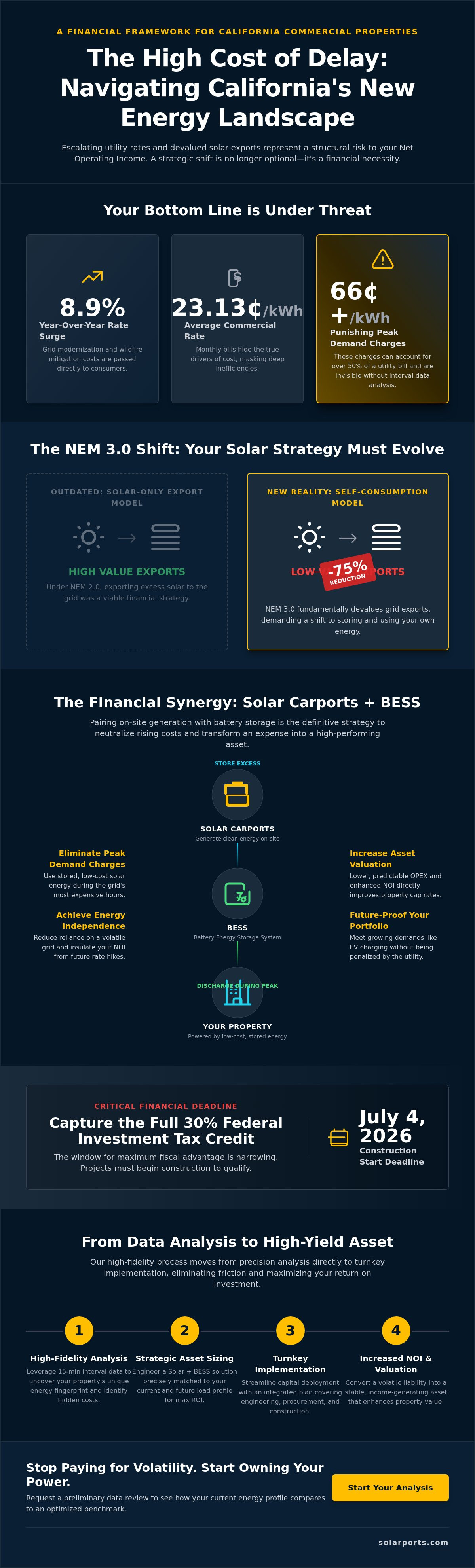
California electricity rates have surged 8.9% year-over-year, yet many property owners are still operating on outdated energy assumptions. A rigorous commercial energy cost saving analysis is no longer a luxury; it's a financial necessity for any asset manager looking to protect their bottom line from escalating utility costs that now reach up to 23.13¢/kWh. You likely recognize that the transition to NEM 3.0 has fundamentally devalued solar-only exports, leaving you with opaque billing structures and punishing peak demand charges that erode your net operating income.

This guide provides the financial framework you need to master commercial energy analysis, allowing you to eliminate utility waste and transform your California property assets into high-performing, energy-independent investments. You'll learn how to navigate the 75% reduction in export compensation by pairing solar carports with Battery Energy Storage Systems (BESS) to capture the full 30% federal tax credit before the July 4, 2026, construction deadline. We will outline a data-backed roadmap to reduce demand charges and secure long-term price certainty through precise asset sizing and strategic operational planning.

Key Takeaways

  • Reframe utility expenditures as structural risks rather than variable costs to protect your property's net operating income.
  • Understand how a high-fidelity commercial energy cost saving analysis leverages 15-minute interval data to expose hidden inefficiencies in your building’s load profile.
  • Evaluate the financial synergy of pairing solar carports with Battery Energy Storage Systems (BESS) to mitigate peak demand charges and stabilize long-term energy pricing.
  • Navigate the complexities of NEM 3.0 by shifting your energy strategy from grid-exporting to high-value self-consumption models.
  • Streamline your capital deployment by moving from a rigorous analytical roadmap directly into turnkey implementation to eliminate installation friction.

The Strategic Necessity of Commercial Energy Cost Saving Analysis

Utility volatility is a structural threat. For California property owners, rising electricity rates are no longer a minor variable expense; they represent a fundamental risk to net operating income and long-term asset viability. A standard energy audit typically focuses on historical waste, identifying minor inefficiencies like lighting or HVAC maintenance. While useful, these audits lack the financial depth required to address the systemic price hikes currently impacting the Western grid. A sophisticated commercial energy cost saving analysis shifts the focus from simple remediation to strategic investment, identifying opportunities to turn a monthly liability into a high-yield asset.

Data-driven planning is the only defense against the punishing peak demand charges that define the California market. Without a rigorous analysis of 15-minute interval data, property owners often fall into the trap of over-capitalizing on inefficient systems or under-sizing their energy assets. Precision in the planning phase ensures that capital is deployed where it generates the highest internal rate of return. It prevents the common mistake of installing hardware that doesn't align with the building's specific load profile, ultimately protecting the bottom line from fiscal erosion.

From Operational Expense to Strategic Asset

Energy independence directly correlates with Net Operating Income (NOI). By transitioning from a model of "paying for power" to "owning the generation," you effectively lock in your energy costs for the next two decades. This stability is highly valued in the commercial real estate market, as it reduces operational uncertainty and improves cap rates. When you integrate on-site generation through rooftop solar or solar carports, you aren't just cutting costs; you're fundamentally increasing the valuation of the property through enhanced fiscal optimization and structural efficiency.

The California Context: Why 2026 is a Critical Pivot Point

The window for maximum fiscal advantage is narrowing. With average commercial electricity rates in California now reaching as high as 23.13¢/kWh, the cost of inaction is quantifiable and compounding. PG&E, SCE, and SDG&E continue to pass grid modernization and wildfire mitigation costs onto consumers, resulting in an 8.9% year-over-year increase in rates. Delaying a commercial energy cost saving analysis means missing the July 4, 2026, deadline to secure the full 30% Federal Investment Tax Credit for projects starting construction. The regulatory environment in 2026 demands immediate, calculated action to avoid the double penalty of higher utility rates and reduced federal incentives.

Anatomy of a High-Fidelity Energy Analysis: Beyond the Standard Audit

Monthly utility bills are insufficient. They provide a retrospective aggregate of consumption but offer zero visibility into the operational inefficiencies that drive costs. A high-fidelity commercial energy cost saving analysis requires 15-minute interval data to expose the building's true "energy fingerprint." This granular level of detail allows for the identification of specific peak demand events that monthly totals obscure. Without this data, you're guessing at the solution rather than engineering a financial remedy.

Future-proofing is essential. Your current load profile will change as you integrate new infrastructure, such as EV charging stations. A robust commercial energy cost saving analysis models these future demands today, ensuring your system remains an asset rather than becoming a bottleneck. You can request a preliminary data review from SolarPorts Development to see how your current interval data compares to optimized benchmarks.

Interval Data and Load Profiling

Average use metrics are dangerous. In the California commercial sector, relying on monthly averages often leads to under-sizing storage capacity or over-sizing generation

Commercial energy cost saving analysis

Quantifying the Impact of BESS and Solar Carports on OPEX

Physical infrastructure is the delivery mechanism for your financial strategy. While data determines the "why," Battery Energy Storage Systems (BESS) and solar carports provide the "how" for aggressive operational expense reduction. A comprehensive commercial energy cost saving analysis must move beyond theoretical savings to quantify the real-world impact of these integrated assets. By deploying hardware that directly addresses high-cost utility intervals, you transform a passive real estate holding into an active energy-generating powerhouse. This isn't merely about sustainability; it's about the precision application of capital to eliminate structural waste.

BESS: The Demand Charge Mitigation Engine

Demand charges are the silent killers of California operational budgets. In many utility territories, these charges can represent 30% to 70% of a total monthly bill. Batteries act as a financial buffer, storing low-cost energy during off-peak hours and discharging it when utility rates and demand charges are at their highest. This process, known as peak shaving, allows a facility to maintain a lower demand profile regardless of actual building activity. Beyond the immediate fiscal relief, storage provides essential resilience against grid instability. You can explore regional financial support for these systems through the Database of State Incentives for Renewables & Efficiency, which tracks the various layers of funding available for storage deployment.

Solar Carports: Maximizing Unused Real Estate

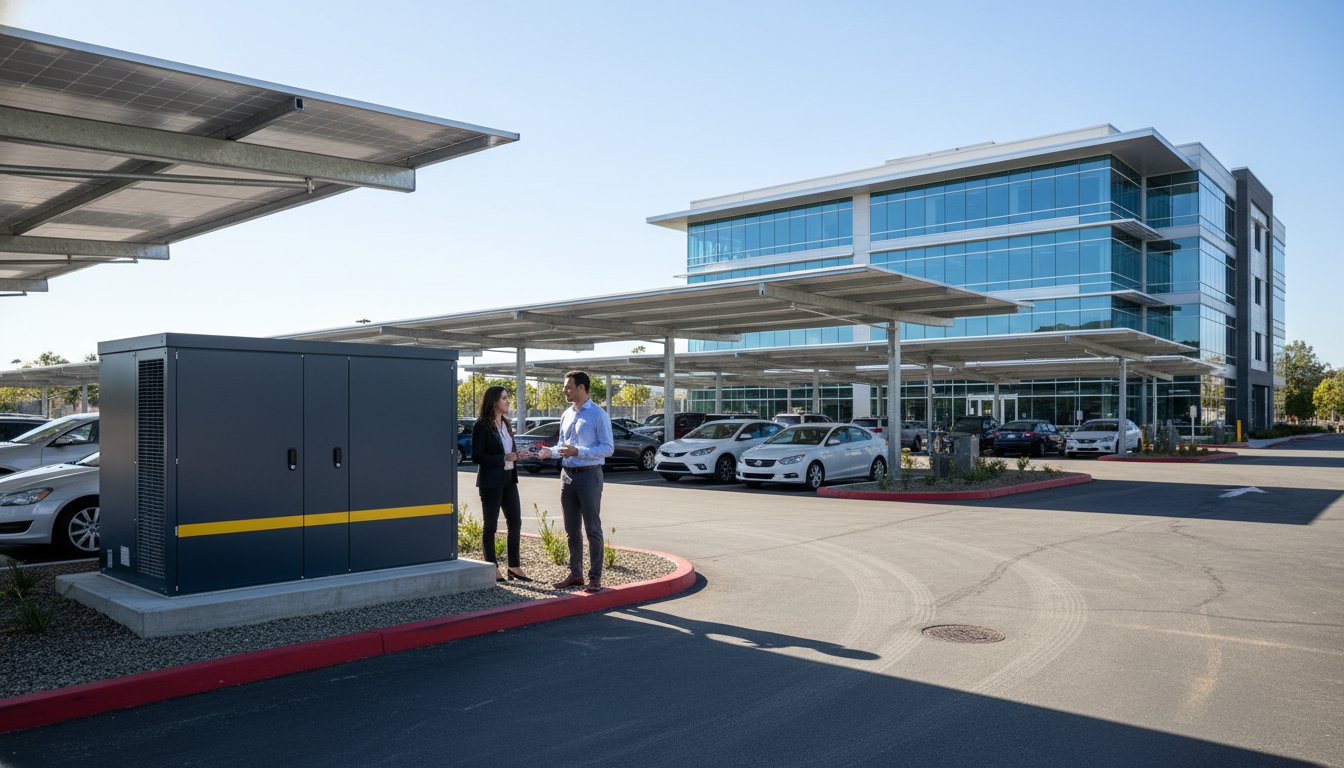
Parking lots are often the most underutilized assets in a commercial portfolio. Solar carports turn these expansive asphalt surfaces into high-yield energy plants. Unlike rooftop solar, which is often constrained by HVAC units, vents, and structural limitations, carports offer superior energy density and unencumbered solar access. They provide a strategic advantage for properties with limited roof space or complex structural requirements. There is also a significant secondary value: shading. Protecting vehicles from the California sun improves the tenant experience and can even reduce the cooling load on the asphalt, subtly lowering the ambient temperature around the building.

Integration is the final step in optimization. Pairing carports with BESS creates a closed-loop system that maximizes self-consumption, a critical requirement under current NEM 3.0 regulations. This synergy also prepares the property for the inevitable demand for on-site EV charging. By generating and storing power on-site, you can offer high-speed charging to tenants and visitors without triggering new, exorbitant demand charges from the utility. Every component of a commercial energy cost saving analysis should point toward this level of integrated, long-term value creation.

The grid is no longer your bank. Under the Net Billing Tariff, commonly known as NEM 3.0, the financial logic of commercial solar has shifted from energy exportation to aggressive self-consumption. Export compensation rates have plummeted by approximately 75%, now averaging just $0.05 to $0.08 per kWh. This regulatory pivot means a commercial energy cost saving analysis must prioritize "avoided cost" modeling over traditional net metering credits. Success in this environment is measured by how much high-cost utility power you don't buy, rather than how much excess power you sell back.

Strategic timing is now a primary driver of project ROI. Property owners who fail to adapt their energy strategy face significantly extended payback periods. While a solar-only system now carries an estimated payback of 9 to 13 years, integrating a Battery Energy Storage System (BESS) can reduce that timeline to 7 to 8 years. You can request a strategic financial evaluation to determine how these regulatory shifts specifically impact your portfolio's internal rate of return.

The NEM 3.0 Reality for Commercial Owners

Batteries are now a mandatory component of solar ROI in California. Under the previous NEM 2.0 rules, the grid acted as a cost-free storage mechanism, allowing for a 1:1 credit on exported power. That era has ended. A storage-centric model is now the only way to capture the full value of your generation. Right-sizing becomes a critical discipline here; over-generating without sufficient storage capacity results in "wasted" electrons that the utility buys for pennies while charging you full price during peak hours. Your commercial energy cost saving analysis must align your discharge schedule with the most expensive time-of-use windows to maximize fiscal impact.

Incentives and Financing Frameworks

Federal and state incentives provide the necessary capital cushion to accelerate deployment. The Federal Investment Tax Credit (ITC) remains at a robust 30% for 2026, though projects must begin construction by July 4, 2026, to secure the full four-year placed-in-service window. Beyond the base credit, projects may qualify for 10% bonus increments by meeting domestic content requirements or locating in designated energy communities. When combined with MACRS accelerated depreciation, these tax shields can offset a massive portion of the initial system cost.

  • SGIP Large-Scale Storage: Incentives for systems over 30 kWh currently range from $250 to $500 per kWh, depending on the specific category.
  • Non-Residential Equity: Small businesses and community buildings may access up to $850 per kWh through specific SGIP allocations.
  • MACRS Depreciation: Five-year accelerated depreciation allows for a rapid recovery of capital, significantly improving the project’s net present value.

Relying on outdated financial models is a recipe for capital inefficiency. The current landscape rewards property owners who treat energy as a sophisticated financial asset rather than a simple utility. By leveraging the 30% ITC and targeted SGIP funding, you can hedge against the 8.9% annual rise in California utility rates while building a resilient, high-valuation property asset.

Executing the Roadmap: From Data Analysis to Turnkey Implementation

Analysis is the foundation; execution is the delivery. A commercial energy cost saving analysis provides the financial blueprint, but the ultimate return on investment depends on the precision of the physical installation. Fragmented project management often leads to "leakage" where the theoretical savings modeled in the planning phase are eroded by uncoordinated construction. A turnkey approach ensures that the strategic intent of the data analysis remains intact from the first load profile study to the final interconnection agreement.

Meticulous planning eliminates the risk of expensive change orders. When the same entity responsible for the initial commercial energy cost saving analysis also handles the engineering and construction, the margin for error narrows significantly. This continuity allows for the seamless integration of complex hardware, such as Battery Energy Storage Systems (BESS) and solar carports, without the friction typical of multi-vendor projects. It's a method that prioritizes structural integrity and fiscal accountability over mere equipment sales.

The Value of a Turnkey Partner

Fragmented contracting creates operational vulnerability. Using separate consultants for analysis and different contractors for installation often results in a lack of ownership over the final performance metrics. SolarPorts Development addresses this by providing a unified project lifecycle. We integrate BESS, rooftop solar, and solar carports into a single, cohesive energy asset designed specifically for the California market. Local expertise is non-negotiable here. Navigating the specific permitting and interconnection requirements of Northern California utilities requires a partner who understands the granular regulatory landscape and can anticipate potential grid bottlenecks before they delay your project.

Monitoring and Long-Term Asset Management

Verification is the final stage of financial optimization. Once a system is operational, ongoing monitoring is required to ensure the real-world performance aligns with the projected financial models. Asset management isn't a passive activity; it involves active Operations and Maintenance (O&M) to protect the project's internal rate of return. High-resolution data dashboards provide property owners with real-time visibility into their savings, allowing for the immediate identification of any performance deviations.

Data-backed decision-making shouldn't end when the panels are installed. As utility rates continue to climb and NEM 3.0 export rules remain in effect, your energy strategy must be dynamic. By maintaining a rigorous focus on performance data, you ensure your property remains a high-yield asset for the duration of its lifecycle. You can schedule your commercial energy cost saving analysis with SolarPorts to begin the transition from utility dependency to strategic energy ownership.

Secure Your Financial Future in the California Energy Market

The window for securing maximum fiscal advantage in the California market is closing. With utility rates climbing and the July 4, 2026, deadline for the full 30% Investment Tax Credit approaching, delay represents a quantifiable financial risk. You've learned how a high-fidelity commercial energy cost saving analysis transforms monthly utility liabilities into controlled, high-yield assets. By integrating specialized BESS and solar carport engineering, you can effectively hedge against peak demand charges and the volatility of the NEM 3.0 landscape.

SolarPorts Development provides the turnkey, California-based expertise required to bridge the gap between data-backed ROI modeling and structural execution. We eliminate the friction of multi-vendor projects by managing the entire lifecycle from initial load profiling to long-term asset management. Protecting your bottom line requires more than a standard audit; it demands a sophisticated financial architecture designed for the specific nuances of the Western grid.

Request Your Data-Driven Energy Cost Saving Analysis

Take the first step toward operational independence and long-term price certainty today.

Frequently Asked Questions

What is the difference between an energy audit and a cost saving analysis?

An energy audit is a retrospective assessment of physical waste, whereas a commercial energy cost saving analysis is a forward-looking financial architecture. Audits identify hardware inefficiencies like leaking valves or outdated lighting. The analysis phase models your 15-minute interval data against utility rate schedules to identify strategic investment opportunities. It prioritizes capital deployment based on internal rate of return rather than simple maintenance.

How much can a commercial property realistically save on electricity in California?

Savings vary by load profile, but reducing peak demand charges offers the most significant fiscal relief. In California, these charges often constitute 30% to 70% of a monthly bill. By utilizing on-site generation and storage, property owners can effectively hedge against utility rates that currently reach up to 23.13¢/kWh. Precise modeling ensures you capture these savings without over-capitalizing on unnecessary hardware.

Does my business need to be in a specific industry to benefit from BESS?

Any facility with high peak demand or consistent evening operations will benefit from Battery Energy Storage Systems (BESS). Industries such as cold storage, manufacturing, and large-scale office complexes are prime candidates due to their significant load spikes. The system acts as a financial buffer, discharging stored energy when grid prices are highest. It's a universal solution for any commercial asset facing the punishing time-of-use rates characteristic of the California market.

What is the typical payback period for a commercial solar carport in Northern California?

Payback periods have shifted under the current regulatory framework. For a solar-only installation, the typical return is realized in 9 to 13 years. Integrating battery storage reduces this timeline to approximately 7 to 8 years. Solar carports follow a similar trajectory but provide added value through vehicle shading and increased generation capacity. These timelines are accelerated by the 30% federal tax credit and MACRS depreciation.

How has NEM 3.0 changed the financial outlook for commercial solar?

NEM 3.0 has fundamentally devalued exported power by approximately 75%. Under previous rules, the grid served as a cost-free battery, but the new tariff rewards self-consumption. Success now depends on a rigorous commercial energy cost saving analysis that aligns generation with on-site demand. The value proposition is no longer about selling power back to the utility; it's about avoiding the purchase of high-cost grid energy entirely.

Can I install battery storage without solar and still save money?

You can install standalone battery storage to target demand charge reduction through peak shaving. This strategy is effective for buildings with high load spikes but limited space for solar arrays. However, pairing storage with solar generation typically results in a superior internal rate of return. Standalone systems still qualify for certain incentives, but they lack the free fuel source that on-site solar provides to maximize long-term operational savings.

What data do I need to provide for a high-fidelity energy analysis?

Precision requires 12 months of 15-minute interval data, often referred to as Green Button data. This granular information allows for the mapping of your facility's exact energy fingerprint against complex utility rate schedules. We also evaluate your current utility tariff, property site plans, and any projected load growth from future EV charging needs. This comprehensive data set is the prerequisite for engineering a system that avoids both under-sizing and over-capitalization.

Are there specific incentives for commercial properties in San Francisco or San Jose?

Properties in San Francisco and San Jose primarily leverage the Self-Generation Incentive Program (SGIP) and the 30% Federal Investment Tax Credit. While municipal-specific rebates occasionally surface, the most substantial savings come from these broader state and federal frameworks. Large-scale storage incentives currently range from $250 to $500 per kWh for qualifying commercial projects. It's essential to verify current budget availability, as general market funds for these programs can fluctuate.

More Articles