
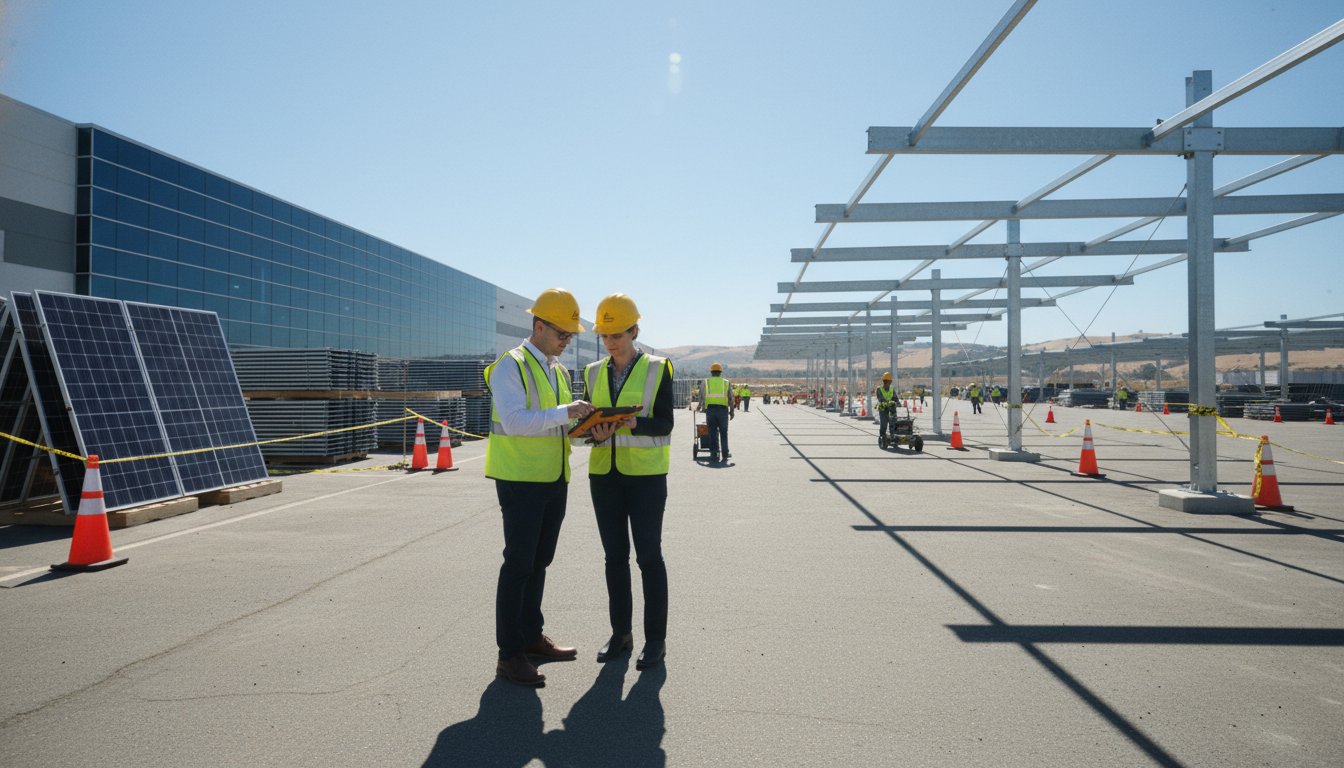
The most expensive mistake you can make with a commercial solar installation timeline is assuming the utility company cares about your ROI. Most executives focus on the speed of the rooftop crew. In reality, the physical build is the shortest part of the process. In 2026, the real battle happens months before a single panel arrives on site. Between the 2025 Title 24 mandates and the complex math of the Solar Billing Plan, your project is a logistics puzzle that requires a precise, front-loaded strategy.
I know it's frustrating to watch your $0.27 per kWh utility bill climb while your project sits in a pile of pending paperwork at the utility office. You want a predictable schedule that doesn't disrupt your daily operations or hit you with surprise permitting costs now that AB 1124 fee caps have expired. This guide provides a realistic, phase-by-phase breakdown of what it actually takes to get commercial solar and storage live in California right now. We'll cover everything from the new PE stamp requirements to the final push for Permission to Operate so you can start capturing that federal tax credit without the typical utility-driven stalls.
Key Takeaways
- Start with a rigorous commercial energy cost saving analysis to right-size your system and avoid the expensive redesigns that often stall projects mid-stream.
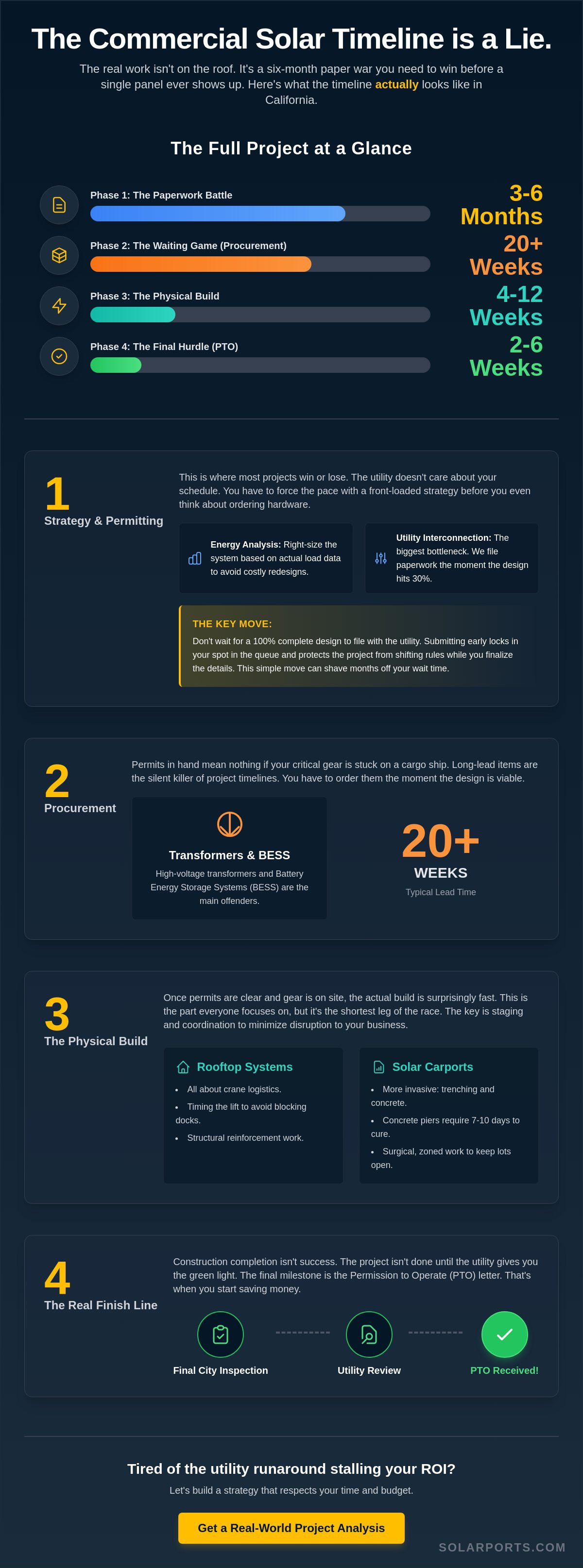
- Budget for a commercial solar installation timeline that prioritizes the three-to-six-month permitting and engineering phase, which is where most California projects actually win or lose.
- Mitigate procurement risks by ordering long-lead items like high-voltage transformers and BESS units early, as these currently face delays of 20 weeks or more.
- Minimize operational downtime by coordinating the physical construction of rooftop or carport systems, which typically takes only four to twelve weeks once equipment is on-site.
- Don't mistake construction completion for project success; the real milestone is securing the utility’s Permission to Operate (PTO) letter after the final city inspection.
The Strategic Blueprint: Why Analysis and Permitting Take the Most Brainpower
The biggest lie in the industry is that the clock starts when the panels arrive. It doesn't. Your commercial solar installation timeline actually begins with a rigorous, data-driven commercial energy cost saving analysis. We don't just "size" a system based on roof space; we look at your interval data to ensure the system matches your actual load under the current Solar Billing Plan. If the design isn't rooted in fiscal reality, you're just buying hardware that won't pay for itself.
Most of the heavy lifting happens during what we call the soft cost phase. The Soft Cost Phase is the specific period covering engineering, AHJ permitting, and initial utility filing. You should expect this phase to consume three to six months of your total commercial solar installation timeline. It is a long window, but it's where the financial viability of your project is secured. While the underlying photovoltaic technology is standardized, the bureaucracy surrounding it is anything but simple.
Utilities are the primary bottleneck in California. They don't move at the speed of business. To combat this, we submit interconnection paperwork the moment the design reaches 30 percent completion. Waiting for a final 100 percent design before filing is a tactical error that can add months of unnecessary waiting to your project's completion date.
Navigating California Regulatory Hurdles
Permitting in Northern California is a study in contrasts. In San Jose, you might find a streamlined path, while in Oakland, the process can feel like a moving target. Local Authorities Having Jurisdiction (AHJ) have their own quirks, and your engineering must account for them from day one. Title 24 compliance is another non-negotiable factor. Since January 1, 2026, the new standards mandate solar and storage for most new commercial builds. This adds a layer of verification that must be baked into your engineering schedule. Our goal is to secure "conditional approval" from the utility as early as possible. This locks in your grid position and protects your project from shifting interconnection rules while you finalize the site details.
Steel, Silicon, and Storage: The Reality of Physical Site Deployment
Procurement is the silent killer of any commercial solar installation timeline. You can have your permits in hand, but if you didn't order your high-voltage transformer or BESS unit five months ago, you're dead in the water. These components currently face lead times of 20 weeks or more. It's a logistical reality that surprises developers who think physical labor is the bottleneck. In truth, the actual on-site construction for a typical commercial rooftop or carport usually lasts only 4 to 12 weeks. The trick is making sure the steel and silicon are actually there when the crew arrives.
If you're looking at a commercial solar carport with EV charging California, staging becomes an art form. We coordinate steel delivery to minimize parking lot closures because we know your tenants or customers won't tolerate a fenced-off lot for months. It's about surgical precision. We work in zones to keep your business operational while we build.
Rooftop vs. Solar Carport Staging
Rooftop installs are all about crane logistics and structural reinforcement timing. You have to time the lift to avoid blocking loading docks or main entrances. Carport installs are different. They involve trenching, concrete pier curing, which takes 7 to 10 days, and structural steel erection. It's a more invasive process, but the dual-use ROI often justifies the extra coordination. Even with these complexities, adhering to California's Solar Permitting Guidebook standards ensures the build stays within code and avoids mid-construction stops.
Integrating Battery Energy Storage Systems (BESS)
Don't wait for the solar to be finished to start on the storage. BESS pad preparation happens in parallel with solar racking. This isn't a linear process; it's a multi-track effort. Once the hardware is set, you need a specific testing window for commissioning commercial-scale batteries. This ensures the software communicates with the grid and your building load correctly. If you're ready to see how this fits your specific property, a professional site assessment can clarify your equipment lead times.
The Interconnection Bottleneck: Navigating the Utility Finish Line
Construction finishes. The crew packs up. The panels look great on the roof. But your utility bill hasn't changed. This is the most aggravating part of the commercial solar installation timeline because you've committed the capital, but the meters are still spinning the wrong way. Construction completion does not mean the system is on; you're now at the mercy of the utility inspector's schedule. It's a period of forced patience that many businesses don't account for in their initial planning.
The "Final Inspection" from the city or county is just the prerequisite for the utility’s PTO letter. Permission to Operate is the formal utility authorization required to energize your system. Without that specific piece of paper, you're legally stuck. Most vendors pretend the project ends when the last bolt is tightened. It doesn't. The gap between physical work and PTO is a bureaucratic minefield that can leave a finished system sitting idle for weeks if the paperwork wasn't handled perfectly months ago.
The 5-Step Path to Permission to Operate (PTO)
We manage this sequence to prevent your project from stalling at the finish line:
- Step 1: AHJ Final Sign-off. The city or county building department verifies the build matches the permitted plans.
- Step 2: Submission of "As-Built" plans. We send the final, real-world configuration to the utility for their records.
- Step 3: Utility field inspection. A utility tech visits the site to verify the safety of the AC disconnect and may upgrade your meter.
- Step 4: Receipt of formal PTO letter. This is the official green light that allows your system to stay energized.
- Step 5: System commissioning and software calibration. We finalize the integration between your solar and the battery storage.
After PTO, the focus shifts to optimization. The first 30 days are for fine-tuning the BESS discharge logic to kill peak demand charges. It's about making sure the battery kicks in exactly when the utility rates spike. This final calibration ensures your commercial solar installation timeline concludes with a high-performance financial asset, not just a bunch of idle hardware on your roof or in your parking lot.
Own Your Energy Future Before the Grid Fails You
A successful commercial solar installation timeline isn't just a calendar of events. It is a series of strategic maneuvers designed to bypass utility delays and maximize your fiscal return. You've seen that the real work happens in the quiet months of permitting and equipment procurement. If you don't secure your BESS and transformer orders early, you aren't just delayed; you're losing money every day your high utility rates continue to climb. The goal is to reach that PTO letter with your operations intact and your ROI modeling verified.
We don't do guesswork. Our approach is built on California-specific expertise and a deep focus on turnkey BESS and carport systems. We use data-driven modeling to ensure your project actually performs as promised. Stop waiting for the utility companies to dictate your operational costs. It is time to take control of your property's energy profile with a partner who understands the granular complexity of the California market. Get a realistic timeline and cost-saving analysis for your property today. Your bottom line deserves the protection of a system that's built right the first time.
Frequently Asked Questions
How long does a typical commercial solar installation take from start to finish in California?
A standard project usually requires six to twelve months to reach completion. Your commercial solar installation timeline is heavily weighted toward the front end, where design, engineering, and permitting consume three to six months. Physical construction is relatively fast, often wrapping up in four to twelve weeks, but the final administrative push for utility approval can add another sixty days of waiting.
Can I keep my business open during the solar carport construction?
Yes, you can maintain full operations through strategic staging and zoned deployment. We coordinate steel delivery and trenching in specific sections to ensure your parking lot remains partially accessible throughout the build. Concrete pier curing takes seven to ten days per section, but this is managed incrementally so your customers or tenants aren't locked out of the entire site at once.
Why is the utility interconnection taking so much longer than the actual construction?
Utility companies operate on administrative cycles that don't mirror the pace of private construction. While a crew can physically install a system in weeks, the utility must review "As-Built" plans, schedule field inspections, and often perform grid-side meter upgrades. This bottleneck is caused by a massive inspection backlog and the rigorous safety verification required for high-voltage smart inverters under current CPUC standards.
What happens if my commercial solar project misses the tax credit deadline due to delays?
Commercial projects currently rely on the Section 48E Investment Tax Credit, which is a critical component of your fiscal planning. While the residential 30 percent credit expired at the end of 2025, commercial incentives remain available but are sensitive to project completion dates. Missing a specific year-end deadline can delay your tax benefit realization by a full fiscal cycle, which is why we front-load the commercial solar installation timeline to protect your cash flow targets.


