
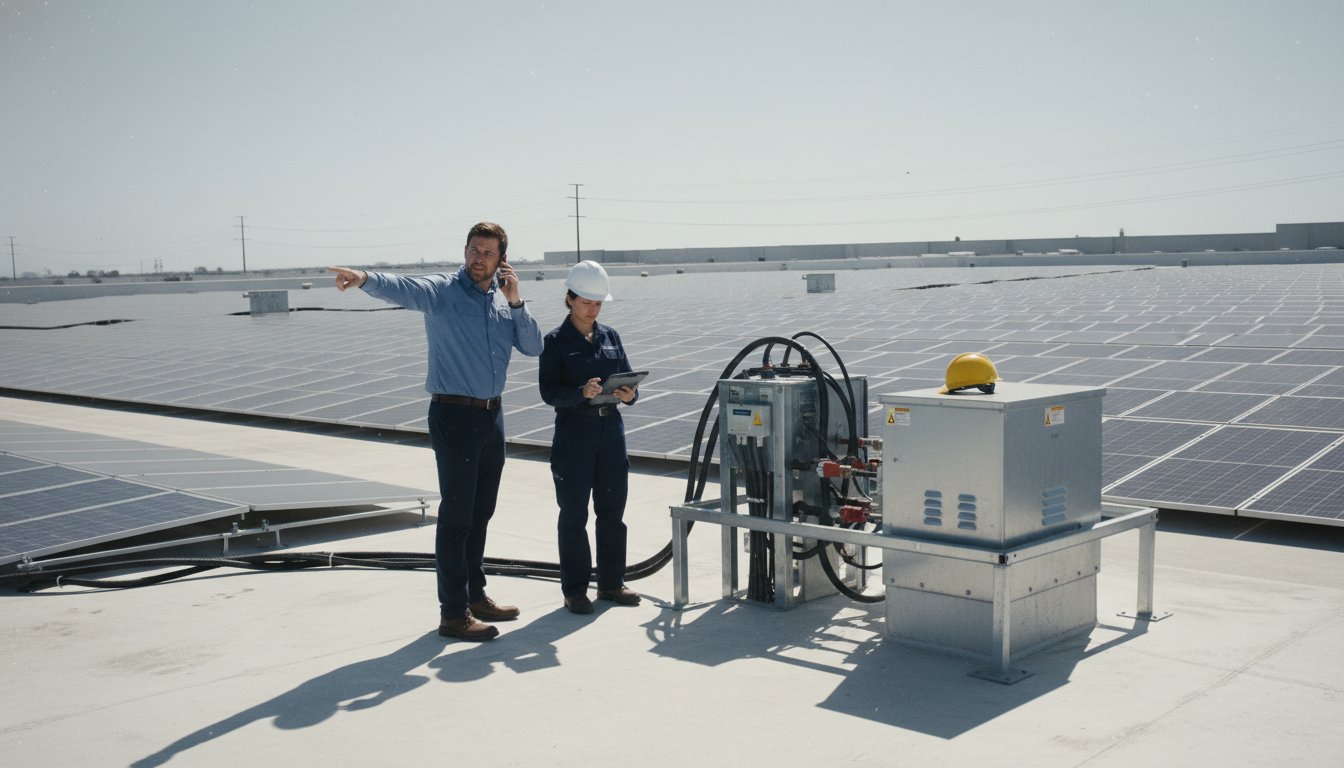
Most commercial solar projects in California don't stall because of bad engineering; they die in the bureaucratic meat grinder of utility interconnection. You've probably realized by now that the "set it and forget it" sales pitch was a lie. Between PG&E, SCE, and SDG&E, getting a system turned on is less about mounting panels and more about surviving a war of attrition with the grid. Effective commercial solar project management CA requires someone who knows exactly which levers to pull when the utility stops answering emails.
It's frustrating to watch your ROI shift because of the 75% reduction in export value under NEM 3.0, especially when you're just trying to lower your operational costs. We're going to pull back the curtain on what it actually takes to get a build across the finish line in 2026. You'll see how to right-size your system to avoid over-engineered waste and why BESS is no longer optional if you want to crush those 4-9 p.m. peak rates. We're covering the July 4, 2026, ITC deadline, the reality of the Physical Work Test, and how to build a turnkey energy asset that actually performs.
Key Takeaways
- Interconnection is a war of attrition; getting a system turned on requires a project manager who knows how to navigate the specific bureaucracy of PG&E and SCE.
- Effective commercial solar project management CA now focuses heavily on battery discharge timing to offset the 75 percent drop in export value under NEM 3.0.
- A rigorous energy cost saving analysis often leads to smaller, higher performing systems that protect your bottom line instead of just filling roof space with unnecessary hardware.
- Secure your 30 percent ITC by understanding the Physical Work Test and the July 4, 2026, deadline before the federal tax window starts to close.
The California Utility Gauntlet: Why Your PM Needs Local Scar Tissue
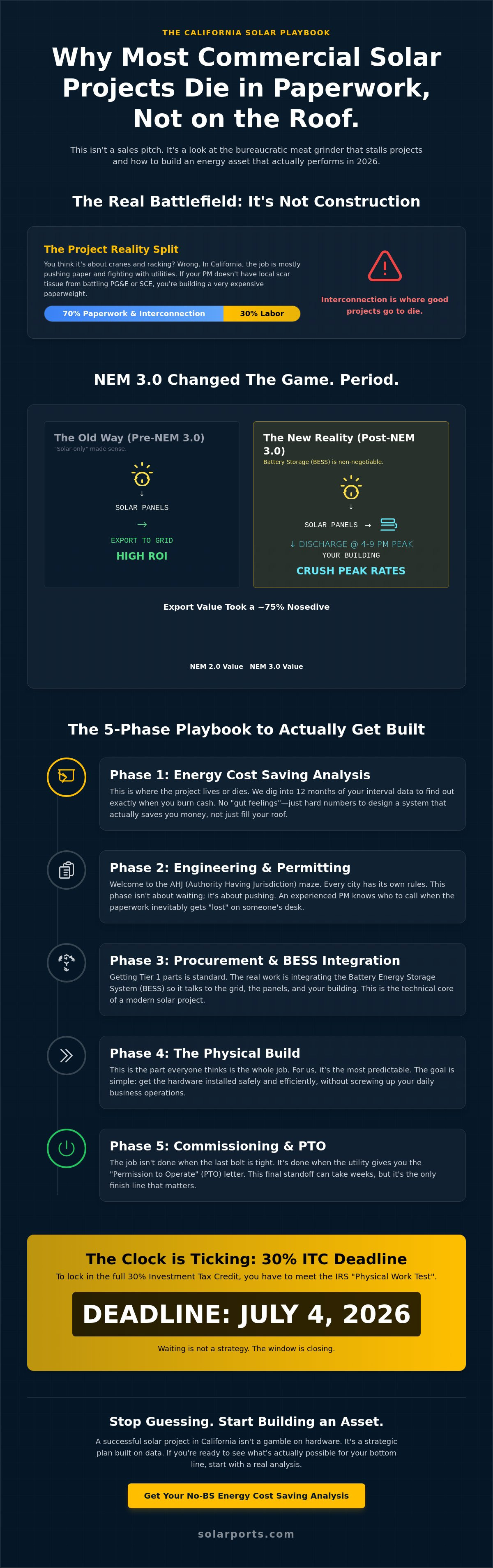
If you think building a commercial solar array is about cranes and racking, you're going to have a rough time. In this state, construction is the easy part. The real work is 70 percent paperwork and 30 percent actual site labor. If your lead for commercial solar project management CA doesn't have the "scar tissue" from fighting with PG&E or SCE, your project is basically a very expensive paperweight sitting on your roof. You need someone who knows exactly which desk a permit is sitting on in Oakland or San Jose.
Interconnection is where projects go to die. The "Rule 21" process is a bureaucratic black hole that often takes longer than the physical build itself. A manager who knows what they're doing won't just wait for the utility to call back. They'll proactively manage those engineering reviews. If you aren't riding the utility's engineers every week, you'll end up with a six-month delay that eats your tax credit window. Solar power in California is a high-stakes game where the rules change every few months, and local knowledge in Northern California isn't just a "plus," it's a non-negotiable requirement for your timeline.
Navigating the Post-NEM 3.0 Landscape
NEM 3.0 killed the simple "solar-only" model. In 2026, putting up panels without a battery is a financial mistake for most businesses. Export rates dropped by about 75 percent, so project managers now have to be part-time economists. They have to run the numbers through the Avoided Cost Calculator to prove your ROI. It's about battery discharge timing now. You want to dump that power when the utility rates are at their peak, usually between 4 and 9 p.m., not just when the sun is out. If your PM isn't talking about discharge strategies, they're living in 2022.
The Interconnection Nightmare
A real manager has the relationships to push through the utility backlog. They understand that the utility isn't your partner; they're a hurdle. Proactive management of the engineering review phase is the only way to avoid the standard six-month stall. You need a PM who treats the utility's "expected timeline" as a challenge to be beaten, not a schedule to be followed. This means knowing when to escalate and who to call when the paperwork stops moving.
The 5-Phase Architecture of a California Commercial Solar Build
A project that isn't built on a foundation of hard data is just a gamble. In the world of commercial solar project management CA, we see too many systems that are over-engineered or, worse, completely mismatched to the building's actual load profile. Successful projects follow a rigid, five-phase architecture that prioritizes financial performance over just "getting panels on the roof."
- Phase 1: Energy Cost Saving Analysis. This is where the project lives or dies. We look at 12 months of interval data to see exactly when you're pulling from the grid.
- Phase 2: Engineering & Permitting. Dealing with AHJs in cities like Oakland or San Jose requires a specific kind of patience. Every jurisdiction has its own interpretation of the electrical code.
- Phase 3: Procurement & BESS Integration. This is the SERP gap most ignore. Securing Tier 1 components is standard, but integrating a Battery Energy Storage System (BESS) is now the core of the project.
- Phase 4: The Physical Build. Whether it's rooftop solar or carports, the construction has to happen without killing your daily operations.
- Phase 5: Commissioning & PTO. The final wait for the utility to say "yes."
Phase 1: The Analysis is the Project
You can't manage what you haven't measured. We don't even suggest a panel layout until we've dissected a full year of your energy usage. Under NEM 3.0, the math has shifted so dramatically that "gut feelings" lead to five-year ROI delays. It's vital to have a commercial solar installation timeline that accounts for these early analytical deep dives. If your project manager skips the 12-month interval data review, they aren't protecting your bottom line. You might want to start with a professional energy cost saving analysis before signing any hardware contracts.
Phase 5: Commissioning and the PTO (Permission to Operate)
The job isn't done when the last bolt is tightened. The "Permission to Operate" letter from the utility is the actual finish line. This final hurdle is often a weeks-long standoff with utility clerks. A managed project ensures that the monitoring software is calibrated and the BESS is programmed for optimal discharge before the crew leaves the site. If you can't see your real-time savings on a dashboard, the project isn't finished.
Right-Sizing the Strategy: Beyond Just Buying Panels
More solar is not always the answer. Sometimes, it's the problem. A lot of sales reps will try to cover every square inch of your roof because that's how they get paid. But in commercial solar project management CA, my job is often telling a client to scale back. If you build a system that produces power you can't use and can't export for a profit under the current NEM 3.0 rates, you've just bought a very expensive ornament. You need to right-size the build to your actual demand charges and your BESS capacity. It's about the math, not the panel count.
Then there's the financial architecture behind the 2026 commercial solar tax credit in California. You have a hard deadline of July 4, 2026, to commence construction if you want to secure that 30 percent ITC. This isn't just about signing a contract; you have to actually meet the Physical Work Test or hit that 5 percent safe harbor cost threshold. A real project manager manages the ledger as much as the job site. If they aren't talking about the July deadline right now, they're already behind.
Things get even messier when you move to the parking lot. A commercial solar carport with EV charging isn't just a solar project; it's a civil engineering project with high-voltage challenges. You're dealing with trenching, ADA compliance, and load management for the chargers. This is where the "Solar Cowboy" approach fails. You can't just hire a guy who knows panels. You need a specialized PM who understands how EV chargers eat into your solar production and how to balance that with your building's primary load.
Turnkey vs. Fragmented Management
Hiring a separate designer, a separate engineer, and a separate installer sounds like a way to save money on paper. It's actually a fast track to change orders that'll blow your budget. When the engineer blames the designer and the installer blames both, you're the one writing the check for the delay. At SolarPorts Development, we keep the "thinking fix" in-house. One point of contact. One responsible party. It stops the finger-pointing before it starts and ensures the original energy cost saving analysis actually matches the final build.
Future-Proofing for 2026 and Beyond
You don't want to be the person who has to rip up concrete in three years because you didn't plan for more storage. Even if you aren't maxing out your BESS today, your PM should be giving you a roadmap for expansion. Good project management is invisible. It's the fire that didn't happen because someone actually checked the switchgear compatibility six months before the hardware arrived. It's about protecting the asset for the next twenty years, not just getting through the next six months.
This focus on technical precision and professional installation is a standard upheld by industry experts like MarGav Solar, who provide the consultancy needed to ensure solar assets remain productive for decades.
Stop Fighting the Grid and Start Building Your Asset
You shouldn't have to spend your time chasing utility clerks or decoding the latest CPUC export rate changes. We've seen projects stall for months because of a single missing signature or a poorly timed interconnection request. Real commercial solar project management CA is about anticipating those friction points before they cost you money. It's about making sure your battery storage and carports actually talk to each other to wipe out those 4-9 p.m. demand charges. If your project lead isn't obsessed with your 12-month interval data, they're just guessing with your capital.
The July 2026 tax credit deadline is moving closer every day. If you want a system that's right-sized for your actual load, you need to start with data, not a sales pitch. We focus exclusively on the California market because that's where the complexity lives. You can get a straight-shooting Energy Cost Saving Analysis from SolarPorts to see exactly where your building is leaking cash. Let's get the paperwork moving so you can finally stop overpaying for power and start owning your energy future.
Frequently Asked Questions
How long does commercial solar project management typically take in California?
Most projects take anywhere from six to twelve months from the initial energy cost saving analysis to the final Permission to Operate letter. The actual construction is usually the fastest part of the timeline. It's the interconnection queue and the local permitting process in cities like Oakland or San Jose that eat up the calendar. If you're aiming to meet the July 4, 2026, ITC deadline, you need to be starting the process at least nine months out to ensure the Physical Work Test is documented correctly.
What is the most common reason for solar project delays in CA?
Utility bureaucracy is the primary reason projects stall. PG&E and SCE often have massive backlogs for interconnection reviews that can add months to a project without warning. A failure in commercial solar project management CA often comes down to a manager who treats utility timelines as suggestions rather than hurdles that need constant, aggressive follow-up. Missing a single document in the Rule 21 filing can reset your waiting period, which is why local experience is non-negotiable.
Do I need a separate manager for battery storage (BESS) and solar carports?
No, and hiring separate managers is a recipe for expensive change orders. You want a single turnkey partner who understands how the structural engineering of a carport affects the electrical integration of a BESS. When you fragment the management, you end up with designers and installers blaming each other for site delays. One lead should handle the entire stack to ensure the battery is programmed to discharge exactly when your carport production drops and your demand charges spike.
How does NEM 3.0 affect the way a project is managed?
NEM 3.0 shifts the focus from maximizing production to maximizing self-consumption. Since export rates dropped by about 75 percent, project management now requires much more sophisticated financial modeling than in the past. Your manager has to use the Avoided Cost Calculator to prove ROI and ensure the system is right-sized for your specific load. It's less about the number of panels and more about the timing of your battery discharge to avoid the highest utility rates between 4 and 9 p.m.


