
Your utility bill isn't just a receipt for power; it's a structural leak in your operational budget that gets wider every time the sun goes down in California. Most owners look at their monthly statement and see a mess of opaque charges and peak-demand penalties that seem impossible to dodge. You've probably wondered how does commercial solar work in a way that actually hits those specific line items instead of just adding more equipment to your roof. It's a fair question because a system that's over-engineered or lacks the right storage capacity is just another capital expense that fails to perform.
We agree that the current utility landscape feels rigged against large-scale property owners. This guide is designed to give you a clear look at the mechanical and financial machinery required to turn sunlight into a predictable, controlled asset. You'll learn how the hardware-to-savings pipeline functions, why Battery Energy Storage Systems (BESS) are the real secret to killing demand charges, and what a roadmap for a turnkey installation looks like. We're moving past the "green" fluff to focus on the fiscal optimization your bottom line requires.
Key Takeaways
- Get past the basic physics and learn why the inverter is the real "brain" of your system's operational efficiency.
- Learn why California's Time-of-Use rates make when you consume power far more important than the total volume you use.
- See why truly understanding how does commercial solar work means treating your roof or parking lot as a strategic financial asset rather than just a utility.
- Discover how Battery Energy Storage Systems (BESS) fill the gaps that solar alone can't touch, especially regarding those brutal peak-demand charges.
- Start with a data-driven energy cost saving analysis to make sure you aren't paying for a system that's over-built or under-engineered for your specific site.
The Mechanics of Commercial Energy Generation and Storage
Commercial solar is not just about mounting glass on a roof and hoping for the best. It's a precise industrial process. At its core, a Photovoltaic system uses high-efficiency silicon wafers to capture photons and convert them into Direct Current (DC). This is the raw material. However, your building runs on Alternating Current (AC). To understand how does commercial solar work at scale, you have to look at the transition from that raw DC power to usable building energy.
The scale is the differentiator. Unlike a residential setup, a commercial property moves massive amounts of power. You need sophisticated switchgear to handle high-voltage loads without compromising your existing infrastructure. If the engineering is sloppy, you aren't just losing efficiency; you're creating a massive operational liability. The inverter is the brain here, managing that conversion and ensuring the power is clean enough for sensitive office equipment or industrial machinery.
Photovoltaic Panels vs. Strategic Inverter Placement
Panel efficiency is a bit of a distraction for executive decision makers. Most Tier 1 panels are within a few percentage points of each other. The real performance gap happens in the architecture. For a large rooftop or a complex solar carport, the choice between string inverters and micro-inverters changes everything. String inverters are often more cost-effective for massive, open arrays, but they have a single point of failure. Micro-inverters offer granular control, which is vital if your site has shading issues or if you're looking for maximum uptime across a multi-acre deployment.
The Critical Role of BESS in California
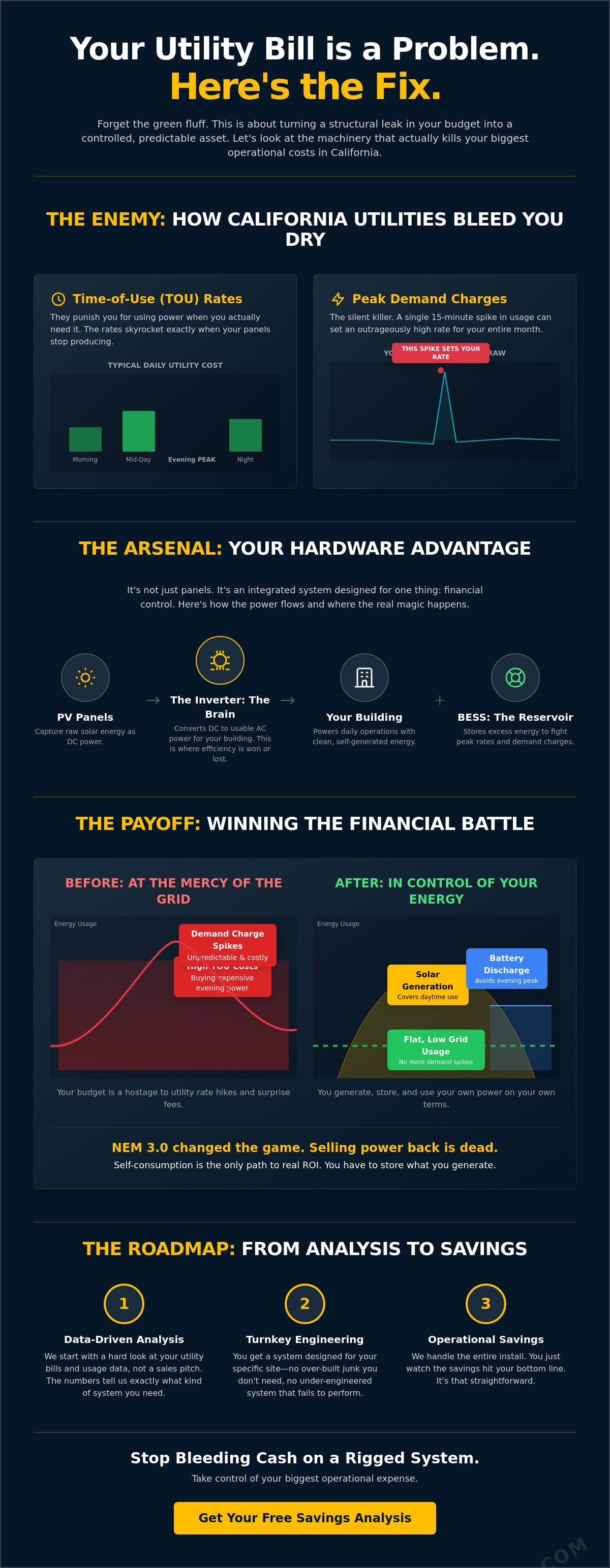
Solar panels stop producing exactly when California electricity gets most expensive. This is the fundamental problem with solar-only setups. A Battery Energy Storage System (BESS) acts as your strategic reservoir. It captures the excess energy you generate at noon and holds it until the evening peak window when utility rates skyrocket. Without storage, you're still at the mercy of the grid's most aggressive pricing. Integrating BESS requires a physical footprint on your property, but a commercial property energy cost saving analysis ensures the hardware doesn't eat up valuable parking or operational space. It's about turning a physical asset into a financial defense mechanism.
The Financial Workflow: How Solar Erases Commercial Utility Costs
Solar doesn't just lower your bill. It performs a surgical replacement of the most expensive energy your business consumes. If you're trying to figure out how does commercial solar work on a balance sheet, you have to stop looking at total kilowatt-hours and start looking at the clock. California utilities use Time of Use (TOU) windows that punish businesses for operating during the late afternoon and evening. By deploying strategies to lower commercial electricity bills California, you effectively shift your reliance away from the grid during these high-cost periods. It's about outmaneuvering a tariff structure designed to maximize utility revenue.
Mitigating Peak Demand Charges
Demand charges are the silent killer of commercial budgets. These are fees based on your highest 15-minute window of usage during a billing cycle. One spike in power can set your rate for the entire month. Battery Energy Storage Systems (BESS) solve this through peak shaving. When your building’s draw hits a certain threshold, the battery kicks in to provide the extra power, keeping your grid profile flat and your costs predictable. It's a defensive play that solar panels alone can't make.
Navigating California’s Net Billing Environment
NEM 3.0 changed the math for every property owner in the state. Selling power back to the grid in 2026 isn't the profit center it used to be; the export rates have dropped significantly. This makes self-consumption the only real driver of ROI. You need to store what you generate. Net Billing is a strategic shift from selling power to storing value. As you evaluate Solar Financing and Ownership Options, remember that the most profitable system is the one that keeps your electrons behind the meter. To see how these shifts affect your specific site, you can schedule a review of your current utility data.
The Project Lifecycle: From Analysis to Operational Savings
A successful project never starts with a purchase order for panels; it begins with a rigorous commercial energy cost saving analysis to ensure the hardware is actually right-sized for the load. If you over-build, you're wasting capital. If you under-engineer, you're leaving those brutal peak-demand charges on the table. To truly grasp how does commercial solar work as a financial tool, you have to see the lifecycle as a data-driven progression rather than just a construction job. It's about precision from day one.
The engineering phase is where the physical reality of your asset takes shape. Whether you're looking at a flat roof or a parking lot carport, structural integrity is non-negotiable. This isn't just about weight; it's about electrical integration and meeting the Solar Photovoltaic Technology Basics required for industrial-grade output. Once the design is set, the real hurdle begins: interconnection. Dealing with California utilities is a specialized skill. Without expert commercial solar project management CA, your system might sit idle for months while you wait for a utility rep to sign off on a meter swap. You have to plan for that friction early because utilities aren't in a hurry to help you stop paying them.
Why the Energy Audit is the First Move
We start by pulling 12 months of interval data to map your building’s unique energy fingerprint. This shows us exactly when your peaks happen and where the waste is. It's often possible to find low-hanging fruit in your current efficiency before we even bolt a single rail to the roof. By cleaning up your consumption profile first, we ensure the solar and storage systems we install are working at maximum fiscal efficiency. You don't want to buy a bigger system than you actually need.
Turnkey Implementation: Rooftops and Carports
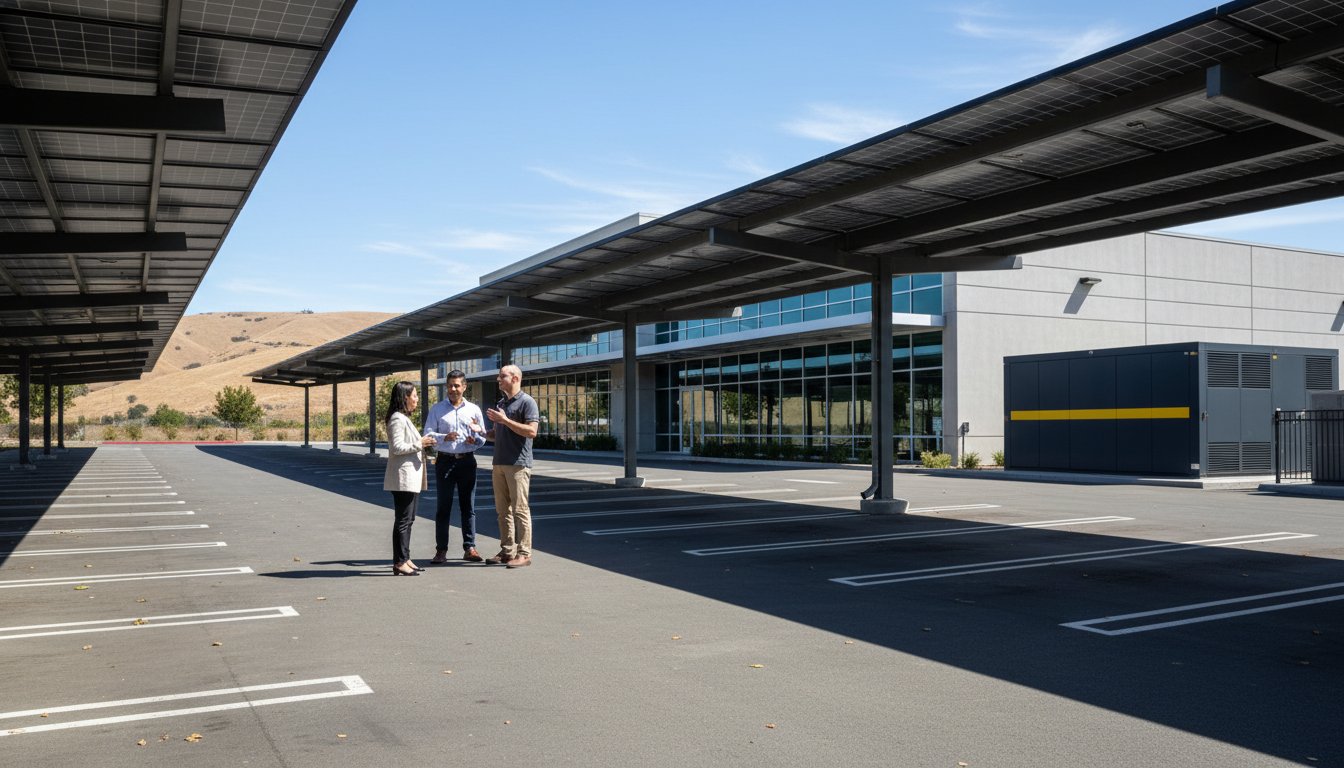
Deploying rooftop solar for office buildings CA is the most direct way to turn dead roof space into a revenue-saving asset. It doesn't cost you a single square foot of usable property. On the other hand, solar carports are becoming a strategic favorite because they turn a liability, like hot, exposed pavement, into a dual-purpose asset. You're providing shade and protection for tenants while generating the power that kills your utility bill. It’s a clean, logical use of space that adds immediate value to the real estate.
Securing Your Operational Bottom Line
California's utility market isn't getting any simpler. You've seen that the real value of solar isn't just in the panels, but in the strategic integration of Battery Energy Storage Systems (BESS) and precise project management. By shifting consumption away from peak windows and utilizing turnkey solutions like solar carports, you turn a variable expense into a controlled asset. Understanding how does commercial solar work from a financial perspective is the first step toward stopping the hemorrhage of overpaying for power. It's about outmaneuvering a system that's currently designed to profit from your inefficiency.
The way ahead isn't about finding a generic vendor; it's about leveraging California-exclusive commercial expertise to run a data-driven energy cost saving analysis. We specialize in turnkey BESS and carport solutions because that's what actually moves the needle for property owners in this state. If you're ready to move from a structural deficit to a strategic advantage, let's look at your specific interval data. You can schedule your free commercial solar consultation for June 2026 to start the process. Taking control of your energy future is a calculated move that pays off every single day.
Common Questions Regarding Commercial Energy Systems
Does commercial solar still work during a power outage?
Standard grid-tied systems shut down during an outage to protect utility workers. It's a safety requirement. If you want your facility to keep running, you need a Battery Energy Storage System (BESS) with islanding capabilities. This allows the system to disconnect from the grid and power critical loads using stored energy. Without that battery, your panels are just expensive roof ornaments until the utility restores the connection.
How much space do I actually need for a commercial solar system?
Your energy load determines the footprint. Most commercial systems require about 100 square feet of roof or parking lot space for every kilowatt of capacity. When property owners ask how does commercial solar work in terms of space, we look at the specific layout of the site. For a medium office building, this often means utilizing the rooftop or a solar carport to meet the total power demand.
What is the typical maintenance schedule for a commercial solar carport?
Carports are remarkably durable, but they aren't "set it and forget it" assets. You should plan for a professional inspection once a year to check torque on fasteners and the health of the electrical connections. Depending on your location in California, you might need panel cleaning twice a year to remove dust or smog residue that blocks sunlight. Keeping the area under the canopy clear of debris is a basic operational task.
How long does the actual installation take once the permits are approved?
Once you have the green light from the local jurisdiction, the boots-on-the-ground phase moves relatively fast. A standard rooftop install might wrap up in a month. However, complex solar carports or large BESS integrations can take up to twelve weeks. The real bottleneck isn't the construction; it's the final utility interconnection. This is why understanding how does commercial solar work within the context of California's grid is vital for managing your timeline.


