

Most California business owners treat solar as a decorative tax write-off when they should be treating it as a tactical defense against a utility provider that's essentially broken. You've seen the monthly statements. Between opaque demand charges and a grid that feels increasingly fragile, the power company has become a primary threat to your operational budget. Strategic solar for commercial buildings California properties utilize is no longer an optional upgrade, it's a financial necessity.
You can stop overpaying for grid power by understanding how to deploy right-sized solar and storage assets. This guide outlines the shift toward self-consumption and battery resiliency under current NEM 3.0 rules. We'll show you how to turn underutilized parking or rooftop space into a financial tool that delivers predictable costs and operational safety. We're breaking down the logic of 2026 energy defense to help you secure a real return on investment.
Key Takeaways
- Stop letting 15-minute demand spikes dictate your monthly overhead by identifying exactly where the grid is draining your cash.
- Deploying solar for commercial buildings California businesses actually profit from requires shifting your focus from simply generating power to tactical energy defense.
- Use a data-driven energy cost saving analysis to ensure you aren't buying more hardware than your property needs for a fast ROI.
- Discover how solar carports and battery storage work together to turn underutilized parking space into a dual-purpose asset that shields your bottom line.
Why California Businesses Are Still Overpaying for Electricity
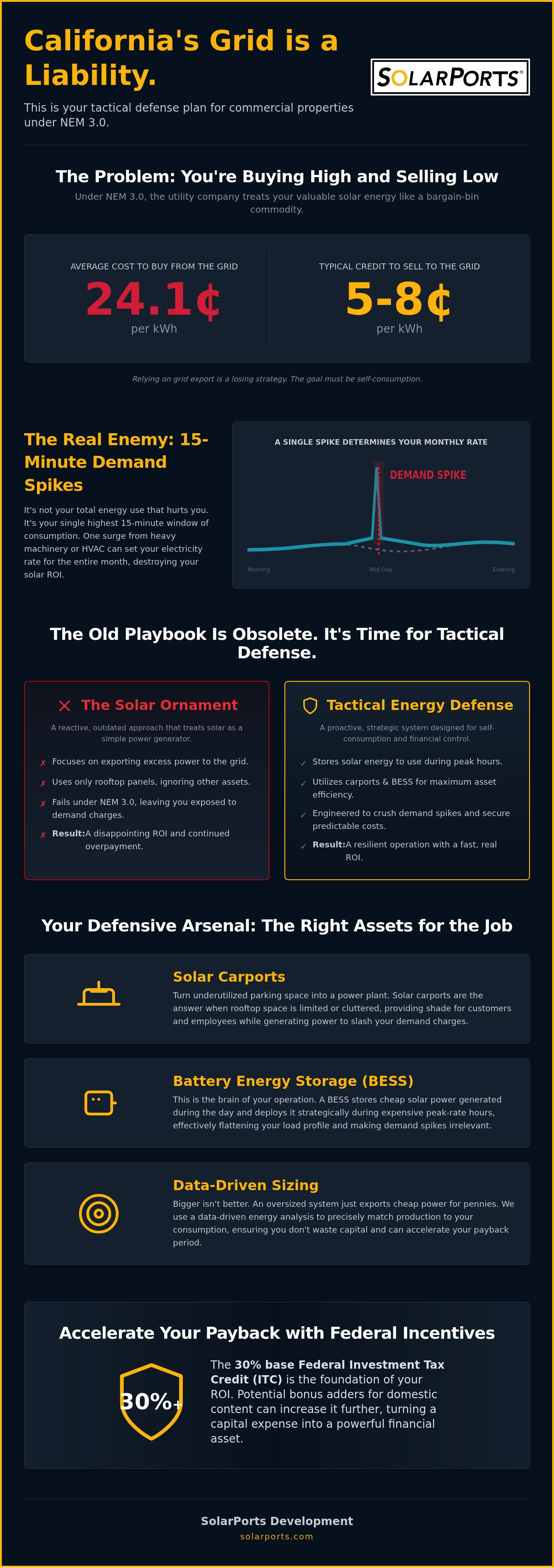
California's grid is a liability. That sounds harsh, but when you're paying 24.1¢/kWh on average, it's the reality. These high rates aren't just about "green energy" mandates anymore. They're driven by massive investments in wildfire mitigation and infrastructure that hasn't kept pace with demand. While Solar power in California has expanded significantly, the financial benefit for businesses has shifted. You can't just slap panels on a roof and expect the utility company to cut you a check. Under current NEM 3.0 rules, exporting power back to the grid pays pennies, roughly $0.05 to $0.08 per kWh. If your system is just a "solar ornament" without a strategy, you're still overpaying for the power you actually use.
The Hidden Cost of Demand Charges in Northern California
Demand charges are essentially a tax on operational inefficiency. Unlike residential customers who pay for total volume, your commercial bill is dictated by your highest 15-minute window of usage. One heavy machinery startup or a cooling system surge can set your rate for the entire month. It's a brutal calculation. To fight back, you need more than just generation; you need control. You should look into the Strategies to Lower Commercial Electricity Bills California owners are using to shave those peaks. Deploying solar for commercial buildings California properties actually benefit from means matching your load to your production in real-time. If you don't, that single spike ruins the ROI of your entire array. It’s about defensive positioning, not just "going green."
The 2026 energy landscape is unforgiving. Relying solely on rooftop solar for commercial buildings California installations without storage or a load-management plan is a recipe for disappointment. You’re essentially buying a tool and only using half of it while the utility takes the rest.
Beyond Rooftops: Carports and Storage as Strategic Assets
Thinking that solar only belongs on a roof is a mistake that limits your ROI. Most developers look at a parking lot and see asphalt; we see a power plant that doubles as a premium amenity. Solar carports are the tactical answer for office plazas and retail centers where roof space is either cluttered with HVAC units or simply too small to offset the building's load. These structures provide immediate value by shading customer vehicles while simultaneously slashing your demand charges. It's a shift from seeing solar as an add-on to seeing it as a core property asset.
Maximizing Real Estate with Solar Carport Systems
In the current market, as noted in the Solar Market Insight Report, the focus has shifted toward maximizing every square foot of a property. A Commercial Solar Carport with EV Charging California installation transforms a passive expense into a revenue-generating asset. It’s a dual-purpose move. You protect employee cars from the sun and use that same footprint to fuel your operations. This isn't just about extra space; it's about better real estate management.
However, the hardware is useless without a Battery Energy Storage System (BESS). Think of BESS as the brain of your solar for commercial buildings California setup. It’s the logic that decides when to pull from the grid and when to burn your own stored energy. Without it, you're at the mercy of the utility's peak pricing. A coordinated, turnkey system ensures the carport, the rooftop, and the battery work together to flatten your load profile. If you're wondering how this fits your specific site, you can schedule a brief walkthrough of your property's energy potential to see the data for yourself.
Right-Sizing Your Investment for Maximum ROI
Bigger isn't better. Many vendors push for maximum-sized systems because it pads their commission. That’s a mistake. Under NEM 3.0, an oversized system just generates cheap power you can't sell back for a profit. You need a data-driven Commercial Energy Cost Saving Analysis to find the sweet spot where your production matches your consumption. This is how solar for commercial buildings California properties actually becomes a financial asset. When evaluating solar for commercial buildings California owners often overlook the nuance of load matching. It’s about precision. You want to offset those expensive peak hours without wasting capital on panels that sit idle.
Accelerating your payback period requires a sharp eye on the Commercial Solar Tax Credit California offers. Between the 30% base ITC and potential bonus adders for domestic content, the math changes quickly. Securing these incentives early in the project lifecycle ensures the capital expenditure doesn't weigh down your balance sheet longer than necessary.
The Path to Energy Independence in 2026
The transition from analysis to activation is where most projects stall. Permitting in Northern California is notoriously complex. That’s why Commercial Solar Project Management in CA is about more than just oversight; it’s about navigating the unfiltered reality of utility interconnections and local codes. A turnkey approach takes you from initial site assessment through grid connection without the typical headaches. It’s time to take control of your overhead. You can schedule your free solar consultation to stop overpaying for grid power and get a clear look at your property's actual saving potential.
Securing Your Operational Future Against Rising Rates
The California grid isn't getting cheaper or more reliable. We've established that the old model of solar as a mere tax write-off is dead. To survive the 2026 energy landscape, you need a system that actively defends your bottom line. This means deploying solar for commercial buildings California properties can actually use to flatten demand charges and store power for peak hours. It's about being a strategic architect for your own real estate.
As turnkey specialists with deep Northern California expertise, we provide data-backed ROI modeling that strips away the guesswork. You shouldn't have to wonder if the math works. You can Request a Commercial Energy Cost Saving Analysis today to see the unfiltered reality of your site's potential. It’s time to stop being a passive utility consumer and start owning your power. You've got the space; let's make it work for you.
Frequently Asked Questions
Is solar still worth it for California businesses after NEM 3.0?
Solar remains a critical asset, but the math has shifted from selling power back to the grid to avoiding expensive utility purchases. Under NEM 3.0, export rates dropped significantly, to around $0.05 per kWh. This makes solar for commercial buildings California properties most effective when paired with storage. You aren't trying to be a mini-utility; you're aiming to stop buying power at 24.1¢/kWh.
How long does a commercial solar carport installation take in California?
A typical turnkey carport project usually spans six to nine months from the initial energy cost saving analysis to final grid interconnection. Permitting in Northern California often takes up the bulk of that timeline, depending on your local jurisdiction. The actual physical construction of the steel structures and panel mounting is relatively fast, often completed in just a few weeks to minimize disruption to your parking operations.
Can BESS help my business avoid peak demand charges?
Battery Energy Storage Systems (BESS) are specifically designed to mitigate those 15-minute spikes that ruin your budget. By discharging stored energy during periods of high facility demand, you "shave" the peak that the utility uses to calculate your monthly demand charge. It’s a tactical move that turns a battery into a financial shield against the most expensive, non-negotiable parts of your utility bill.
What is the typical ROI for commercial solar in Northern California?
ROI for solar for commercial buildings California installations varies based on your specific load profile, but many businesses see a full payback in five to seven years. This is accelerated by the 30% Federal Investment Tax Credit and 20% bonus depreciation available in 2026. Because Northern California rates are among the highest in the country, the cost of doing nothing is often higher than the investment.


