

Your existing solar array isn't failing you, but the utility billing structure is. In 2026, many Bay Area businesses find that even with a roof full of panels, PG&E demand charges still account for over 50% of their monthly bill. It's a frustrating shift. You invested in solar for control, yet you're still at the mercy of peak rates hitting 50 cents per kWh. Adding battery storage to existing commercial solar Bay Area systems has shifted from a sustainability goal to a necessary financial defense.
I've seen the confusion around NEM 2.0 rules and the fear that older inverters won't play nice with new hardware. This guide cuts through that noise. We'll look at how the 30% federal ITC and current SGIP rebates turn a technical retrofit into a clear asset management win. You'll learn how to right-size your storage to kill demand charges and finally lock in the ROI you expected.
Key Takeaways
- Understand why PG&E's 2026 rate hikes make solar-only systems a financial liability and how BESS fixes the "utility trap."
- Learn the specific technical steps for adding battery storage to existing commercial solar Bay Area without needing to replace your entire legacy inverter setup.
- Use a data-driven energy cost saving analysis to pinpoint your property's ideal battery capacity before you commit to any hardware.
- Capture the full financial benefit of the 30% federal ITC and current commercial SGIP rebates to maximize your retrofit’s long-term ROI.
The Bay Area Utility Trap: Why Your Existing Solar Is No Longer Enough
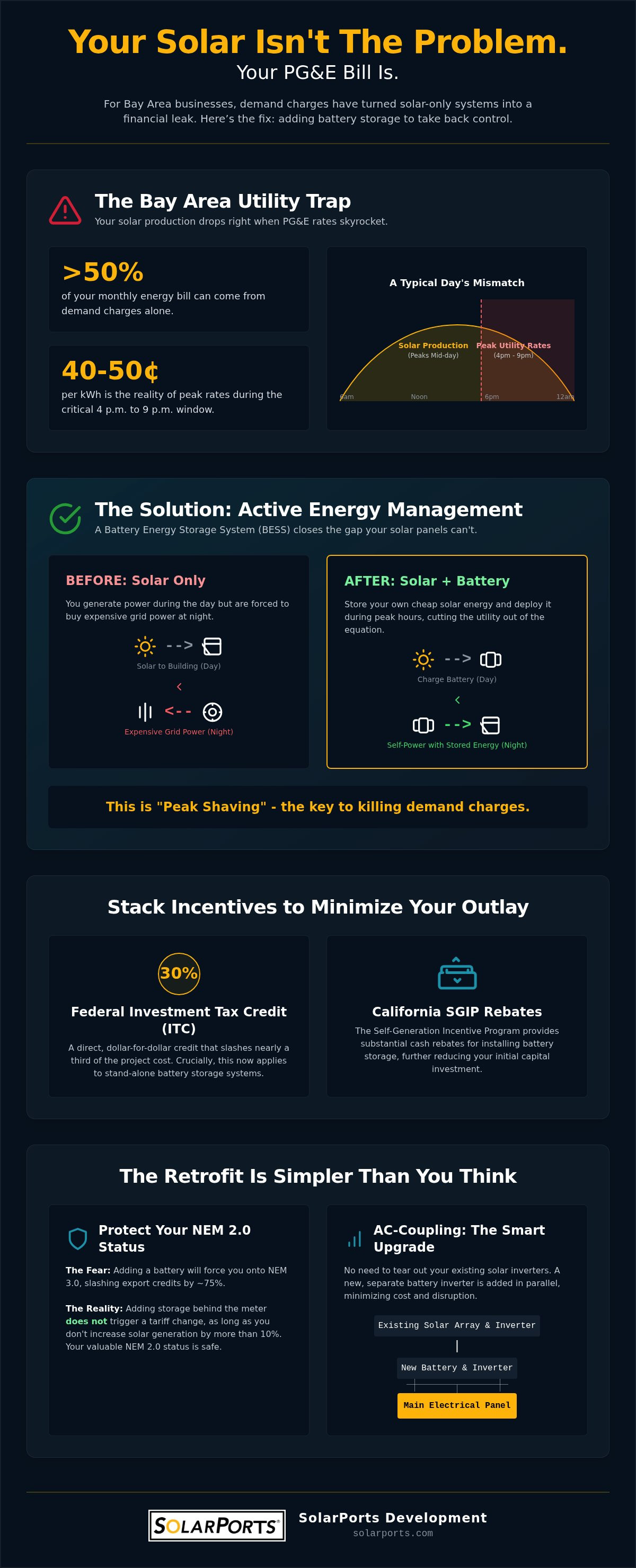
Your solar panels are performing exactly as they were designed to, but the financial math has fundamentally shifted. In 2026, PG&E commercial peak rates frequently fluctuate between 40 and 50 cents per kWh during the critical 4 p.m. to 9 p.m. window. This is the "utility trap." Because your solar production naturally tapers off just as these rates spike, your property remains fully exposed to aggressive demand charges. These fees can easily account for over 50% of your total energy spend, making a solar-only setup a leaky bucket for your operational budget.
Adding battery storage to existing commercial solar Bay Area properties is the only logical way to fight back through peak shaving. By deploying What is a Battery Energy Storage System (BESS), you capture excess solar energy during the day and discharge it when the grid is most expensive. This strategy flattens your demand profile and slashes utility fees that solar alone simply cannot touch. It's about moving from passive generation to active energy management.
NEM 2.0 vs. NEM 3.0: Protecting Your Existing Interconnection
Many owners worry that any modification will kill their grandfathered NEM 2.0 status. It's a valid concern. If you increase your generation capacity by more than 10%, you risk being forced onto NEM 3.0, where export credits drop by roughly 75%. However, adding storage is a different category. A professional commercial energy cost saving analysis by SolarPorts Development ensures your BESS is integrated behind the meter without triggering a mandatory tariff change. Energy storage acts as a strategic shield, preserving the high value of your original solar investment against a utility landscape that increasingly penalizes export.
The Retrofit Reality: Technical Hurdles of Adding Storage to Older Systems
Retrofitting isn't a plug-and-play scenario. Your existing hardware, specifically legacy inverters from five or ten years ago, might not communicate with modern lithium-ion management systems. This is where most projects stall before they even begin. Before looking at hardware specs, you need a commercial energy cost saving analysis to determine the exact capacity required. Over-engineering is a waste of capital, while under-sizing means you'll still get hit by demand charges when the sun goes down.
Then there's the physical reality of the Bay Area. High-density zones in Oakland or San Jose have tight setbacks and strict fire codes that didn't exist when your solar was first installed. You've got to navigate NFPA 855 and the 2026 UL 9540A standards for thermal runaway. It's not just about finding a spare corner in the warehouse; it's about finding compliant space that won't trigger a permitting nightmare with the local fire marshal.
AC-Coupling: The Secret to Retrofitting Without Tearing Out Your Inverter
AC-coupling is usually the standard for adding battery storage to existing commercial solar Bay Area arrays. Instead of replacing your perfectly good solar inverter, we add a separate battery-specific inverter that talks directly to the grid. There's a tiny efficiency loss, maybe 1% to 3%, but it's nothing compared to the massive cost and downtime of a full system overhaul. At SolarPorts Development projects, we use this method to keep installation timelines short and minimize business disruptions. It also simplifies your application for California's Self-Generation Incentive Program (SGIP), ensuring you capture every available rebate dollar. If you're unsure if your site can handle the physical footprint, book a technical site assessment to see what’s possible.
Financial Defense: How BESS Turns Your Property into a Profit Center
Stop thinking about batteries as an emergency generator. For a commercial landlord in San Jose or San Francisco, a Battery Energy Storage System (BESS) is a high-yield arbitrage tool. You're buying or generating power when it's cheap and deploying it when PG&E wants 50 cents per kWh. This isn't just about keeping the lights on during a grid failure. It's about systematically attacking the demand charges that solar can't reach. Adding battery storage to existing commercial solar Bay Area systems leverages the 30% Federal Investment Tax Credit (ITC), which in 2026 applies to both integrated and stand-alone storage. Review our guide on strategies to lower commercial electricity bills in California to see how this fits into a broader fiscal plan.
The SGIP and ITC Stack: Minimizing Your Capital Outlay
The real magic happens when you stack the ITC with California's Self-Generation Incentive Program. In 2026, SGIP rebates for standard commercial projects range from roughly $0.15 to $0.25 per watt-hour. For a 100 kWh system, that can mean a $15,000 to $25,000 rebate. We focus on "right-sizing" your system because over-building just to have a bigger battery often dilutes your incentive-to-cost ratio. You want the smallest footprint that delivers the maximum demand charge reduction. It's a precision game that requires looking at your actual interval data. To see how these numbers apply to your specific property, schedule a free solar and storage consultation today.
Neutralize Your Demand Charges and Secure 2026 Incentives
The math for commercial solar has fundamentally shifted. It's no longer enough to generate power; you have to control the timing of your consumption to avoid those evening peak spikes. Adding battery storage to existing commercial solar Bay Area systems is the most effective way to neutralize PG&E demand charges while locking in the 30% federal tax credit before the 2026 window closes. We've shown that AC-coupling provides the path of least resistance for older inverters, and precision right-sizing is what actually protects your bottom line.
SolarPorts Development specializes exclusively in the California commercial market, providing the data-driven ROI modeling needed to justify a retrofit. We manage the entire turnkey BESS implementation, from initial analysis to final interconnection with the utility. You don't have to navigate technical fire codes or SGIP paperwork alone. Schedule your free commercial solar and storage consult for 2026 to secure your property's financial future. Your property can be a profit center again.
Frequently Asked Questions
Will adding a battery to my existing solar system void my warranty?
Adding a battery won't void your existing solar warranty if you use an AC-coupled configuration. When adding battery storage to existing commercial solar Bay Area systems this way, the two systems remain electrically separate on the DC side. Since we aren't opening up your original inverters or re-wiring panels, your manufacturer’s protection remains intact. It’s a clean integration that adds functionality without risk.
How much space does a commercial BESS require for a Bay Area office or warehouse?
Space requirements vary based on your specific energy profile, but a typical 100 kWh commercial system usually fits within a 10 by 15 foot footprint. In high-density Bay Area zones, we often utilize vertical racking or compact outdoor enclosures to meet strict fire code setbacks. We determine the exact dimensions during our initial technical site assessment to ensure we don't crowd your operational areas.
Can I use my battery storage for backup power during a PSPS event in Northern California?
You can use battery storage for backup during a PSPS event, but it requires an islanding configuration to safely disconnect from the grid. Most commercial retrofits focus on peak shaving to lower bills, so you must specify backup needs during the design phase. This ensures your critical loads stay powered when PG&E shuts down the lines for wildfire prevention in Northern California.
How long does the interconnection process take with PG&E for a battery retrofit?
The interconnection process with PG&E for adding battery storage to existing commercial solar Bay Area sites usually takes four to eight weeks after installation. While local building permits might only take 10 business days, the utility's engineering review and final Permission to Operate involve significant red tape. We manage this entire administrative timeline to ensure your system doesn't sit idle for months.


