
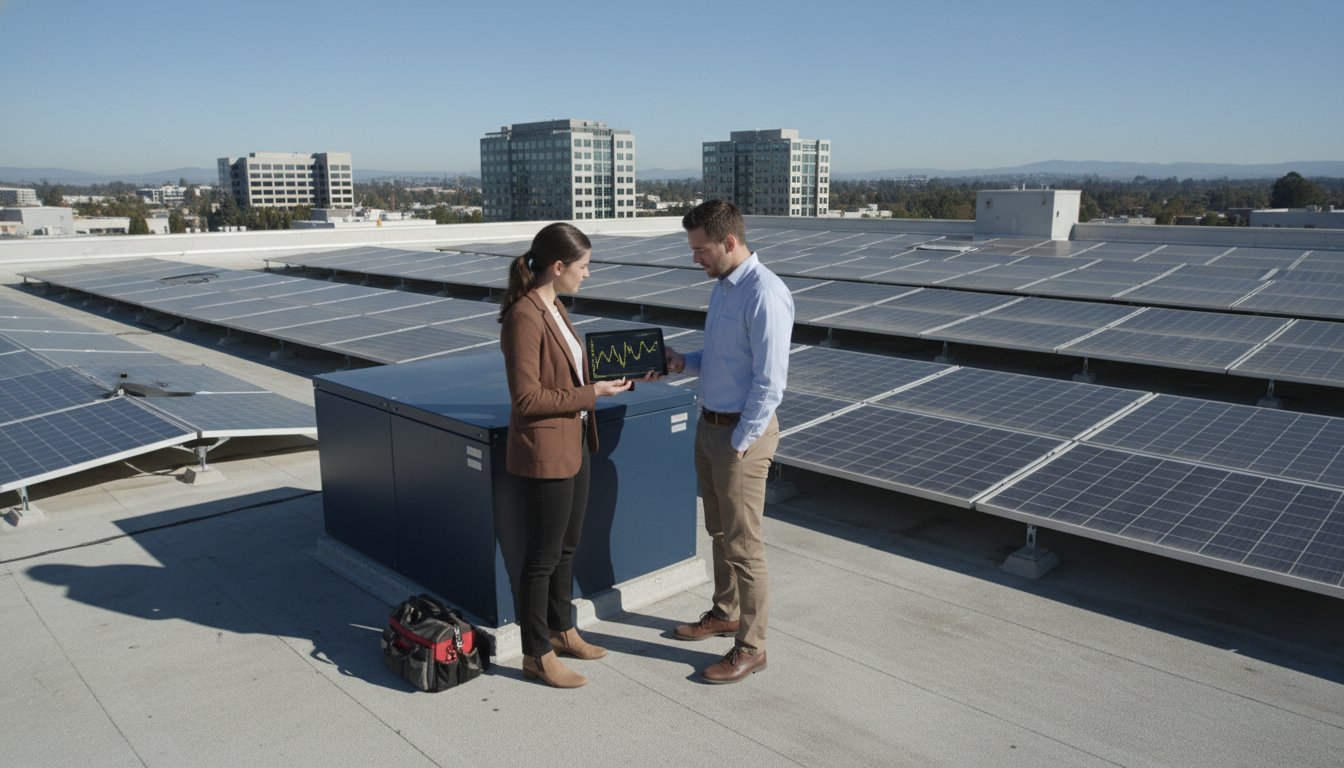
The Strategic Importance of Right-Sizing Commercial Solar
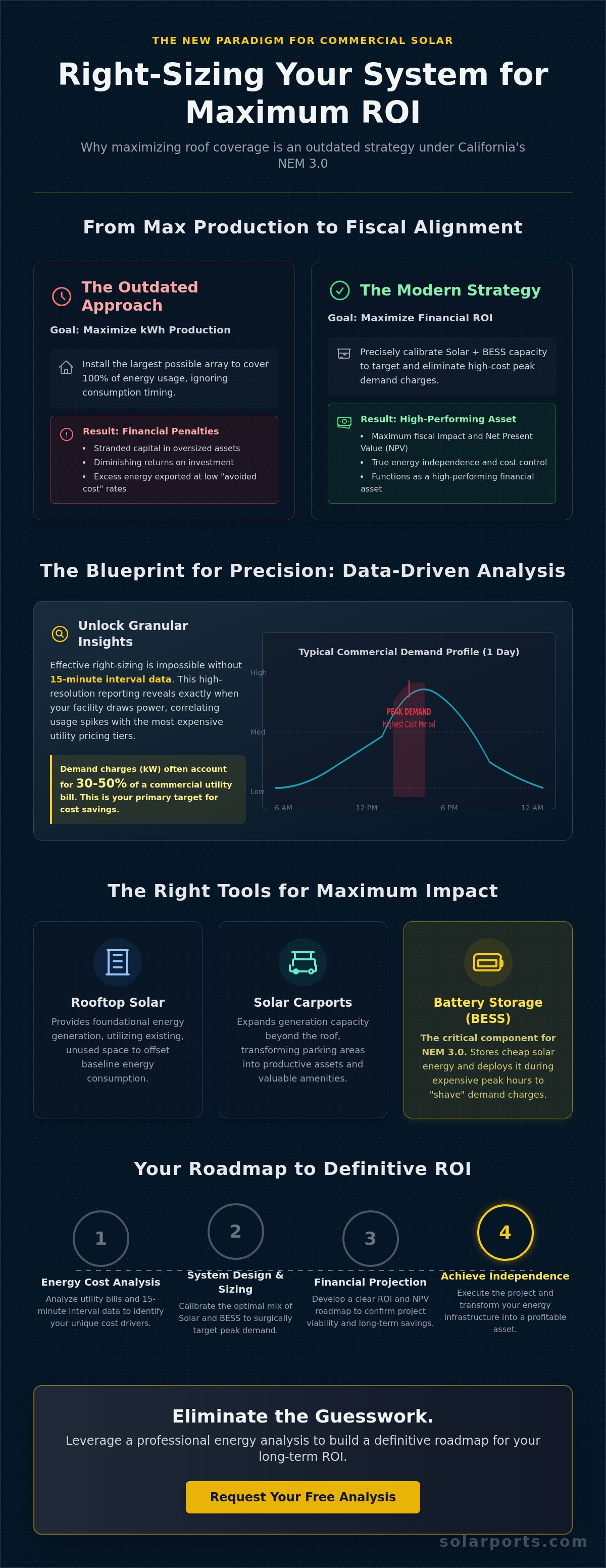
Let's get one thing straight. Right-sizing a commercial solar system isn't about covering your roof with as many panels as it can hold. That's the old way of thinking, and in California, it's a recipe for wasting money. The game has changed. It's no longer about who can produce the most energy; it's about who can manage it most intelligently.
In today's energy market, "bigger" is almost never better. An oversized system generates a lot of power when you don't need it and exports it to the grid for pennies. An undersized system leaves a fortune on the table in avoided utility costs. Both are mistakes. Getting it right means finding the precise intersection of your operational needs and your financial goals. (Rooftop solar power system)
- What is right-sizing? It's the disciplined process of designing a solar and storage system that delivers the fastest possible payback, not the highest possible kilowatt-hour number.
- Why 'bigger' is a liability: Under California's NEM 3.0, exporting excess solar is a losing proposition. Every oversized panel is an investment with diminishing, often negative, returns.
- The shift in thinking: We've moved from simple energy production to active energy management. Your building is now an asset that needs to store, deploy, and use its own power to fight back against utility demand charges.
- The risk of undersizing: Playing it too safe means you're still exposed to punishing peak rates and leaving massive, predictable savings unrealized year after year.
Defining ROI vs. Max Production
Anyone can design a system that generates a ton of electricity. The real challenge is designing one that generates the maximum return on your investment. A system built for maximum net present value (NPV) looks very different from one built to just offset 100% of your bill. It’s about surgical precision, not brute force.
The core idea is simple: Right-sizing is finding the perfect equilibrium between your upfront installation cost and the total utility expenditure you avoid over the life of the system. Every dollar you invest has to work for you, and that requires a plan tailored to your specific financial reality.
The Hidden Costs of Improper Sizing
Getting the size wrong isn't just a minor miscalculation; it has real, cascading consequences. An underbuilt system can’t shield you from peak demand charges, leaving your operations vulnerable to the grid's most expensive hours. You thought you solved the problem, but the worst parts of your utility bill are still there.
Oversizing is just as bad. It’s financial waste, plain and simple. You paid for generating capacity that does nothing but export energy at rock-bottom "avoided cost" rates. That capital could have been used for a correctly sized battery, which would actually attack your high-cost demand charges. This isn't just an operational issue; it impacts your property's valuation and long-term financial strategy.
Data-Driven Load Analysis: The Blueprint for Precision
If a solar company gives you a quote without first demanding at least a year of your 15-minute interval data, you should end the conversation. Period. A standard monthly bill is useless for this work. That interval data is the absolute, non-negotiable blueprint for designing a system that works.
It tells us everything: when you use power, how much you use, and exactly when those brutal peak demand charges are hitting you. We analyze your load profile to find the patterns—the seasonal swings, the daily spikes from equipment starting up. We have to account for Northern California's specific weather and sun angles. This isn't guesswork; it's forensics.
- 15-Minute Interval Data: This is the DNA of your building's energy use. Without it, any proposal is a shot in the dark.
- Peak Demand Windows: We identify the 2-3 hours a day that are costing you the most money. The entire system design is built around crushing those peaks.
- Seasonal Variations: Your summer cooling load is different from your winter heating load. The system has to perform optimally year-round, not just on a perfect day in May.
- Future-Proofing: Are you adding EV chargers? Electrifying your heating? We need to know. A right-sized system accounts for where your business is going, not just where it's been.
Decoding Your Utility Bill
Your PG&E bill is intentionally confusing. It's designed to be. You're hit with two main charges: energy charges (kWh), which is the volume of electricity you use, and demand charges (kW), which is a penalty for your highest peak usage in any 15-minute window. For most commercial properties, those demand charges are the real killer, often making up over 50% of the bill.
The first step is a deep dive into this data to see exactly where the financial pain is coming from. If you want to understand this process better, our guide on a commercial property energy cost saving analysis breaks down how we turn that raw data into a strategic roadmap.
Forecasting Future Energy Needs
A static analysis is a failed analysis. We have to look ahead. If you're planning to bring in a new, energy-hungry tenant or upgrade a major piece of machinery, that has to be baked into the model from day one. The same goes for energy efficiency. If you're upgrading to LED lighting or a more efficient HVAC system, that reduces the load the solar has to serve, changing the sizing calculation entirely.
And then there's the big one: EV charging. This isn't a minor addition; it's a massive new load. Integrating EV charging into the initial solar and storage design is infinitely smarter and more cost-effective than trying to bolt it on later.
The California Variable: Navigating NEM 3.0 and BESS Integration
NEM 3.0 didn't just tweak the rules for commercial solar in California; it completely upended the old model. The strategy of "spin the meter backward" is dead. The value of energy you export to the grid has been slashed by about 75%, meaning an oversized, export-focused system is now a financial dead end.
This is why a Battery Energy Storage System (BESS) is no longer an optional add-on. It's the core of any smart commercial solar project in California. The new model is all about self-consumption: generating your own power and storing it in your own battery to use during your most expensive peak hours. You aren't trying to sell power to the utility; you're trying to buy as little from them as humanly possible.
- How NEM 3.0 changed the math: It made on-site storage and self-consumption the only financially viable path forward.
- Why BESS is now mandatory: A battery allows you to absorb your own solar production and discharge it strategically to eliminate high demand charges.
- The 'Self-Consumption' model: We size the system for what you can use and store on-site, not what you can sell back to the grid.
- Mitigating demand charges: This is the primary job of the battery. It watches your load and dispatches power to "shave" the peaks before they can trigger a massive charge on your bill.
Right-Sizing the Battery Energy Storage System (BESS)
Sizing the battery is just as critical as sizing the solar array. It's a delicate balance. Too little storage, and you can't absorb all your mid-day solar generation or cover your entire peak window. Too much, and you've overspent on capacity you'll never use. We determine the optimal power-to-energy ratio for your specific load profile, ensuring the battery can both absorb your solar and discharge fast enough to counteract your demand spikes.
The goal is to pair the battery and the solar so they work as one cohesive unit. For a closer look at how this technology directly attacks your highest costs, see our explanation of how BESS reduces peak demand charges.
Calculating Export Value in 2024 and Beyond
Under NEM 3.0, the value of your exported energy is determined by the "Avoided Cost Calculator." It’s a complex formula that changes hour by hour, but the takeaway is simple: exporting solar power in the middle of the day, when solar is abundant, is worth next to nothing. Without a battery to store that energy for later, you're practically giving it away.
Incentives like the Self-Generation Incentive Program (SGIP) can help with the upfront cost of a battery, but the real value comes from the permanent reduction in your operational expenses. The ROI is driven by the demand charges you erase, not the crumbs the utility pays you for exports.
Physical Constraints vs. Energy Goals: Carports and Rooftops
Sometimes, your energy goals are bigger than your roof. We start every project with a hard look at the physical realities: Is the roof structure sound? How much usable, unshaded square footage is actually there after we account for HVAC units, vents, and fire code setbacks? Often, the roof alone can't support a truly right-sized system for a high-load building.
Ensuring the underlying structure is prepared for a decades-long solar commitment is a critical first step. For those evaluating their roof's health, Colorado Pro Roofing is an example of a professional contractor that provides the expert assessment and repair services necessary to ensure the surface is stable before panels are installed.
This is where solar carports become a strategic asset, not just an amenity. By utilizing your parking areas, you can add significant generating capacity without compromising your roof. For many properties, a hybrid approach combining rooftop and carport systems is the only way to achieve the scale needed to make a real dent in a massive utility bill.
The Carport Advantage for Right-Sizing
Solar carports are problem-solvers. They bypass rooftop obstacles completely. They turn an underutilized asset—your parking lot—into a power plant. And they create a natural synergy with EV charging infrastructure, providing a covered, convenient place for tenants or employees to charge their vehicles with clean energy generated just a few feet away.
Zoning and Structural Feasibility
This isn't just about throwing panels up. Every structure we build has to meet stringent Northern California municipal codes, including wind and seismic requirements. Before a single design is finalized, a professional structural analysis is completed. Navigating the local permitting process is a critical step, and doing it wrong can cause months of delays. It has to be done right, from the foundation up.
Executing a Turnkey Energy Analysis with SolarPorts
Our process is transparent and disciplined. We start with your interval data, build a detailed financial model based on your specific utility tariff, and present you with a feasibility study that eliminates all the guesswork. There are no vague estimates or generic quotes.
We show you exactly how a right-sized system will perform on your property, what the ROI will be, and how quickly it will pay for itself. From there, we manage the entire turnkey implementation: final design, engineering, permitting, and construction. Our job is to deliver a fully operational asset that starts saving you money from day one.
The Value of a Professional Feasibility Study
A SolarPorts energy cost saving analysis is a comprehensive financial document. It models your projected savings against current and future utility rate structures. It details the impact of federal tax credits and depreciation (MACRS). It gives you a clear, data-backed roadmap to understand the investment from every angle, allowing you to make a decision with confidence.
Moving Toward Implementation
Once the numbers are proven, we help you navigate the financing options—whether a direct purchase, lease, or PPA makes the most sense for your capital strategy. We then lay out a clear timeline, from final approval to system commissioning. The goal is to get you energy independent as quickly and efficiently as possible.
If you're tired of guessing and want to see what a data-driven approach can do for your property's bottom line, the next step is simple.


