
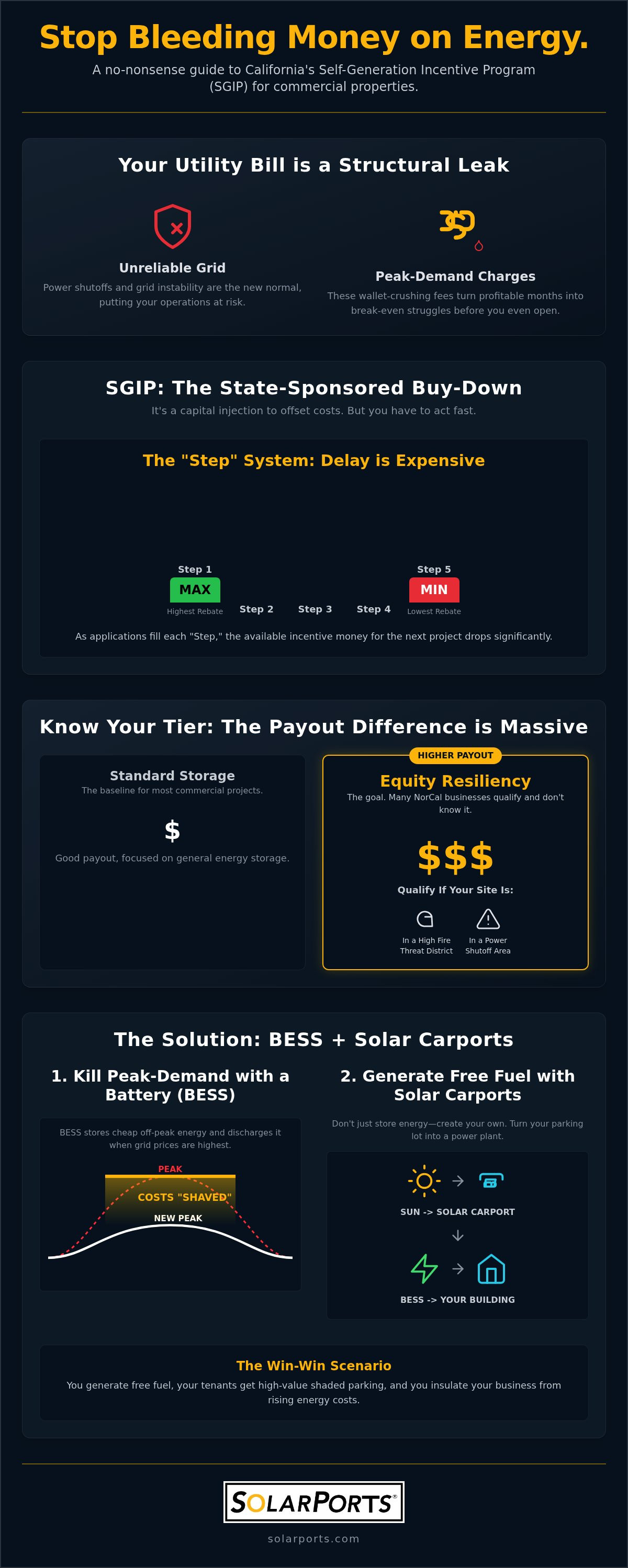
Your utility bill isn't just a cost of doing business; it's a structural leak in your balance sheet. In Northern California, peak-demand charges can turn a profitable month into a break-even struggle before you even open your doors. You know the grid is becoming less reliable and more expensive, yet the solutions often feel just as complicated as the problem. Accessing the California Self-Generation Incentive Program for business usually feels like a full-time job in translating government acronyms. It's enough to make any executive walk away from free capital.
You shouldn't have to be a policy expert to save money. This guide cuts through the noise to show you exactly how to leverage SGIP funds for your commercial battery storage project. We're laying out a clear path to secure your funding and slash operational expenses. You'll learn how to turn energy reliability into a competitive advantage for your asset.
Key Takeaways
- Treat the SGIP as a state-sponsored buy-down that turns battery storage into a mandatory financial asset for your property.
- The "Step" system means delay is expensive; as applications pile up, the available funding for your project drops.
- Find out how the California Self-Generation Incentive Program for business prioritizes resiliency, potentially offering much higher payouts for high-risk areas.
- Don't just store power; generate it by integrating solar carports to provide "free" fuel and high-value shade for your tenants.
The Reality of SGIP for California Businesses in 2026
Think of the California Self-Generation Incentive Program for business as a state-sponsored buy-down. It's a strategic capital injection designed to offset the heavy upfront costs of energy infrastructure. By 2026, the state's focus has moved past simple adoption. The priority is now grid resiliency and aggressive load shifting. This isn't a project you undertake to look "green" on a brochure. It's a calculated move to kill the peak-demand charges that bloat your commercial utility bill. If you hesitate, you're making a six-figure mistake. Every month you wait is another month of paying top-tier rates while the incentive tiers move closer to expiration.
BESS: The Engine Behind the Incentive
Battery Energy Storage Systems (BESS) are the primary vehicle for this funding. They function as the hardware engine that makes the financial math work. Instead of being a passive consumer, your building becomes an active participant in energy management. A BESS allows you to "shave the peak" by discharging stored energy when grid prices are at their highest. It's a simple mechanism with a massive fiscal impact. However, you can't guess your way into the right setup. A commercial energy cost saving analysis is the only reliable way to right-size your battery system. This data ensures your project captures the maximum possible rebate while providing the energy independence your commercial asset needs to thrive in a volatile market.
Navigating SGIP Tiers: How to Actually Secure the Funding
Funding is a race. The California Self-Generation Incentive Program for business operates on a declining "Step" system. When a tier fills up, the incentive amount drops. If you're slow to submit, you're literally leaving money on the table for your competitors. It's that simple. Delaying your application by a few months can result in a significantly lower rebate, changing the entire internal rate of return for your project.
You need to know which bucket you fall into. Large-Scale Storage is the standard, but Equity Resiliency is the goal. Equity Resiliency criteria usually involve being in a Tier 2 or 3 High Fire Threat District or serving a critical facility during power shutoffs. Many businesses in Northern California meet these requirements without even knowing it. The difference in the payout can be massive. The paperwork is a bureaucratic grind. A turnkey developer handles the application technicalities, ensuring the "thinking fix" is done right the first time. You can schedule a strategy session to see which tier fits your specific zip code.
The Value of a Commercial Energy Cost Saving Analysis
You can't apply for the California Self-Generation Incentive Program for business with a guess. The CPUC requires data-backed sizing before they ever approve a reservation. SolarPorts Development looks at your actual usage history to right-size the BESS. This ensures you capture the maximum incentive without overbuilding an asset you don't need. It's about fiscal precision. For more on the numbers, check out our Commercial Solar ROI Analysis to see how these systems perform in the real world.
Beyond the Rebate: Integrating BESS with Solar Carports
SGIP pays for the battery. That's a massive win, but it only solves half the equation. You still need to fill that battery with something. Buying power from the utility just to store it for later is usually a losing game. This is why solar carports are the ultimate move for commercial property owners. You're turning a hot, underutilized parking lot into a proprietary power plant. It's just smart logic. Your tenants get shaded parking, which keeps them happy, while you generate the "free" fuel to charge your BESS.
California businesses are in a unique position right now. You can stack the California Self-Generation Incentive Program for business with federal tax credits, effectively shrinking your payback period. It's about maximizing every available dollar to build an asset that pays you back for decades. For more ideas on cutting costs, look at our Strategies to Lower Commercial Electricity Bills in California. You'll see why storage alone isn't the full story.
Locking in Your 2026 Energy Strategy
The shift from being a utility customer to being an infrastructure owner is a mental hurdle, but the financial data is clear. In Northern California, where land is tight and sun is abundant, solar carports are a strategic necessity. You aren't just "going green." You're building a moat around your operational expenses. To truly leverage the California Self-Generation Incentive Program for business, you need an integrated plan. The transition starts with a single, data-driven assessment. Don't let another year of peak-demand charges eat your margins. You can Schedule your free solar and BESS consultation for June 2026 to get the exact numbers for your site.
Take Control of Your Operational Overhead
The window to maximize the California Self-Generation Incentive Program for business is closing as tiers fill up. You've seen that this isn't about chasing a trend. It's about protecting your commercial property from grid volatility and the certainty of rising peak-demand charges. By integrating BESS with solar carports, you aren't just saving money; you're building a proprietary energy infrastructure that adds tangible value to your real estate. We specialize in Northern California turnkey projects. We handle everything from the initial data-driven assessment to the final application submission. You don't have to navigate the bureaucracy alone. It's time to stop paying for the utility's inefficiencies and start owning your power. Book your free commercial energy cost saving analysis here to get started. Let's make your energy strategy a competitive advantage.
Frequently Asked Questions
Is SGIP still available for businesses in 2026?
Yes, the program is active, but it's a moving target. In 2026, funding availability depends on your utility's specific Step status. Since the program is first-come, first-served, Northern California property owners should act before the current funding pool is exhausted. It's a race against the "Step" system where delay directly reduces your potential rebate amount.
How much does SGIP cover for commercial battery storage?
The rebate amount is determined by the tier your project qualifies for. While Large-Scale Storage is common, the Equity Resiliency tier offers much higher payouts for facilities in high fire threat districts. The California Self-Generation Incentive Program for business is structured to incentivize grid stability, so the specific dollar amount depends on the battery's capacity and your building's location.
Can I combine SGIP with the federal Investment Tax Credit (ITC)?
You can absolutely stack these incentives to maximize your project's ROI. Combining the California Self-Generation Incentive Program for business with the federal Investment Tax Credit (ITC) creates a significant capital offset. This synergy allows commercial real estate owners in California to deploy advanced energy infrastructure while keeping the net investment manageable and the payback period short.
Does SolarPorts Development handle the SGIP application process?
SolarPorts Development provides a complete turnkey solution that includes managing the entire application process. We handle the technical data requirements and the complex paperwork required by the CPUC. You don't have to worry about the administrative burden or technical errors that could disqualify your reservation. Our team ensures your project is correctly filed for the highest possible incentive tier.


